answers.tex

<< Tests géométriques

Table des matières

Chapitre B

Réponses aux exercices

Je crois que chaque être humain a un nombre fini de battements de cœur.
Je n’ai pas l’intention d’en gaspiller un seul à courir faire des exercices.

— Buzz Aldrin (1930–)

B.1Chapitre 1

  1. 𝐚=(2.5,3)𝐛=(1,2)𝐜=(2.5,2)\mathbf{a} = ( - 2.5,3)\qquad\quad\;\;\mathbf{b} = (1,2)\qquad\quad\mathbf{c} = (2.5,2)
    [4pt] 𝐝=(1,1)𝐞=(0,0)𝐟=(2,0.5)\mathbf{d} = ( - 1,1)\qquad\;\quad\quad\mathbf{e} = (0,0)\qquad\quad\mathbf{f} = (2, - 0.5)
    [4pt] 𝐠=(0.5,1.5)𝐡=(0,2)𝐢=(3,2)\mathbf{g} = ( - 0.5, - 1.5)\qquad\mathbf{h} = (0, - 2)\qquad\;\mathbf{i} = ( - 3, - 2)

  2. 𝐚=(1,2,4)𝐛=(3,3,5)𝐜=(3,6,2.5)𝐝=(3,0,1)𝐞=(0,0,0)𝐟=(0,0,3)𝐠=(3.5,4,0)𝐡=(5,5,1.5)𝐢=(4,1,5)\mathbf{a} = (1,2,4)\qquad\qquad\;\mathbf{b} = ( - 3, - 3, - 5)\qquad\mathbf{c} = ( - 3,6,2.5)\mathbf{d} = (3,0, - 1)\qquad\;\;\;\;\;\mspace{180mu}\mathbf{e} = (0,0,0)\qquad\qquad\;\mspace{180mu}\mathbf{f} = (0,0,3)\mathbf{g} = ( - 3.5,4,0)\qquad\;\;\;\mathbf{h} = (5, - 5, - 1.5)\qquad\mathbf{i} = (4,1,5)

  3. Voir le tableau ci-dessous.

    Main gauche

  4. (a) Main droite.     (b) Échanger yy et zz.     (c) Échanger yy et zz.

    1. (a)Main droite.

    2. (b) xusyaerox_{us}\leftarrow y_{aero} ,     yuszaeroy_{us}\leftarrow - z_{aero} ,     zusxaeroz_{us}\leftarrow x_{aero}

    3. (c) xaerozusx_{aero}\leftarrow z_{us} ,     yaeroxusy_{aero}\leftarrow x_{us} ,     zaeroyusz_{aero}\leftarrow - y_{us}

  5. (a) Sens horaire     (b) Sens antihoraire     (c) Sens antihoraire     (d) Sens horaire

  6. (a) 15     (b) 30     (c) 3840     (d) 2016840     (e) 5050

  7. (a) π/6\pi/6 (b) π/4- \pi/4 (c) π/3\pi/3 (d) π/2\pi/2 (e) π- \pi
    (f) 5π/45\pi/4 (g) 3π/2- 3\pi/2 (h) 2.9232.923 (i) 9.1989.198 (j) 6π- 6\pi
  8. (a) 30o- 30^{o} (b) 120o120^{o} (c) 270o270^{o} (d) 240o- 240^{o} (e) 360o360^{o}
    (f) 1o1^{o} (g) 10o10^{o} (h) 900o- 900^{o} (i) 1800o1800^{o} (j) 36o36^{o}
  9. L’épouvantail aurait dû dire :

    La somme des carrés des jambes d’un triangle rectangle est égale au carré du côté restant.

    puisque le théorème de Pythagore est c2=a2+b2c^{2} = a^{2} + b^{2}, où aa et bb sont les jambes du triangle rectangle et cc est l’hypoténuse.

    1. (a) (sin(α)/csc(α))+(cos(α)/sec(α))=sin2(α)+cos2(α)=1(\sin(\alpha)/\csc(\alpha)) + (\cos(\alpha)/\sec(\alpha)) = \sin^{2}(\alpha) + \cos^{2}(\alpha) = 1

    2. (b) (sec2(θ)1)/sec2(θ)=1(1/sec2(θ))=1cos2(θ)=sin2(θ)(\sec^{2}(\theta) - 1)/\sec^{2}(\theta) = 1 - (1/\sec^{2}(\theta)) = 1 - \cos^{2}(\theta) = \sin^{2}(\theta)

    3. (c) 1+cot2(t)=1+(cos2(t)/sin2(t))=(sin2(t)/sin2(t))+(cos2(t)/sin2(t))=(sin2(t)+cos2(t))/sin2(t)=1/sin2(t)=csc2(t)1 + \cot^{2}(t) = 1 + (\cos^{2}(t)/\sin^{2}(t)) = (\sin^{2}(t)/\sin^{2}(t)) + (\cos^{2}(t)/\sin^{2}(t)) = (\sin^{2}(t) + \cos^{2}(t))/\sin^{2}(t) = 1/\sin^{2}(t) = \csc^{2}(t)

    4. (d) cos(ϕ)(tan(ϕ)+cot(ϕ))=sin(ϕ)+(cos2(ϕ)/sin(ϕ))=(sin2(ϕ)+cos2(ϕ))/sin(ϕ)=1/sin(ϕ)=csc(ϕ)\cos(\phi)(\tan(\phi) + \cot(\phi)) = \sin(\phi) + (\cos^{2}(\phi)/\sin(\phi)) = (\sin^{2}(\phi) + \cos^{2}(\phi))/\sin(\phi) = 1/\sin(\phi) = \csc(\phi)

B.2Chapitre 2

    1. 𝐚\mathbf{a} est un vecteur ligne 2D. 𝐛\mathbf{b} est un vecteur colonne 3D. 𝐜\mathbf{c} est un vecteur colonne 4D.

    2. by+cw+ax+bz=0+6+(3)+5=8b_{y} + c_{w} + a_{x} + b_{z} = 0 + 6 + ( - 3) + 5 = 8

    1. “Combien pesez-vous ?” Votre poids est une grandeur scalaire. Mais la force de gravité, qui vous attire vers le bas, est un vecteur, et donc si vous avez dit que le poids était un vecteur pour cette raison, vous avez aussi raison. (“Mon poids est 150 livres de force dans la direction vers le bas.”)

    2. “Savez-vous à quelle vitesse vous alliez ?” L’agent fait probablement référence à la rapidité de votre véhicule, qui est une grandeur scalaire.

    3. “C’est à deux pâtés de maisons au nord d’ici.” Grandeur vectorielle.

    4. “Nous voyageons de Los Angeles à New York à 600 mph, à une altitude de 33 000 pieds.” La vitesse “600 mph” est une grandeur scalaire. Puisque New York est à l’est de Los Angeles, on pourrait raisonnablement inférer une direction vers l’est, donc “600 mph vers l’est” est une vitesse, qui est une grandeur vectorielle. De même, “33 000 pieds” est une grandeur scalaire, bien que si vous êtes tatillon, vous pourriez dire qu’une direction “vers le haut” est implicite, auquel cas “33 000 pieds vers le haut” est une grandeur vectorielle.

  1. 𝐚=[0,2]𝐛=[0,2]𝐜=[0.5,2]\mathbf{a} = \lbrack 0,2\rbrack\mspace{3420mu}\mathbf{b} = \lbrack 0, - 2\rbrack\mspace{3240mu}\mathbf{c} = \lbrack 0.5,2\rbrack
    [4pt] 𝐝=[0.5,2]𝐞=[0.5,3]𝐟=[2,0]\mathbf{d} = \lbrack 0.5,2\rbrack\mspace{2160mu}\mathbf{e} = \lbrack 0.5, - 3\rbrack\mspace{2160mu}\mathbf{f} = \lbrack - 2,0\rbrack
    [4pt] 𝐠=[2,1]𝐡=[2.5,2]𝐢=[6,1]\mathbf{g} = \lbrack - 2,1\rbrack\mspace{2160mu}\mathbf{h} = \lbrack 2.5,2\rbrack\mspace{3240mu}\mathbf{i} = \lbrack 6,1\rbrack

    1. La taille d’un vecteur dans un diagramme n’a pas d’importance ; on a juste besoin de le dessiner au bon endroit. Faux. C’est l’inverse ; pour les vecteurs, la taille est importante (c’est-à-dire la longueur du vecteur), la position n’a pas d’importance.

    2. Le déplacement exprimé par un vecteur peut être visualisé comme une séquence de déplacements alignés sur les axes. Vrai.

    3. Ces déplacements alignés sur les axes de la question précédente doivent se produire dans l’ordre. Faux. On peut les appliquer dans n’importe quel ordre et obtenir le même résultat final.

    4. Le vecteur [x,y]\lbrack x,y\rbrack donne le déplacement du point (x,y)(x,y) vers l’origine. Faux. C’est l’inverse ; le vecteur [x,y]\lbrack x,y\rbrack donne le déplacement de l’origine vers le point (x,y)(x,y).

    1. [37]=[37]- \begin{bmatrix} 3 & 7 \\ \end{bmatrix} = \begin{bmatrix} {- 3} & {- 7} \\ \end{bmatrix}

    2. [125]=(12)2+52=169=13{\parallel \begin{bmatrix} {- 12} & 5 \\ \end{bmatrix} \parallel} = \sqrt{( - 12)^{2} + 5^{2}} = \sqrt{169} = 13

    3. [831/2]=82+(3)2+(1/2)2=64+9+(1/4)=293/48.56{\parallel \begin{bmatrix} 8 & {- 3} & {1/2} \\ \end{bmatrix} \parallel} = \sqrt{8^{2} + ( - 3)^{2} + (1/2)^{2}} = \sqrt{64 + 9 + (1/4)}\mspace{83mu} = \sqrt{293/4} \approx 8.56

    4. 3[470]=[(3)(4)(3)(7)(3)(0)]=[12210]3\begin{bmatrix} 4 & {- 7} & 0 \\ \end{bmatrix} = \begin{bmatrix} {(3)(4)} & {(3)( - 7)} & {(3)(0)} \\ \end{bmatrix} = \begin{bmatrix} 12 & {- 21} & 0 \\ \end{bmatrix}

    5. [45]/2=[25/2]\begin{bmatrix} 4 & 5 \\ \end{bmatrix}/2 = \begin{bmatrix} 2 & {5/2} \\ \end{bmatrix}

    1. [125]norm=[125][125]=[125]13=[1213513][0.9230.385]\begin{bmatrix} 12 & 5 \\ \end{bmatrix}_{\text{norm}} = \frac{\begin{bmatrix} 12 & 5 \\ \end{bmatrix}}{\parallel \begin{bmatrix} 12 & 5 \\ \end{bmatrix} \parallel} = \frac{\begin{bmatrix} 12 & 5 \\ \end{bmatrix}}{13} = \begin{bmatrix} \frac{12}{13} & \frac{5}{13} \\ \end{bmatrix}\mspace{63mu} \approx \begin{bmatrix} 0.923 & 0.385 \\ \end{bmatrix}

    2. [0743.632]norm=[0743.632][0743.632]=[0743.632]02+743.6322=[0743.632]743.632=[01]\begin{bmatrix} 0 & 743.632 \\ \end{bmatrix}_{\text{norm}} = \frac{\begin{bmatrix} 0 & 743.632 \\ \end{bmatrix}}{\parallel \begin{bmatrix} 0 & 743.632 \\ \end{bmatrix} \parallel} = \frac{\begin{bmatrix} 0 & 743.632 \\ \end{bmatrix}}{\sqrt{0^{2} + 743.632^{2}}}\mspace{86mu} = \frac{\begin{bmatrix} 0 & 743.632 \\ \end{bmatrix}}{743.632} = \begin{bmatrix} 0 & 1 \\ \end{bmatrix}

    3. [831/2]norm=[831/2][831/2][831/2]8.56[0.9350.3500.058]\begin{bmatrix} 8 & {- 3} & {1/2} \\ \end{bmatrix}_{\text{norm}} = \frac{\begin{bmatrix} 8 & {- 3} & {1/2} \\ \end{bmatrix}}{\parallel \begin{bmatrix} 8 & {- 3} & {1/2} \\ \end{bmatrix} \parallel} \approx \frac{\begin{bmatrix} 8 & {- 3} & {1/2} \\ \end{bmatrix}}{8.56}\mspace{92mu} \approx \begin{bmatrix} 0.935 & {- 0.350} & 0.058 \\ \end{bmatrix}

    4. [1234]norm=[1234][1234]=[1234](12)2+32+(4)2=[1234]13=[1213313413]\begin{bmatrix} {- 12} & 3 & {- 4} \\ \end{bmatrix}_{\text{norm}} = \frac{\begin{bmatrix} {- 12} & 3 & {- 4} \\ \end{bmatrix}}{\parallel \begin{bmatrix} {- 12} & 3 & {- 4} \\ \end{bmatrix} \parallel} = \frac{\begin{bmatrix} {- 12} & 3 & {- 4} \\ \end{bmatrix}}{\sqrt{( - 12)^{2} + 3^{2} + ( - 4)^{2}}}\mspace{92mu} = \frac{\begin{bmatrix} {- 12} & 3 & {- 4} \\ \end{bmatrix}}{13} = \begin{bmatrix} \frac{- 12}{13} & \frac{3}{13} & \frac{- 4}{13} \\ \end{bmatrix}

    5. [1111]norm=[1111][1111]=[1111]12+12+12+12=[1111]2=[0.50.50.50.5]\begin{bmatrix} 1 & 1 & 1 & 1 \\ \end{bmatrix}_{\text{norm}} = \frac{\begin{bmatrix} 1 & 1 & 1 & 1 \\ \end{bmatrix}}{\parallel \begin{bmatrix} 1 & 1 & 1 & 1 \\ \end{bmatrix} \parallel} = \frac{\begin{bmatrix} 1 & 1 & 1 & 1 \\ \end{bmatrix}}{\sqrt{1^{2} + 1^{2} + 1^{2} + 1^{2}}}\mspace{92mu} = \frac{\begin{bmatrix} 1 & 1 & 1 & 1 \\ \end{bmatrix}}{2} = \begin{bmatrix} 0.5 & 0.5 & 0.5 & 0.5 \\ \end{bmatrix}

    1. [723]+[664]=[7+62+63+(4)]=[1347]\begin{bmatrix} 7 & {- 2} & {- 3} \\ \end{bmatrix} + \begin{bmatrix} 6 & 6 & {- 4} \\ \end{bmatrix} = \begin{bmatrix} {7 + 6} & {- 2 + 6} & {- 3 + ( - 4)} \\ \end{bmatrix} = \begin{bmatrix} 13 & 4 & {- 7} \\ \end{bmatrix}

    2. [291]+[291]=[2+(2)9+(9)1+1]=[000]\begin{bmatrix} 2 & 9 & {- 1} \\ \end{bmatrix} + \begin{bmatrix} {- 2} & {- 9} & 1 \\ \end{bmatrix} = \begin{bmatrix} {2 + ( - 2)} & {9 + ( - 9)} & {- 1 + 1} \\ \end{bmatrix} = \begin{bmatrix} 0 & 0 & 0 \\ \end{bmatrix}

    3. [3107][874]=[3810(7)74]=[5173]\begin{bmatrix} 3 \\ 10 \\ 7 \\ \end{bmatrix} - \begin{bmatrix} 8 \\ {- 7} \\ 4 \\ \end{bmatrix} = \begin{bmatrix} {3 - 8} \\ {10 - ( - 7)} \\ {7 - 4} \\ \end{bmatrix} = \begin{bmatrix} {- 5} \\ 17 \\ 3 \\ \end{bmatrix}

    4. [4511][4511]=[4(4)5(5)1111]=[81022]\begin{bmatrix} 4 \\ 5 \\ {- 11} \\ \end{bmatrix} - \begin{bmatrix} {- 4} \\ {- 5} \\ 11 \\ \end{bmatrix} = \begin{bmatrix} {4 - ( - 4)} \\ {5 - ( - 5)} \\ {- 11 - 11} \\ \end{bmatrix} = \begin{bmatrix} 8 \\ 10 \\ {- 22} \\ \end{bmatrix}

    5. 3[abc]4[2106]=[3a3b3c][84024]=[3a83b403c+24]3\begin{bmatrix} a \\ b \\ c \\ \end{bmatrix} - 4\begin{bmatrix} 2 \\ 10 \\ {- 6} \\ \end{bmatrix} = \begin{bmatrix} {3a} \\ {3b} \\ {3c} \\ \end{bmatrix} - \begin{bmatrix} 8 \\ 40 \\ {- 24} \\ \end{bmatrix} = \begin{bmatrix} {3a - 8} \\ {3b - 40} \\ {3c + 24} \\ \end{bmatrix}

    1. distance([106],[1430])=(10(14))2+(630)2=242+(24)2=576+576=115233.94{{distance}\left( \begin{bmatrix} 10 \\ 6 \\ \end{bmatrix},\begin{bmatrix} {- 14} \\ 30 \\ \end{bmatrix} \right)} = \sqrt{(10 - ( - 14))^{2} + (6 - 30)^{2}}\mspace{116mu} = \sqrt{24^{2} + ( - 24)^{2}} = \sqrt{576 + 576}\mspace{116mu} = \sqrt{1152} \approx 33.94

    2. distance([00],[125])=(0(12))2+(05)2=122+(5)2=144+25=169=13{{distance}\left( \begin{bmatrix} 0 \\ 0 \\ \end{bmatrix},\begin{bmatrix} {- 12} \\ 5 \\ \end{bmatrix} \right)} = \sqrt{(0 - ( - 12))^{2} + (0 - 5)^{2}}\mspace{113mu} = \sqrt{12^{2} + ( - 5)^{2}} = \sqrt{144 + 25}\mspace{113mu} = \sqrt{169} = 13

    3. distance([3107],[874])=(38)2+(10(7))2+(74)2=(5)2+172+32=25+289+9=32317.97{{distance}\left( \begin{bmatrix} 3 \\ 10 \\ 7 \\ \end{bmatrix},\begin{bmatrix} 8 \\ {- 7} \\ 4 \\ \end{bmatrix} \right)} = \sqrt{(3 - 8)^{2} + (10 - ( - 7))^{2} + (7 - 4)^{2}}\mspace{125mu} = \sqrt{( - 5)^{2} + 17^{2} + 3^{2}} = \sqrt{25 + 289 + 9}\mspace{125mu} = \sqrt{323} \approx 17.97

    4. distance([249],[679.5])=(6(2))2+(7(4))2+(9.59)2=82+(3)2+(0.5)2=64+9+0.25=73.258.56{{distance}\left( \begin{bmatrix} {- 2} \\ {- 4} \\ 9 \\ \end{bmatrix},\begin{bmatrix} 6 \\ {- 7} \\ 9.5 \\ \end{bmatrix} \right)} = \sqrt{(6 - ( - 2))^{2} + ( - 7 - ( - 4))^{2} + (9.5 - 9)^{2}}\mspace{125mu} = \sqrt{8^{2} + ( - 3)^{2} + (0.5)^{2}} = \sqrt{64 + 9 + 0.25}\mspace{125mu} = \sqrt{73.25} \approx 8.56

    5. distance([4444],[6666])=(64)2+(6(4))2+(6(4))2+(64)2=(10)2+(10)2+(10)2+(10)2=100+100+100+100=400=20{{distance}\left( \begin{bmatrix} 4 \\ {- 4} \\ {- 4} \\ 4 \\ \end{bmatrix},\begin{bmatrix} {- 6} \\ 6 \\ 6 \\ {- 6} \\ \end{bmatrix} \right)} = \sqrt{( - 6 - 4)^{2} + (6 - ( - 4))^{2} + (6 - ( - 4))^{2} + ( - 6 - 4)^{2}}\mspace{125mu} = \sqrt{( - 10)^{2} + (10)^{2} + (10)^{2} + ( - 10)^{2}}\mspace{125mu} = \sqrt{100 + 100 + 100 + 100}\mspace{125mu} = \sqrt{400} = 20

    1. [26][38]=(2)(3)+(6)(8)=6+48=42\begin{bmatrix} 2 \\ 6 \\ \end{bmatrix} \cdot \begin{bmatrix} {- 3} \\ 8 \\ \end{bmatrix} = (2)( - 3) + (6)(8) = - 6 + 48 = 42

    2. 7[12][114]=[714][114]=(7)(11)+(14)(4)=21- 7\begin{bmatrix} 1 & 2 \\ \end{bmatrix} \cdot \begin{bmatrix} 11 & {- 4} \\ \end{bmatrix} = \begin{bmatrix} {- 7} & {- 14} \\ \end{bmatrix} \cdot \begin{bmatrix} 11 & {- 4} \\ \end{bmatrix}\mspace{110mu} = ( - 7)(11) + ( - 14)( - 4)\mspace{110mu} = - 21

    3. 10+[513][4139]=10+((5)(4)+(1)(13)+(3)(9))=10+(20+(13)+27)=10+(6)=410 + \begin{bmatrix} {- 5} \\ 1 \\ 3 \\ \end{bmatrix} \cdot \begin{bmatrix} 4 \\ {- 13} \\ 9 \\ \end{bmatrix} = 10 + (( - 5)(4) + (1)( - 13) + (3)(9))\mspace{100mu} = 10 + ( - 20 + ( - 13) + 27)\mspace{100mu} = 10 + ( - 6) = 4

    4. 3[204]([823/2]+[097])=[6012][8717/2]=(6)(8)+(0)(7)+(12)(17/2)=543\begin{bmatrix} {- 2} \\ 0 \\ 4 \\ \end{bmatrix} \cdot \left( \begin{bmatrix} 8 \\ {- 2} \\ {3/2} \\ \end{bmatrix} + \begin{bmatrix} 0 \\ 9 \\ 7 \\ \end{bmatrix} \right) = \begin{bmatrix} {- 6} \\ 0 \\ 12 \\ \end{bmatrix} \cdot \begin{bmatrix} 8 \\ 7 \\ {17/2} \\ \end{bmatrix}\mspace{140mu} = ( - 6)(8) + (0)(7) + (12)(17/2) = 54

  2. 𝐯=𝐧̂𝐯𝐧̂𝐧̂2=𝐧̂𝐯𝐧̂1=𝐧̂(𝐯𝐧̂)=[2/22/20]([431][2/22/20])=[2/22/20](22+322+0)=[2/22/20]722=[7/27/20]\mathbf{v}_{\parallel} = \hat{\mathbf{n}}\frac{\mathbf{v} \cdot \hat{\mathbf{n}}}{{\parallel \hat{\mathbf{n}} \parallel}^{2}} = \hat{\mathbf{n}}\frac{\mathbf{v} \cdot \hat{\mathbf{n}}}{1} = \hat{\mathbf{n}}\left( \mathbf{v} \cdot \hat{\mathbf{n}} \right)\mspace{14mu} = \begin{bmatrix} {\sqrt{2}/2} \\ {\sqrt{2}/2} \\ 0 \\ \end{bmatrix}\left( \begin{bmatrix} 4 \\ 3 \\ {- 1} \\ \end{bmatrix} \cdot \begin{bmatrix} {\sqrt{2}/2} \\ {\sqrt{2}/2} \\ 0 \\ \end{bmatrix} \right) = \begin{bmatrix} {\sqrt{2}/2} \\ {\sqrt{2}/2} \\ 0 \\ \end{bmatrix}\left( 2\sqrt{2} + \frac{3\sqrt{2}}{2} + 0 \right)\mspace{14mu} = \begin{bmatrix} {\sqrt{2}/2} \\ {\sqrt{2}/2} \\ 0 \\ \end{bmatrix}\frac{7\sqrt{2}}{2} = \begin{bmatrix} {7/2} \\ {7/2} \\ 0 \\ \end{bmatrix}
    𝐯=𝐯𝐯=[431][7/27/20]=[47/237/210]=[1/21/21]\mathbf{v}_{\bot} = \mathbf{v} - \mathbf{v}_{\parallel}\mspace{14mu} = \begin{bmatrix} 4 \\ 3 \\ {- 1} \\ \end{bmatrix} - \begin{bmatrix} {7/2} \\ {7/2} \\ 0 \\ \end{bmatrix} = \begin{bmatrix} {4 - 7/2} \\ {3 - 7/2} \\ {- 1 - 0} \\ \end{bmatrix} = \begin{bmatrix} {1/2} \\ {- 1/2} \\ {- 1} \\ \end{bmatrix}

  3. Définissons un triangle à l’aide des vecteurs 𝐚\mathbf{a}, 𝐛\mathbf{b}, et 𝐚𝐛\mathbf{a} - \mathbf{b}, et soit θ\theta l’angle entre 𝐚\mathbf{a} et 𝐛\mathbf{b}. Alors la longueur au carré de l’arête 𝐚𝐛\mathbf{a} - \mathbf{b} est :

    𝐚𝐛2=(𝐚𝐛)(𝐚𝐛)=𝐚𝐚2𝐚𝐛+𝐛𝐛=𝐚𝐚+𝐛𝐛2𝐚𝐛=𝐚2+𝐛22𝐚𝐛cosθ\begin{matrix} {\parallel {\mathbf{a} - \mathbf{b}} \parallel}^{2} & {=} & {\left( \mathbf{a} - \mathbf{b} \right) \cdot \left( \mathbf{a} - \mathbf{b} \right)} \\ & {=} & {\mathbf{a} \cdot \mathbf{a} - 2\mathbf{a} \cdot \mathbf{b} + \mathbf{b} \cdot \mathbf{b}} \\ & {=} & {\mathbf{a} \cdot \mathbf{a} + \mathbf{b} \cdot \mathbf{b} - 2\mathbf{a} \cdot \mathbf{b}} \\ & {=} & {{\parallel \mathbf{a} \parallel}^{2} + {\parallel \mathbf{b} \parallel}^{2} - 2{\parallel \mathbf{a} \parallel}{\parallel \mathbf{b} \parallel}\cos\theta} \\ \end{matrix}

    qui est la loi des cosinus.

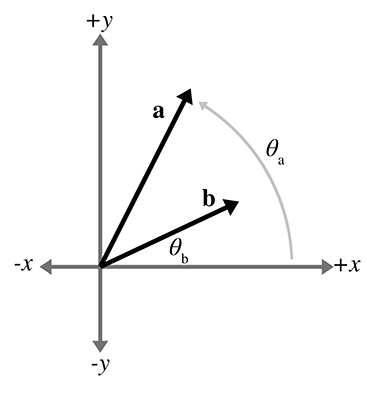
  4. Premièrement, obtenons quelques informations sur les composantes des vecteurs.
    image
    D’après la figure, on a

    ax=𝐚cosθa,ay=𝐚sinθa,bx=𝐛cosθb,by=𝐛sinθb.\begin{matrix} a_{x} & {= {\parallel \mathbf{a} \parallel}\cos\theta_{a},} & a_{y} & {= {\parallel \mathbf{a} \parallel}\sin\theta_{a},} \\ b_{x} & {= {\parallel \mathbf{b} \parallel}\cos\theta_{b},} & b_{y} & {= {\parallel \mathbf{b} \parallel}\sin\theta_{b}.} \\ \end{matrix}

    On peut maintenant procéder avec la définition algébrique du produit scalaire et l’identité de différence de cosinus :

    𝐚𝐛=axbx+ayby=𝐚cosθa𝐛cosθb+𝐚sinθa𝐛sinθb=𝐚𝐛(cosθacosθb+sinθasinθb)=𝐚𝐛cos(θbθa)=𝐚𝐛cosθ.\begin{matrix} {\mathbf{a} \cdot \mathbf{b}} & {= a_{x}b_{x} + a_{y}b_{y}} \\ & {= {\parallel \mathbf{a} \parallel}\cos\theta_{a}{\parallel \mathbf{b} \parallel}\cos\theta_{b} + {\parallel \mathbf{a} \parallel}\sin\theta_{a}{\parallel \mathbf{b} \parallel}\sin\theta_{b}} \\ & {= {\parallel \mathbf{a} \parallel}{\parallel \mathbf{b} \parallel}\left( \cos\theta_{a}\cos\theta_{b} + \sin\theta_{a}\sin\theta_{b} \right)} \\ & {= {\parallel \mathbf{a} \parallel}{\parallel \mathbf{b} \parallel}\cos\left( \theta_{b} - \theta_{a} \right)} \\ & {= {\parallel \mathbf{a} \parallel}{\parallel \mathbf{b} \parallel}\cos\theta.} \\ \end{matrix}

    1. (a)

      1. (1) [34]1=|3|+|4|=7[34]2=|3|2+|4|2=5[34]3=|3|3+|4|33=9134.498[34]=max(|3|,|4|)=4{\parallel \begin{bmatrix} 3 & 4 \\ \end{bmatrix} \parallel}_{1} = \left| 3 \right| + \left| 4 \right| = 7{\parallel \begin{bmatrix} 3 & 4 \\ \end{bmatrix} \parallel}_{2} = \sqrt{\left| 3 \right|^{2} + \left| 4 \right|^{2}} = 5{\parallel \begin{bmatrix} 3 & 4 \\ \end{bmatrix} \parallel}_{3} = \sqrt[3]{\left| 3 \right|^{3} + \left| 4 \right|^{3}} = \sqrt[3]{91} \approx 4.498{\parallel \begin{bmatrix} 3 & 4 \\ \end{bmatrix} \parallel}_{\infty} = \max\left( \left| 3 \right|,\left| 4 \right| \right) = 4

      2. (2) [512]1=|5|+|12|=17[512]2=|5|2+|12|2=13[512]3=|5|3+|12|33=1853312.283[512]=max(|5|,|12|)=12{\parallel \begin{bmatrix} 5 & {- 12} \\ \end{bmatrix} \parallel}_{1} = \left| 5 \right| + \left| {- 12} \right| = 17{\parallel \begin{bmatrix} 5 & {- 12} \\ \end{bmatrix} \parallel}_{2} = \sqrt{\left| 5 \right|^{2} + \left| {- 12} \right|^{2}} = 13{\parallel \begin{bmatrix} 5 & {- 12} \\ \end{bmatrix} \parallel}_{3} = \sqrt[3]{\left| 5 \right|^{3} + \left| {- 12} \right|^{3}} = \sqrt[3]{1853} \approx 12.283{\parallel \begin{bmatrix} 5 & {- 12} \\ \end{bmatrix} \parallel}_{\infty} = \max\left( \left| 5 \right|,\left| {- 12} \right| \right) = 12

      3. (3) [2107]1=|2|+|10|+|7|=19[2107]2=|2|2+|10|2+|7|2=15312.369[2107]3=|2|3+|10|3+|7|33=1351311.055[2107]=max(|2|,|10|,|7|)=10{\parallel \begin{bmatrix} {- 2} & 10 & {- 7} \\ \end{bmatrix} \parallel}_{1} = \left| {- 2} \right| + \left| 10 \right| + \left| {- 7} \right| = 19{\parallel \begin{bmatrix} {- 2} & 10 & {- 7} \\ \end{bmatrix} \parallel}_{2} = \sqrt{\left| {- 2} \right|^{2} + \left| 10 \right|^{2} + \left| {- 7} \right|^{2}} = \sqrt{153} \approx 12.369{\parallel \begin{bmatrix} {- 2} & 10 & {- 7} \\ \end{bmatrix} \parallel}_{3} = \sqrt[3]{\left| {- 2} \right|^{3} + \left| 10 \right|^{3} + \left| {- 7} \right|^{3}} = \sqrt[3]{1351} \approx 11.055{\parallel \begin{bmatrix} {- 2} & 10 & {- 7} \\ \end{bmatrix} \parallel}_{\infty} = \max\left( \left| {- 2} \right|,\left| 10 \right|,\left| {- 7} \right| \right) = 10

      4. (4) [619]1=|6|+|1|+|9|=16[619]2=|6|2+|1|2+|9|2=11810.863[619]3=|6|3+|1|3+|9|33=94639.817[619]=max(|6|,|1|,|9|)=9{\parallel \begin{bmatrix} 6 & 1 & {- 9} \\ \end{bmatrix} \parallel}_{1} = \left| 6 \right| + \left| 1 \right| + \left| {- 9} \right| = 16{\parallel \begin{bmatrix} 6 & 1 & {- 9} \\ \end{bmatrix} \parallel}_{2} = \sqrt{\left| 6 \right|^{2} + \left| 1 \right|^{2} + \left| {- 9} \right|^{2}} = \sqrt{118} \approx 10.863{\parallel \begin{bmatrix} 6 & 1 & {- 9} \\ \end{bmatrix} \parallel}_{3} = \sqrt[3]{\left| 6 \right|^{3} + \left| 1 \right|^{3} + \left| {- 9} \right|^{3}} = \sqrt[3]{946} \approx 9.817{\parallel \begin{bmatrix} 6 & 1 & {- 9} \\ \end{bmatrix} \parallel}_{\infty} = \max\left( \left| 6 \right|,\left| 1 \right|,\left| {- 9} \right| \right) = 9

      5. (5) [2222]1=|2|+|2|+|2|+|2|=8[2222]2=|2|2+|2|2+|2|2+|2|2=4[2222]3=|2|3+|2|3+|2|3+|2|33=3233.175[2222]=max(|2|,|2|,|2|,|2|)=2{\parallel \begin{bmatrix} {- 2} & {- 2} & {- 2} & {- 2} \\ \end{bmatrix} \parallel}_{1} = \left| {- 2} \right| + \left| {- 2} \right| + \left| {- 2} \right| + \left| {- 2} \right| = 8{\parallel \begin{bmatrix} {- 2} & {- 2} & {- 2} & {- 2} \\ \end{bmatrix} \parallel}_{2} = \sqrt{\left| {- 2} \right|^{2} + \left| {- 2} \right|^{2} + \left| {- 2} \right|^{2} + \left| {- 2} \right|^{2}} = 4{\parallel \begin{bmatrix} {- 2} & {- 2} & {- 2} & {- 2} \\ \end{bmatrix} \parallel}_{3} = \sqrt[3]{\left| {- 2} \right|^{3} + \left| {- 2} \right|^{3} + \left| {- 2} \right|^{3} + \left| {- 2} \right|^{3}} = \sqrt[3]{32} \approx 3.175{\parallel \begin{bmatrix} {- 2} & {- 2} & {- 2} & {- 2} \\ \end{bmatrix} \parallel}_{\infty} = \max\left( \left| {- 2} \right|,\left| {- 2} \right|,\left| {- 2} \right|,\left| {- 2} \right| \right) = 2

    2. (b)

      1. (1)Le cercle unité pour la norme L1L^{1} est un carré de côtés de longueur 2\sqrt{2} pivoté de 4545^{\circ}.

      2. (2)Le cercle unité pour la norme L2L^{2} est le cercle unité bien connu que nous connaissons tous.

      3. (3)Le cercle unité pour la norme infinie est un carré de côtés de longueur 22.

      Notez que les trois cercles unitaires incluent les vecteurs [1,0]\lbrack 1,0\rbrack, [0,1]\lbrack 0,1\rbrack, [1,0]\lbrack - 1,0\rbrack, [0,1]\lbrack 0, - 1\rbrack.

  5. L’homme achète une boîte ou a un bagage qui fait 2 pieds de long, 2 pieds de large et 2 pieds de haut. Si l’objet est très mince, comme une épée, il peut mettre l’objet en diagonale dans la boîte ou le bagage. Le plus long objet qu’il pourrait emporter ainsi est 22+22+223,46\sqrt{2^{2} + 2^{2} + 2^{2}} \approx 3{,}46 pieds.

  6. Posons 𝐬=𝐚+𝐛+𝐜+𝐝+𝐞+𝐟\mathbf{s} = \mathbf{a} + \mathbf{b} + \mathbf{c} + \mathbf{d} + \mathbf{e} + \mathbf{f}. Par inspection de la Figure 2.11, on voit que

    𝐬=[53].\mathbf{s} = \begin{bmatrix} {- 5} \\ 3 \\ \end{bmatrix}.

    On confirme ceci numériquement en utilisant l’équation ci-dessus et les valeurs des autres vecteurs, également obtenues par inspection de la Figure 2.11 :

    𝐬=𝐚+𝐛+𝐜+𝐝+𝐞+𝐟=[13]+[13]+[32]+[12]+[64]+[13]=[(1)+1+3+(1)+(6)+(1)3+3+(2)+(2)+4+(3)]=[53]\begin{matrix} \mathbf{s} & {=} & {\mathbf{a} + \mathbf{b} + \mathbf{c} + \mathbf{d} + \mathbf{e} + \mathbf{f}} \\ & {=} & {\begin{bmatrix} {- 1} \\ 3 \\ \end{bmatrix} + \begin{bmatrix} 1 \\ 3 \\ \end{bmatrix} + \begin{bmatrix} 3 \\ {- 2} \\ \end{bmatrix} + \begin{bmatrix} {- 1} \\ {- 2} \\ \end{bmatrix} + \begin{bmatrix} {- 6} \\ 4 \\ \end{bmatrix} + \begin{bmatrix} {- 1} \\ {- 3} \\ \end{bmatrix}} \\ & {=} & \begin{bmatrix} {( - 1) + 1 + 3 + ( - 1) + ( - 6) + ( - 1)} \\ {3 + 3 + ( - 2) + ( - 2) + 4 + ( - 3)} \\ \end{bmatrix} \\ & {=} & \begin{bmatrix} {- 5} \\ 3 \\ \end{bmatrix} \\ \end{matrix}

  7. Main gauche.

    1. Soit 𝐜=[cxcy]\mathbf{c} = \begin{bmatrix} c_{x} \\ c_{y} \\ \end{bmatrix} et 𝐫=[rxry]\mathbf{r} = \begin{bmatrix} r_{x} \\ r_{y} \\ \end{bmatrix}. Alors

      𝐩UpperLeft=[cxrxcy+ry],𝐩UpperRight=[cx+rxcy+ry],𝐩LowerLeft=[cxrxcyry],𝐩LowerRight=[cx+rxcyry].\begin{matrix} \mathbf{p}_{UpperLeft} & {= \begin{bmatrix} {c_{x} - r_{x}} \\ {c_{y} + r_{y}} \\ \end{bmatrix},} & \mathbf{p}_{UpperRight} & {= \begin{bmatrix} {c_{x} + r_{x}} \\ {c_{y} + r_{y}} \\ \end{bmatrix},} \\ \mathbf{p}_{LowerLeft} & {= \begin{bmatrix} {c_{x} - r_{x}} \\ {c_{y} - r_{y}} \\ \end{bmatrix},} & \mathbf{p}_{LowerRight} & {= \begin{bmatrix} {c_{x} + r_{x}} \\ {c_{y} - r_{y}} \\ \end{bmatrix}.} \\ \end{matrix}

    2. Soit 𝐜=[cxcycz]\mathbf{c} = \begin{bmatrix} c_{x} \\ c_{y} \\ c_{z} \\ \end{bmatrix} et 𝐫=[rxryrz]\mathbf{r} = \begin{bmatrix} r_{x} \\ r_{y} \\ r_{z} \\ \end{bmatrix}. Alors

      𝐩FrontUpperLeft=[cxrxcy+rycz+rz],𝐩FrontUpperRight=[cx+rxcy+rycz+rz],𝐩FrontLowerLeft=[cxrxcyrycz+rz],𝐩FrontLowerRight=[cx+rxcyrycz+rz],\begin{matrix} {\mathbf{p}_{FrontUpperLeft} = \begin{bmatrix} {c_{x} - r_{x}} \\ {c_{y} + r_{y}} \\ {c_{z} + r_{z}} \\ \end{bmatrix},} & {\qquad\mathbf{p}_{FrontUpperRight} = \begin{bmatrix} {c_{x} + r_{x}} \\ {c_{y} + r_{y}} \\ {c_{z} + r_{z}} \\ \end{bmatrix},} \\ {\mathbf{p}_{FrontLowerLeft} = \begin{bmatrix} {c_{x} - r_{x}} \\ {c_{y} - r_{y}} \\ {c_{z} + r_{z}} \\ \end{bmatrix},} & {\qquad\mathbf{p}_{FrontLowerRight} = \begin{bmatrix} {c_{x} + r_{x}} \\ {c_{y} - r_{y}} \\ {c_{z} + r_{z}} \\ \end{bmatrix},} \\ \end{matrix}

      𝐩BackUpperLeft=[cxrxcy+ryczrz],𝐩BackUpperRight=[cx+rxcy+ryczrz],𝐩BackLowerLeft=[cxrxcyryczrz],𝐩BackLowerRight=[cx+rxcyryczrz].\begin{matrix} {\mathbf{p}_{BackUpperLeft} = \begin{bmatrix} {c_{x} - r_{x}} \\ {c_{y} + r_{y}} \\ {c_{z} - r_{z}} \\ \end{bmatrix},} & {\qquad\mathbf{p}_{BackUpperRight} = \begin{bmatrix} {c_{x} + r_{x}} \\ {c_{y} + r_{y}} \\ {c_{z} - r_{z}} \\ \end{bmatrix},} \\ {\mathbf{p}_{BackLowerLeft} = \begin{bmatrix} {c_{x} - r_{x}} \\ {c_{y} - r_{y}} \\ {c_{z} - r_{z}} \\ \end{bmatrix},} & {\qquad\mathbf{p}_{BackLowerRight} = \begin{bmatrix} {c_{x} + r_{x}} \\ {c_{y} - r_{y}} \\ {c_{z} - r_{z}} \\ \end{bmatrix}.} \\ \end{matrix}

    1. Utilisez le signe du produit scalaire entre 𝐯\mathbf{v} et 𝐱𝐩\mathbf{x} - \mathbf{p} pour déterminer si le point 𝐱\mathbf{x} est devant ou derrière le PNJ. Cela découle de l’interprétation géométrique du produit scalaire,

      𝐯(𝐱𝐩)=𝐯𝐱𝐩cosθ,\begin{matrix} {\mathbf{v} \cdot (\mathbf{x} - \mathbf{p}) = {\parallel \mathbf{v} \parallel}{\parallel {\mathbf{x} - \mathbf{p}} \parallel}\cos\theta,} \\ \end{matrix}

      θ\theta est l’angle entre 𝐯\mathbf{v} et 𝐱𝐩\mathbf{x} - \mathbf{p}.
      𝐯\parallel \mathbf{v} \parallel et 𝐱𝐩\parallel {\mathbf{x} - \mathbf{p}} \parallel sont toujours positifs, laissant le signe du produit scalaire entièrement à la valeur de cosθ\cos\theta. Si cosθ>0\cos\theta > 0, alors θ\theta est inférieur à 9090^{\circ} et 𝐱\mathbf{x} est devant le PNJ. De même, si cosθ<0\cos\theta < 0, alors θ\theta est supérieur à 9090^{\circ} et 𝐱\mathbf{x} est derrière le PNJ.
      Le cas particulier de 𝐯(𝐱𝐩)=0\mathbf{v} \cdot (\mathbf{x} - \mathbf{p}) = 0 signifie que 𝐱\mathbf{x} se trouve directement à gauche ou à droite du PNJ. Si ce cas n’a pas besoin d’être traité explicitement, il peut arbitrairement signifier soit devant soit derrière.

      1. (1) 𝐱\mathbf{x} est devant le PNJ.

        [52]([00][34])=[52][34]=(5)(3)+(2)(4)=23\begin{matrix} {\begin{bmatrix} 5 \\ {- 2} \\ \end{bmatrix} \cdot \left( \begin{bmatrix} 0 \\ 0 \\ \end{bmatrix} - \begin{bmatrix} {- 3} \\ 4 \\ \end{bmatrix} \right)} & {= \begin{bmatrix} 5 \\ {- 2} \\ \end{bmatrix} \cdot \begin{bmatrix} 3 \\ {- 4} \\ \end{bmatrix} = (5)(3) + ( - 2)( - 4) = 23} \\ \end{matrix}

      2. (2) 𝐱\mathbf{x} est devant le PNJ.

        [52]([16][34])=[52][42]=(5)(4)+(2)(2)=16\begin{matrix} {\begin{bmatrix} 5 \\ {- 2} \\ \end{bmatrix} \cdot \left( \begin{bmatrix} 1 \\ 6 \\ \end{bmatrix} - \begin{bmatrix} {- 3} \\ 4 \\ \end{bmatrix} \right)} & {= \begin{bmatrix} 5 \\ {- 2} \\ \end{bmatrix} \cdot \begin{bmatrix} 4 \\ 2 \\ \end{bmatrix} = (5)(4) + ( - 2)(2) = 16} \\ \end{matrix}

      3. (3) 𝐱\mathbf{x} est derrière le PNJ.

      4. (4) 𝐱\mathbf{x} est derrière le PNJ.

        [52]([60][34])=[52][34]=(5)(3)+(2)(4)=7\begin{matrix} {\begin{bmatrix} 5 \\ {- 2} \\ \end{bmatrix} \cdot \left( \begin{bmatrix} {- 6} \\ 0 \\ \end{bmatrix} - \begin{bmatrix} {- 3} \\ 4 \\ \end{bmatrix} \right)} & {= \begin{bmatrix} 5 \\ {- 2} \\ \end{bmatrix} \cdot \begin{bmatrix} {- 3} \\ {- 4} \\ \end{bmatrix} = (5)( - 3) + ( - 2)( - 4)} \\ & {= - 7} \\ \end{matrix}

      5. (4) 𝐱\mathbf{x} est derrière le PNJ.

        [52]([47][34])=[52][13]=(5)(1)+(2)(3)=11\begin{matrix} {\begin{bmatrix} 5 \\ {- 2} \\ \end{bmatrix} \cdot \left( \begin{bmatrix} {- 4} \\ 7 \\ \end{bmatrix} - \begin{bmatrix} {- 3} \\ 4 \\ \end{bmatrix} \right)} & {= \begin{bmatrix} 5 \\ {- 2} \\ \end{bmatrix} \cdot \begin{bmatrix} {- 1} \\ 3 \\ \end{bmatrix} = (5)( - 1) + ( - 2)(3) = - 11} \\ \end{matrix}

      6. (5) 𝐱\mathbf{x} est devant le PNJ.

        [52]([55][34])=[52][81]=(5)(8)+(2)(1)=38\begin{matrix} {\begin{bmatrix} 5 \\ {- 2} \\ \end{bmatrix} \cdot \left( \begin{bmatrix} 5 \\ 5 \\ \end{bmatrix} - \begin{bmatrix} {- 3} \\ 4 \\ \end{bmatrix} \right)} & {= \begin{bmatrix} 5 \\ {- 2} \\ \end{bmatrix} \cdot \begin{bmatrix} 8 \\ 1 \\ \end{bmatrix} = (5)(8) + ( - 2)(1) = 38} \\ \end{matrix}

      7. (6) 𝐱\mathbf{x} est devant le PNJ.

        [52]([30][34])=[52][04]=(5)(0)+(2)(4)=8\begin{matrix} {\begin{bmatrix} 5 \\ {- 2} \\ \end{bmatrix} \cdot \left( \begin{bmatrix} {- 3} \\ 0 \\ \end{bmatrix} - \begin{bmatrix} {- 3} \\ 4 \\ \end{bmatrix} \right)} & {= \begin{bmatrix} 5 \\ {- 2} \\ \end{bmatrix} \cdot \begin{bmatrix} 0 \\ {- 4} \\ \end{bmatrix} = (5)(0) + ( - 2)( - 4) = 8} \\ \end{matrix}

      8. (7) 𝐱\mathbf{x} peut être soit devant soit derrière le PNJ, selon la façon dont on décide de gérer ce cas particulier.

        [52]([63.5][34])=[52][37.5]=(5)(3)+(2)(7.5)=0\begin{matrix} {\begin{bmatrix} 5 \\ {- 2} \\ \end{bmatrix} \cdot \left( \begin{bmatrix} {- 6} \\ {- 3.5} \\ \end{bmatrix} - \begin{bmatrix} {- 3} \\ 4 \\ \end{bmatrix} \right)} & {= \begin{bmatrix} 5 \\ {- 2} \\ \end{bmatrix} \cdot \begin{bmatrix} {- 3} \\ {- 7.5} \\ \end{bmatrix} = (5)( - 3) + ( - 2)( - 7.5) = 0} \\ \end{matrix}

    1. Pour déterminer si le point 𝐱\mathbf{x} est visible par le PNJ, comparer cosθ\cos\theta à cos(ϕ/2)\cos(\phi/2). Si cosθcos(ϕ/2)\cos\theta \geq \cos(\phi/2), alors 𝐱\mathbf{x} est visible par le PNJ.
      La valeur de cos(ϕ/2)\cos(\phi/2) peut être obtenue à partir de l’angle du champ de vision. Pour obtenir cosθ\cos\theta, utiliser le produit scalaire

      cosθ=𝐯(𝐱𝐩)𝐯𝐱𝐩.\cos\theta = \frac{\mathbf{v} \cdot (\mathbf{x} - \mathbf{p})}{{\parallel \mathbf{v} \parallel}{\parallel {\mathbf{x} - \mathbf{p}} \parallel}}.

    2. Le champ de vision du PNJ est 9090^{\circ}, donc la valeur qui nous intéresse est cos(45)0,707\cos(45^{\circ}) \approx 0{,}707.

      1. (1) 𝐱\mathbf{x} est visible par le PNJ.

        cosθ=[52]([00][34])[52][00][34]=23(29)((25)0,8540,707\begin{matrix} {\cos\theta = \frac{\begin{bmatrix} 5 \\ {- 2} \\ \end{bmatrix} \cdot \left( \begin{bmatrix} 0 \\ 0 \\ \end{bmatrix} - \begin{bmatrix} {- 3} \\ 4 \\ \end{bmatrix} \right)}{{\parallel \begin{bmatrix} 5 \\ {- 2} \\ \end{bmatrix} \parallel}{\parallel {\begin{bmatrix} 0 \\ 0 \\ \end{bmatrix} - \begin{bmatrix} {- 3} \\ 4 \\ \end{bmatrix}} \parallel}} = \frac{23}{(\sqrt{29})(\sqrt{(}25)} \approx 0{,}854 \geq 0{,}707} \\ \end{matrix}

      2. (2) 𝐱\mathbf{x} n’est pas visible par le PNJ.

        cosθ=[52]([16][34])[52][16][34]=16(29)(20)0,664<0,707\begin{matrix} {\cos\theta = \frac{\begin{bmatrix} 5 \\ {- 2} \\ \end{bmatrix} \cdot \left( \begin{bmatrix} 1 \\ 6 \\ \end{bmatrix} - \begin{bmatrix} {- 3} \\ 4 \\ \end{bmatrix} \right)}{{\parallel \begin{bmatrix} 5 \\ {- 2} \\ \end{bmatrix} \parallel}{\parallel {\begin{bmatrix} 1 \\ 6 \\ \end{bmatrix} - \begin{bmatrix} {- 3} \\ 4 \\ \end{bmatrix}} \parallel}} = \frac{16}{(\sqrt{29})(\sqrt{20})} \approx 0{,}664 < 0{,}707} \\ \end{matrix}

      3. (3) 𝐱\mathbf{x} n’est pas visible par le PNJ.

        cosθ=[52]([60][34])[52][60][34]=7(29)(25)0,260<0,707\begin{matrix} {\cos\theta} & {= \frac{\begin{bmatrix} 5 \\ {- 2} \\ \end{bmatrix} \cdot \left( \begin{bmatrix} {- 6} \\ 0 \\ \end{bmatrix} - \begin{bmatrix} {- 3} \\ 4 \\ \end{bmatrix} \right)}{{\parallel \begin{bmatrix} 5 \\ {- 2} \\ \end{bmatrix} \parallel}{\parallel {\begin{bmatrix} {- 6} \\ 0 \\ \end{bmatrix} - \begin{bmatrix} {- 3} \\ 4 \\ \end{bmatrix}} \parallel}} = \frac{- 7}{(\sqrt{29})(\sqrt{25})}} \\ & {\approx - 0{,}260 < 0{,}707} \\ \end{matrix}

      4. (4) 𝐱\mathbf{x} n’est pas visible par le PNJ.

        cosθ=[52]([47][34])[52][47][34]=11(29)(10)0,646<0,707\begin{matrix} {\mspace{0mu}\cos\theta = \frac{\begin{bmatrix} 5 \\ {- 2} \\ \end{bmatrix} \cdot \left( \begin{bmatrix} {- 4} \\ 7 \\ \end{bmatrix} - \begin{bmatrix} {- 3} \\ 4 \\ \end{bmatrix} \right)}{{\parallel \begin{bmatrix} 5 \\ {- 2} \\ \end{bmatrix} \parallel}{\parallel {\begin{bmatrix} {- 4} \\ 7 \\ \end{bmatrix} - \begin{bmatrix} {- 3} \\ 4 \\ \end{bmatrix}} \parallel}} = \frac{- 11}{(\sqrt{29})(\sqrt{10})} \approx - 0{,}646 < 0{,}707} \\ \end{matrix}

      5. (5) 𝐱\mathbf{x} est visible par le PNJ.

        cosθ=[52]([55][34])[52][55][34]=38(29)(65)0,8750,707\begin{matrix} {\mspace{0mu}\cos\theta = \frac{\begin{bmatrix} 5 \\ {- 2} \\ \end{bmatrix} \cdot \left( \begin{bmatrix} 5 \\ 5 \\ \end{bmatrix} - \begin{bmatrix} {- 3} \\ 4 \\ \end{bmatrix} \right)}{{\parallel \begin{bmatrix} 5 \\ {- 2} \\ \end{bmatrix} \parallel}{\parallel {\begin{bmatrix} 5 \\ 5 \\ \end{bmatrix} - \begin{bmatrix} {- 3} \\ 4 \\ \end{bmatrix}} \parallel}} = \frac{38}{(\sqrt{29})(\sqrt{65})} \approx 0{,}875 \geq 0{,}707} \\ \end{matrix}

      6. (6) 𝐱\mathbf{x} n’est pas visible par le PNJ.

        cosθ=[52]([30][34])[52][30][34]=8(29)(16)0,371<0,707\begin{matrix} {\mspace{0mu}\cos\theta = \frac{\begin{bmatrix} 5 \\ {- 2} \\ \end{bmatrix} \cdot \left( \begin{bmatrix} {- 3} \\ 0 \\ \end{bmatrix} - \begin{bmatrix} {- 3} \\ 4 \\ \end{bmatrix} \right)}{{\parallel \begin{bmatrix} 5 \\ {- 2} \\ \end{bmatrix} \parallel}{\parallel {\begin{bmatrix} {- 3} \\ 0 \\ \end{bmatrix} - \begin{bmatrix} {- 3} \\ 4 \\ \end{bmatrix}} \parallel}} = \frac{8}{(\sqrt{29})(\sqrt{16})} \approx 0{,}371 < 0{,}707} \\ \end{matrix}

      7. (7) 𝐱\mathbf{x} n’est pas visible par le PNJ.

        cosθ=[52]([63.5][34])[52][63.5][34]=0(29)(65,25)=0<0,707\begin{matrix} {\mspace{0mu}\cos\theta = \frac{\begin{bmatrix} 5 \\ {- 2} \\ \end{bmatrix} \cdot \left( \begin{bmatrix} {- 6} \\ {- 3.5} \\ \end{bmatrix} - \begin{bmatrix} {- 3} \\ 4 \\ \end{bmatrix} \right)}{{\parallel \begin{bmatrix} 5 \\ {- 2} \\ \end{bmatrix} \parallel}{\parallel {\begin{bmatrix} {- 6} \\ {- 3.5} \\ \end{bmatrix} - \begin{bmatrix} {- 3} \\ 4 \\ \end{bmatrix}} \parallel}} = \frac{0}{(\sqrt{29})(\sqrt{65{,}25})} = 0 < 0{,}707} \\ \end{matrix}

    3. Le PNJ ne peut voir qu’à une distance de 7 unités, donc seuls les points qui sont à la fois dans le champ de vision et à cette distance seront visibles.

      1. (1) 𝐱\mathbf{x} est visible par le PNJ.

        [00][34]=[34]=25=5<7\begin{matrix} {{\parallel {\begin{bmatrix} 0 \\ 0 \\ \end{bmatrix} - \begin{bmatrix} {- 3} \\ 4 \\ \end{bmatrix}} \parallel} = {\parallel \begin{bmatrix} 3 \\ {- 4} \\ \end{bmatrix} \parallel} = \sqrt{25} = 5 < 7} \\ \end{matrix}

      2. (2) 𝐱\mathbf{x} n’est pas visible par le PNJ ; il est en dehors du champ de vision.

      3. (3) 𝐱\mathbf{x} n’est pas visible par le PNJ ; il est en dehors du champ de vision.

      4. (4) 𝐱\mathbf{x} n’est pas visible par le PNJ ; il est en dehors du champ de vision.

      5. (5) 𝐱\mathbf{x} n’est pas visible par le PNJ.

        [55][34]=[81]=658,062>7\begin{matrix} {{\parallel {\begin{bmatrix} 5 \\ 5 \\ \end{bmatrix} - \begin{bmatrix} {- 3} \\ 4 \\ \end{bmatrix}} \parallel} = {\parallel \begin{bmatrix} 8 \\ 1 \\ \end{bmatrix} \parallel} = \sqrt{65} \approx 8{,}062 > 7} \\ \end{matrix}

      6. (6) 𝐱\mathbf{x} n’est pas visible par le PNJ ; il est en dehors du champ de vision.

      7. (7) 𝐱\mathbf{x} n’est pas visible par le PNJ ; il est en dehors du champ de vision.

    1. Posons 𝐯ab=𝐛𝐚\mathbf{v}_{ab} = \mathbf{b} - \mathbf{a} et 𝐯bc=𝐜𝐛\mathbf{v}_{bc} = \mathbf{c} - \mathbf{b}. Puisque les trois points se trouvent dans le plan xzxz, les deux vecteurs se trouvent aussi dans ce plan et on a

      𝐯ab=[xab0zab],𝐯bc=[xbc0zbc].\begin{matrix} \mathbf{v}_{ab} & {= \begin{bmatrix} x_{ab} \\ 0 \\ z_{ab} \\ \end{bmatrix},} & \mathbf{v}_{bc} & {= \begin{bmatrix} x_{bc} \\ 0 \\ z_{bc} \\ \end{bmatrix}.} \\ \end{matrix}

      En calculant le produit vectoriel des vecteurs dans l’ordre dans lequel les points sont parcourus, on obtient :

      𝐯ab×𝐯bc=[0xbczabxabzbc0]\begin{matrix} {\mathbf{v}_{ab} \times \mathbf{v}_{bc} = \begin{bmatrix} 0 \\ {x_{bc}z_{ab} - x_{ab}z_{bc}} \\ 0 \\ \end{bmatrix}} \\ \end{matrix}

      Le signe de xbczabxabzbcx_{bc}z_{ab} - x_{ab}z_{bc} peut ensuite être utilisé pour déterminer le sens de rotation du PNJ. Comme on travaille dans un système de coordonnées main gauche, si la valeur est négative, le PNJ tourne dans le sens antihoraire ; si elle est positive, il tourne dans le sens horaire. Le cas particulier de 0 signifie que le PNJ marche soit en ligne droite vers l’avant, soit avance puis recule le long de la même ligne.

      1. (1) 𝐯ab=[3,0,2]\mathbf{v}_{ab} = \lbrack\,{- 3},\, 0,\, 2\,\rbrack. 𝐯bc=[3,0,4]\mathbf{v}_{bc} = \lbrack\,{- 3},\, 0,\,{- 4}\,\rbrack. xbczabxabzbc=(3)(2)(3)(4)=18<0x_{bc}z_{ab} - x_{ab}z_{bc} = ( - 3)(2) - ( - 3)( - 4) = - 18 < 0. Donc le PNJ tourne dans le sens antihoraire.

      2. (2) 𝐯ab=[7,0,5]\mathbf{v}_{ab} = \lbrack\, 7,\, 0,\, 5\,\rbrack. 𝐯bc=[1,0,3]\mathbf{v}_{bc} = \lbrack\,{- 1},\, 0,\, 3\,\rbrack. xbczabxabzbc=(1)(5)(7)(3)=26<0x_{bc}z_{ab} - x_{ab}z_{bc} = ( - 1)(5) - (7)(3) = - 26 < 0. Donc le PNJ tourne dans le sens antihoraire.

      3. (3) 𝐯ab=[6,0,5]\mathbf{v}_{ab} = \lbrack\, 6,\, 0,\,{- 5}\,\rbrack. 𝐯bc=[12,0,5]\mathbf{v}_{bc} = \lbrack\,{- 12},\, 0,\,{- 5}\,\rbrack. xbczabxabzbc=(12)(5)(6)(5)=90>0x_{bc}z_{ab} - x_{ab}z_{bc} = ( - 12)( - 5) - (6)( - 5) = 90 > 0. Donc le PNJ tourne dans le sens horaire.

      4. (4) 𝐯ab=[3,0,1]\mathbf{v}_{ab} = \lbrack\, 3,\, 0,\, 1\,\rbrack. 𝐯bc=[3,0,2]\mathbf{v}_{bc} = \lbrack\, 3,\, 0,\, 2\,\rbrack. xbczabxabzbc=(3)(1)(3)(2)=3<0x_{bc}z_{ab} - x_{ab}z_{bc} = (3)(1) - (3)(2) = - 3 < 0. Donc le PNJ tourne dans le sens antihoraire.

  8. 𝐩=𝐩+(k1)(𝐩𝐧)𝐧=[100]+(k1)([100][nxnynz])[nxnynz]=[100]+(k1)(nx)[nxnynz]=[100]+[(k1)nx2(k1)nxny(k1)nxnz]=[1+(k1)nx2(k1)nxny(k1)nxnz]\mathbf{p}^{\prime} = \mathbf{p} + \left( k - 1 \right)\left( \mathbf{p} \cdot \mathbf{n} \right)\mathbf{n}\mspace{14mu} = \begin{bmatrix} 1 \\ 0 \\ 0 \\ \end{bmatrix} + \left( k - 1 \right)\left( \begin{bmatrix} 1 \\ 0 \\ 0 \\ \end{bmatrix} \cdot \begin{bmatrix} n_{x} \\ n_{y} \\ n_{z} \\ \end{bmatrix} \right)\begin{bmatrix} n_{x} \\ n_{y} \\ n_{z} \\ \end{bmatrix}\mspace{14mu} = \begin{bmatrix} 1 \\ 0 \\ 0 \\ \end{bmatrix} + \left( k - 1 \right)\left( n_{x} \right)\begin{bmatrix} n_{x} \\ n_{y} \\ n_{z} \\ \end{bmatrix}\mspace{14mu} = \begin{bmatrix} 1 \\ 0 \\ 0 \\ \end{bmatrix} + \begin{bmatrix} {\left( k - 1 \right){n_{x}}^{2}} \\ {\left( k - 1 \right)n_{x}n_{y}} \\ {\left( k - 1 \right)n_{x}n_{z}} \\ \end{bmatrix}\mspace{14mu} = \begin{bmatrix} {1 + \left( k - 1 \right){n_{x}}^{2}} \\ {\left( k - 1 \right)n_{x}n_{y}} \\ {\left( k - 1 \right)n_{x}n_{z}} \\ \end{bmatrix}

  9. 𝐩=cosθ(𝐩(𝐩𝐧)𝐧)+sinθ(𝐧×𝐩)+(𝐩𝐧)𝐧=cosθ([100]([100][nxnynz])[nxnynz])+sinθ([nxnynz]×[100])+([100][nxnynz])[nxnynz]=cosθ([100]nx[nxnynz])+sinθ[0nzny]+nx[nxnynz]=cosθ[1nx2nxnynxnz]+sinθ[0nzny]+nx[nxnynz]=cosθ[1nx2nxnynxnz]+sinθ[0nzny]+[nx2nxnynxnz]=[cosθnx2cosθnxnycosθnxnzcosθ]+[0nzsinθnysinθ]+[nx2nxnynxnz]=[cosθnx2cosθ+nx2nxnycosθ+nzsinθ+nxnynxnzcosθnysinθ+nxnz]=[nx2(1cosθ)+cosθnxny(1cosθ)+nzsinθnxnz(1cosθ)nysinθ]\mathbf{p}^{\prime} = \cos\theta\left( \mathbf{p} - \left( \mathbf{p} \cdot \mathbf{n} \right)\mathbf{n} \right) + \sin\theta\left( \mathbf{n} \times \mathbf{p} \right) + \left( \mathbf{p} \cdot \mathbf{n} \right)\mathbf{n}\mspace{14mu} = \cos\theta\left( \begin{bmatrix} 1 \\ 0 \\ 0 \\ \end{bmatrix} - \left( \begin{bmatrix} 1 \\ 0 \\ 0 \\ \end{bmatrix} \cdot \begin{bmatrix} n_{x} \\ n_{y} \\ n_{z} \\ \end{bmatrix} \right)\begin{bmatrix} n_{x} \\ n_{y} \\ n_{z} \\ \end{bmatrix} \right) + \sin\theta\left( \begin{bmatrix} n_{x} \\ n_{y} \\ n_{z} \\ \end{bmatrix} \times \begin{bmatrix} 1 \\ 0 \\ 0 \\ \end{bmatrix} \right) + \left( \begin{bmatrix} 1 \\ 0 \\ 0 \\ \end{bmatrix} \cdot \begin{bmatrix} n_{x} \\ n_{y} \\ n_{z} \\ \end{bmatrix} \right)\begin{bmatrix} n_{x} \\ n_{y} \\ n_{z} \\ \end{bmatrix}\mspace{14mu} = \cos\theta\left( \begin{bmatrix} 1 \\ 0 \\ 0 \\ \end{bmatrix} - n_{x}\begin{bmatrix} n_{x} \\ n_{y} \\ n_{z} \\ \end{bmatrix} \right) + \sin\theta\begin{bmatrix} 0 \\ n_{z} \\ {- n_{y}} \\ \end{bmatrix} + n_{x}\begin{bmatrix} n_{x} \\ n_{y} \\ n_{z} \\ \end{bmatrix}\mspace{14mu} = \cos\theta\begin{bmatrix} {1 - {n_{x}}^{2}} \\ {- n_{x}n_{y}} \\ {- n_{x}n_{z}} \\ \end{bmatrix} + \sin\theta\begin{bmatrix} 0 \\ n_{z} \\ {- n_{y}} \\ \end{bmatrix} + n_{x}\begin{bmatrix} n_{x} \\ n_{y} \\ n_{z} \\ \end{bmatrix}\mspace{14mu} = \cos\theta\begin{bmatrix} {1 - {n_{x}}^{2}} \\ {- n_{x}n_{y}} \\ {- n_{x}n_{z}} \\ \end{bmatrix} + \sin\theta\begin{bmatrix} 0 \\ n_{z} \\ {- n_{y}} \\ \end{bmatrix} + \begin{bmatrix} {n_{x}}^{2} \\ {n_{x}n_{y}} \\ {n_{x}n_{z}} \\ \end{bmatrix}\mspace{14mu} = \begin{bmatrix} {\cos\theta - {n_{x}}^{2}\cos\theta} \\ {- n_{x}n_{y}\cos\theta} \\ {- n_{x}n_{z}\cos\theta} \\ \end{bmatrix} + \begin{bmatrix} 0 \\ {n_{z}\sin\theta} \\ {- n_{y}\sin\theta} \\ \end{bmatrix} + \begin{bmatrix} {n_{x}}^{2} \\ {n_{x}n_{y}} \\ {n_{x}n_{z}} \\ \end{bmatrix}\mspace{14mu} = \begin{bmatrix} {\cos\theta - {n_{x}}^{2}\cos\theta + {n_{x}}^{2}} \\ {- n_{x}n_{y}\cos\theta + n_{z}\sin\theta + n_{x}n_{y}} \\ {- n_{x}n_{z}\cos\theta - n_{y}\sin\theta + n_{x}n_{z}} \\ \end{bmatrix}\mspace{14mu} = \begin{bmatrix} {{n_{x}}^{2}\left( 1 - \cos\theta \right) + \cos\theta} \\ {n_{x}n_{y}\left( 1 - \cos\theta \right) + n_{z}\sin\theta} \\ {n_{x}n_{z}\left( 1 - \cos\theta \right) - n_{y}\sin\theta} \\ \end{bmatrix}

B.3Chapitre 3

    1. (a) Espace objet.

    2. (b) On pourrait comparer ma coordonnée xx en espace monde avec la coordonnée xx en espace monde du livre. Ou bien, on examine simplement le signe de la coordonnée xx en espace droit.

    3. (c) Espace monde.

    4. (d) Espace objet. Ou on pourrait dire qu’on peut calculer un produit scalaire avec notre vecteur de direction de regard — ce qui est équivalent à extraire la coordonnée zz dans l’espace objet.

  1. D’abord translater le point de [12,0,6]\lbrack - 12,0,6\rbrack par rapport aux axes, puis faire pivoter de 42° dans le sens horaire autour de l’axe yy.

    1. (a) Linéairement dépendants. Le deuxième vecteur de base est le vecteur nul, qui ne peut pas appartenir à un ensemble linéairement indépendant car il peut être exprimé comme le produit de n’importe quel autre vecteur de base et 0.

    2. (b) Linéairement indépendants.

    3. (c) Linéairement dépendants. Pour des vecteurs 3D, le plus grand ensemble linéairement indépendant qu’on pourrait espérer est trois vecteurs, mais cet ensemble en contient quatre.

    4. (d) Linéairement dépendants. Le dernier vecteur est un multiple du premier.

    5. (e) Linéairement dépendants. Le dernier vecteur est la somme des deux premiers.

    6. (f) Linéairement indépendants.

    1. (a) Orthogonaux.

    2. (b) Non orthogonaux. Toutes les paires de vecteurs ont des produits scalaires non nuls.

    3. (c) Orthogonaux.

    4. (d) Orthogonaux.

    5. (e) Non orthogonaux. La première paire de vecteurs est perpendiculaire, mais [7,1,5][2,0,1]=9\lbrack 7, - 1,5\rbrack \cdot \lbrack - 2,0,1\rbrack = - 9, et [5,5,6][2,0,1]=16\lbrack 5,5, - 6\rbrack \cdot \lbrack - 2,0,1\rbrack = - 16.

    1. (a) Non. Les deuxième et troisième vecteurs de base n’ont clairement pas de longueur unité.

    2. (b) Non. Aucun des vecteurs de base n’a de longueur unité.

    3. (c) Oui, ils sont orthonormaux.

    4. (d) Non. Les premier et deuxième vecteurs de base ne sont pas perpendiculaires.

    5. (e) Oui, ils sont orthonormaux.

    6. (f) Oui, ils sont orthonormaux.

    7. (g) Non. Les deuxième et troisième vecteurs de base n’ont pas de longueur unité.

    1. (a) Droit : (0,866,2,000,0,500)( - 0{,}866,2{,}000,0{,}500) ; Monde : (0,134,12,000,3,500)(0{,}134,12{,}000,3{,}500)

    2. (b) Droit : (0,866,2,000,0,500)(0{,}866,2{,}000, - 0{,}500) ; Monde : (1,866,12,000,2,500)(1{,}866,12{,}000,2{,}500)

    3. (c) Droit : (0,0,0)(0,0,0) ; Monde : (1,10,3)(1,10,3)

    4. (d) Droit : (1,116,5,000,0,067)(1{,}116,5{,}000, - 0{,}067) ; Monde : (2,116,15,000,2,933)(2{,}116,15{,}000,2{,}933)

    5. (e) Droit : (5,000,5,000,8,660)(5{,}000,5{,}000,8{,}660) ; Monde : (6,000,15,000,11,660)(6{,}000,15{,}000,11{,}660)

    6. (f) Droit : (0,000,0,000,0,000)(0{,}000,0{,}000,0{,}000) ; Objet : (0,000,0,000,0,000)(0{,}000,0{,}000,0{,}000)

    7. (g) Droit : (1,000,10,000,3,000)( - 1{,}000, - 10{,}000, - 3{,}000) ; Objet : (0,634,10,000,3,098)(0{,}634, - 10{,}000, - 3{,}098)

    8. (h) Droit : (1,732,0,000,1,000)(1{,}732,0{,}000, - 1{,}000) ; Objet : (2,000,0,000,0,000)(2{,}000,0{,}000,0{,}000)

    9. (i) Droit : (1,000,1,000,1,000)(1{,}000,1{,}000,1{,}000) ; Objet : (0,366,1,000,1,366)(0{,}366,1{,}000,1{,}366)

    10. (j) Droit : (0,000,10,000,0,000)(0{,}000,10{,}000,0{,}000) ; Objet : (0,000,10,000,0,000)(0{,}000,10{,}000,0{,}000)

B.4Chapitre 4

  1. Voir le tableau ci-dessous.

    Matrice Lignes Colonnes Carrée Diagonale
    𝐀\mathbf{A} 4 3 Non Non
    𝐁\mathbf{B} 3 3 Oui Oui
    𝐂\mathbf{C} 2 2 Oui Non
    𝐃\mathbf{D} 5 2 Non Non
    𝐄\mathbf{E} 1 3 Non Non
    𝐅\mathbf{F} 4 1 Non Non
    𝐆\mathbf{G} 1 4 Non Non
    𝐇\mathbf{H} 3 1 Non Non
  2. 𝐀T=[134812063151025]T=[131231040128655]\mathbf{A}^{T} = \begin{bmatrix} 13 & 4 & {- 8} \\ 12 & 0 & 6 \\ {- 3} & {- 1} & 5 \\ 10 & {- 2} & 5 \\ \end{bmatrix}^{T} = \begin{bmatrix} 13 & 12 & {- 3} & 10 \\ 4 & 0 & {- 1} & {- 2} \\ {- 8} & 6 & 5 & 5 \\ \end{bmatrix}
    𝐁T=[kx000ky000kz]T=[kx000ky000kz]\mathbf{B}^{T} = \begin{bmatrix} k_{x} & 0 & 0 \\ 0 & k_{y} & 0 \\ 0 & 0 & k_{z} \\ \end{bmatrix}^{T} = \begin{bmatrix} k_{x} & 0 & 0 \\ 0 & k_{y} & 0 \\ 0 & 0 & k_{z} \\ \end{bmatrix}
    𝐂T=[15873]T=[15783]𝐃T=[agbhcidjfk]T=[abcdfghijk]𝐄T=[013]T=[013]𝐅T=[xyzw]T=[xyzw]𝐆T=[1020301]T=[1020301]𝐇T=[αβγ]T=[αβγ]\mathbf{C}^{T} = \begin{bmatrix} 15 & 8 \\ {- 7} & 3 \\ \end{bmatrix}^{T} = \begin{bmatrix} 15 & {- 7} \\ 8 & 3 \\ \end{bmatrix}\mspace{29mu}\mathbf{D}^{T} = \begin{bmatrix} a & g \\ b & h \\ c & i \\ d & j \\ f & k \\ \end{bmatrix}^{T} = \begin{bmatrix} a & b & c & d & f \\ g & h & i & j & k \\ \end{bmatrix}\mathbf{E}^{T} = \begin{bmatrix} 0 & 1 & 3 \\ \end{bmatrix}^{T} = \begin{bmatrix} 0 \\ 1 \\ 3 \\ \end{bmatrix}\mspace{29mu}\mathbf{F}^{T} = \begin{bmatrix} x \\ y \\ z \\ w \\ \end{bmatrix}^{T} = \begin{bmatrix} x & y & z & w \\ \end{bmatrix}\mathbf{G}^{T} = \begin{bmatrix} 10 & 20 & 30 & 1 \\ \end{bmatrix}^{T} = \begin{bmatrix} 10 \\ 20 \\ 30 \\ 1 \\ \end{bmatrix}\mspace{29mu}\mathbf{H}^{T} = \begin{bmatrix} \alpha \\ \beta \\ \gamma \\ \end{bmatrix}^{T} = \begin{bmatrix} \alpha & \beta & \gamma \\ \end{bmatrix}

  3. 𝐀𝐁\mathbf{A}\mathbf{B} &4&3&3&3&4&3 𝐀𝐇\mathbf{A}\mathbf{H} &4&3&3&1&4&1
    𝐁𝐁\mathbf{B}\mathbf{B} &3&3&3&3&3&3 𝐁𝐇\mathbf{B}\mathbf{H} &3&3&3&1&3&1
    𝐂𝐂\mathbf{C}\mathbf{C} &2&2&2&2&2&2 𝐃𝐂\mathbf{D}\mathbf{C} &5&2&2&2&5&2
    𝐄𝐁\mathbf{E}\mathbf{B} &1&3&3&3&1&3 𝐄𝐇\mathbf{E}\mathbf{H} &1&3&3&1&1&1
    𝐅𝐄\mathbf{F}\mathbf{E} &4&1&1&3&4&3 𝐅𝐆\mathbf{F}\mathbf{G} &4&1&1&4&4&4
    𝐆𝐀\mathbf{G}\mathbf{A} &1&4&4&3&1&3 𝐆𝐅\mathbf{G}\mathbf{F} &1&4&4&1&1&1
    𝐇𝐄\mathbf{H}\mathbf{E} &3&1&1&3&3&3 𝐇𝐆\mathbf{H}\mathbf{G} &3&1&1&4&3&4
    1. (a) [1250][3741/3]=[(1)(3)+(2)(4)(1)(7)+(2)(1/3)(5)(3)+(0)(4)(5)(7)+(0)(1/3)]=[3+(8)7+(2/3)15+035+0]=[1119/31535]\begin{bmatrix} 1 & {- 2} \\ 5 & 0 \\ \end{bmatrix}\begin{bmatrix} {- 3} & 7 \\ 4 & {1/3} \\ \end{bmatrix} = \begin{bmatrix} {(1)( - 3) + ( - 2)(4)} & {(1)(7) + ( - 2)(1/3)} \\ {(5)( - 3) + (0)(4)} & {(5)(7) + (0)(1/3)} \\ \end{bmatrix}\mspace{104mu} = \begin{bmatrix} {- 3 + ( - 8)} & {7 + ( - 2/3)} \\ {- 15 + 0} & {35 + 0} \\ \end{bmatrix} = \begin{bmatrix} {- 11} & {19/3} \\ {- 15} & 35 \\ \end{bmatrix}

    2. (b) Impossible ; on ne peut pas multiplier une matrice 2×22 \times 2 par un vecteur 1×21 \times 2 à droite.

    3. (c) [314][203576142]\begin{bmatrix} 3 & {- 1} & 4 \\ \end{bmatrix}\begin{bmatrix} {- 2} & 0 & 3 \\ 5 & 7 & {- 6} \\ 1 & {- 4} & 2 \\ \end{bmatrix}
      [6pt] =[(3)(2)+(1)(5)+(4)(1)(3)(0)+(1)(7)+(4)(4)(3)(3)+(1)(6)+(4)(2)]= \begin{bmatrix} {(3)( - 2) + ( - 1)(5) + (4)(1)} & {(3)(0) + ( - 1)(7) + (4)( - 4)} & {(3)(3) + ( - 1)( - 6) + (4)(2)} \\ \end{bmatrix}
      [6pt] =[6+(5)+40+(7)+(16)9+6+8]=[72323]= \begin{bmatrix} {- 6 + ( - 5) + 4} & {0 + ( - 7) + ( - 16)} & {9 + 6 + 8} \\ \end{bmatrix} = \begin{bmatrix} {- 7} & {- 23} & 23 \\ \end{bmatrix}

    4. (d) [xyzw][1000010000100001]=[xyzw]\begin{bmatrix} x & y & z & w \\ \end{bmatrix}\begin{bmatrix} 1 & 0 & 0 & 0 \\ 0 & 1 & 0 & 0 \\ 0 & 0 & 1 & 0 \\ 0 & 0 & 0 & 1 \\ \end{bmatrix} = \begin{bmatrix} x & y & z & w \\ \end{bmatrix}

    5. (e) Impossible ; on ne peut pas multiplier un vecteur 1×41 \times 4 par un vecteur 2×12 \times 1.

    6. (f) [1001][m11m12m21m22]=[m11m12m21m22]\begin{bmatrix} 1 & 0 \\ 0 & 1 \\ \end{bmatrix}\begin{bmatrix} m_{11} & m_{12} \\ m_{21} & m_{22} \\ \end{bmatrix} = \begin{bmatrix} m_{11} & m_{12} \\ m_{21} & m_{22} \\ \end{bmatrix}

    7. (g) [33][6745]=[(3)(6)+(3)(4)(3)(7)+(3)(5)]=[18+(12)21+15]=[66]\begin{bmatrix} 3 & 3 \\ \end{bmatrix}\begin{bmatrix} 6 & {- 7} \\ {- 4} & 5 \\ \end{bmatrix} = \begin{bmatrix} {(3)(6) + (3)( - 4)} & {(3)( - 7) + (3)(5)} \\ \end{bmatrix}\mspace{89mu} = \begin{bmatrix} {18 + ( - 12)} & {- 21 + 15} \\ \end{bmatrix} = \begin{bmatrix} 6 & {- 6} \\ \end{bmatrix}

    8. (h) Impossible ; on ne peut pas multiplier une matrice 3×33 \times 3 par une matrice 2×32 \times 3 à droite.

    1. (a) [512][100010001]\begin{bmatrix} 5 & {- 1} & 2 \\ \end{bmatrix}\begin{bmatrix} 1 & 0 & 0 \\ 0 & 1 & 0 \\ 0 & 0 & 1 \\ \end{bmatrix}
      [4pt] =[(5)(1)+(1)(0)+(2)(0)(5)(0)+(1)(1)+(2)(0)(5)(0)+(1)(0)+(2)(1)]\quad = \begin{bmatrix} {(5)(1) + ( - 1)(0) + (2)(0)} & {(5)(0) + ( - 1)(1) + (2)(0)} & {(5)(0) + ( - 1)(0) + (2)(1)} \\ \end{bmatrix}
      [4pt] =[512]\quad = \begin{bmatrix} 5 & {- 1} & 2 \\ \end{bmatrix}
      [4pt] [100010001][512]=[(1)(5)+(0)(1)+(0)(2)(0)(5)+(1)(1)+(0)(2)(0)(5)+(0)(1)+(1)(2)]=[512]\begin{bmatrix} 1 & 0 & 0 \\ 0 & 1 & 0 \\ 0 & 0 & 1 \\ \end{bmatrix}\begin{bmatrix} 5 \\ {- 1} \\ 2 \\ \end{bmatrix} = \begin{bmatrix} {(1)(5) + (0)( - 1) + (0)(2)} \\ {(0)(5) + (1)( - 1) + (0)(2)} \\ {(0)(5) + (0)( - 1) + (1)(2)} \\ \end{bmatrix} = \begin{bmatrix} 5 \\ {- 1} \\ 2 \\ \end{bmatrix}

    2. (b) [512][253171214]\begin{bmatrix} 5 & {- 1} & 2 \\ \end{bmatrix}\begin{bmatrix} 2 & 5 & {- 3} \\ 1 & 7 & 1 \\ {- 2} & {- 1} & 4 \\ \end{bmatrix}
      [6pt] =[(5)(2)+(1)(1)+(2)(2)(5)(5)+(1)(7)+(2)(1)(5)(3)+(1)(1)+(2)(4)]= \begin{bmatrix} {(5)(2) + ( - 1)(1) + (2)( - 2)} & {(5)(5) + ( - 1)(7) + (2)( - 1)} & {(5)( - 3) + ( - 1)(1) + (2)(4)} \\ \end{bmatrix}
      [6pt] =[10+(1)+(4)25+(7)+(2)15+(1)+8]=[5168]= \begin{bmatrix} {10 + ( - 1) + ( - 4)} & {25 + ( - 7) + ( - 2)} & {- 15 + ( - 1) + 8} \\ \end{bmatrix} = \begin{bmatrix} 5 & 16 & {- 8} \\ \end{bmatrix}
      [6pt] [253171214][512]=[(2)(5)+(5)(1)+(3)(2)(1)(5)+(7)(1)+(1)(2)(2)(5)+(1)(1)+(4)(2)]=[10+(5)+(6)5+(7)+210+1+8]=[101]\begin{bmatrix} 2 & 5 & {- 3} \\ 1 & 7 & 1 \\ {- 2} & {- 1} & 4 \\ \end{bmatrix}\begin{bmatrix} 5 \\ {- 1} \\ 2 \\ \end{bmatrix} = \begin{bmatrix} {(2)(5) + (5)( - 1) + ( - 3)(2)} \\ {(1)(5) + (7)( - 1) + (1)(2)} \\ {( - 2)(5) + ( - 1)( - 1) + (4)(2)} \\ \end{bmatrix} = \begin{bmatrix} {10 + ( - 5) + ( - 6)} \\ {5 + ( - 7) + 2} \\ {- 10 + 1 + 8} \\ \end{bmatrix} = \begin{bmatrix} {- 1} \\ 0 \\ {- 1} \\ \end{bmatrix}

    3. (c) [512][172703231]=[(5)(1)+(1)(7)+(2)(2)(5)(7)+(1)(0)+(2)(3)(5)(2)+(1)(3)+(2)(1)]=[5+(7)+435+0+(6)10+3+(2)]=[22911][172703231][512]=[(1)(5)+(7)(1)+(2)(2)(7)(5)+(0)(1)+(3)(2)(2)(5)+(3)(1)+(1)(2)]=[5+(7)+435+0+(6)10+3+(2)]=[22911]\begin{bmatrix} 5 & {- 1} & 2 \\ \end{bmatrix}\begin{bmatrix} 1 & 7 & 2 \\ 7 & 0 & {- 3} \\ 2 & {- 3} & {- 1} \\ \end{bmatrix}\quad = \begin{bmatrix} {(5)(1) + ( - 1)(7) + (2)(2)} & {(5)(7) + ( - 1)(0) + (2)( - 3)} & {(5)(2) + ( - 1)( - 3) + (2)( - 1)} \\ \end{bmatrix}\quad = \begin{bmatrix} {5 + ( - 7) + 4} & {35 + 0 + ( - 6)} & {10 + 3 + ( - 2)} \\ \end{bmatrix} = \begin{bmatrix} 2 & 29 & 11 \\ \end{bmatrix}\begin{bmatrix} 1 & 7 & 2 \\ 7 & 0 & {- 3} \\ 2 & {- 3} & {- 1} \\ \end{bmatrix}\begin{bmatrix} 5 \\ {- 1} \\ 2 \\ \end{bmatrix} = \begin{bmatrix} {(1)(5) + (7)( - 1) + (2)(2)} \\ {(7)(5) + (0)( - 1) + ( - 3)(2)} \\ {(2)(5) + ( - 3)( - 1) + ( - 1)(2)} \\ \end{bmatrix} = \begin{bmatrix} {5 + ( - 7) + 4} \\ {35 + 0 + ( - 6)} \\ {10 + 3 + ( - 2)} \\ \end{bmatrix} = \begin{bmatrix} 2 \\ 29 \\ 11 \\ \end{bmatrix}

    4. (d) [512][043401310]=[(5)(0)+(1)(4)+(2)(3)(5)(4)+(1)(0)+(2)(1)(5)(3)+(1)(1)+(2)(0)]=[0+(4)+(6)(20)+0+215+1+0]=[101816][043401310][512]=[(0)(5)+(4)(1)+(3)(2)(4)(5)+(0)(1)+(1)(2)(3)(5)+(1)(1)+(0)(2)]=[0+4+620+0+(2)15+(1)+0]=[101816]\begin{bmatrix} 5 & {- 1} & 2 \\ \end{bmatrix}\begin{bmatrix} 0 & {- 4} & 3 \\ 4 & 0 & {- 1} \\ {- 3} & 1 & 0 \\ \end{bmatrix}\quad = \begin{bmatrix} {(5)(0) + ( - 1)(4) + (2)( - 3)} & {(5)( - 4) + ( - 1)(0) + (2)(1)} & {(5)(3) + ( - 1)( - 1) + (2)(0)} \\ \end{bmatrix}\quad = \begin{bmatrix} {0 + ( - 4) + ( - 6)} & {( - 20) + 0 + 2} & {15 + 1 + 0} \\ \end{bmatrix} = \begin{bmatrix} {- 10} & {- 18} & 16 \\ \end{bmatrix}\begin{bmatrix} 0 & {- 4} & 3 \\ 4 & 0 & {- 1} \\ {- 3} & 1 & 0 \\ \end{bmatrix}\begin{bmatrix} 5 \\ {- 1} \\ 2 \\ \end{bmatrix} = \begin{bmatrix} {(0)(5) + ( - 4)( - 1) + (3)(2)} \\ {(4)(5) + (0)( - 1) + ( - 1)(2)} \\ {( - 3)(5) + (1)( - 1) + (0)(2)} \\ \end{bmatrix} = \begin{bmatrix} {0 + 4 + 6} \\ {20 + 0 + ( - 2)} \\ {- 15 + ( - 1) + 0} \\ \end{bmatrix} = \begin{bmatrix} 10 \\ 18 \\ {- 16} \\ \end{bmatrix}

    1. (a) ((𝐀T)T)T=𝐀T\left( \left( \mathbf{A}^{T} \right)^{T} \right)^{T} = \mathbf{A}^{T}

    2. (b) (𝐁𝐀T)T(𝐂𝐃T)=((𝐀T)T(𝐁)T)(𝐂𝐃T)=(𝐀𝐁T)(𝐂𝐃T)=𝐀𝐁T𝐂𝐃T\left( {\mathbf{B}\mathbf{A}}^{T} \right)^{T}\left( {\mathbf{C}\mathbf{D}}^{T} \right) = \left( \left( \mathbf{A}^{T} \right)^{T}\left( \mathbf{B} \right)^{T} \right)\left( {\mathbf{C}\mathbf{D}}^{T} \right) = \left( {\mathbf{A}\mathbf{B}}^{T} \right)\left( {\mathbf{C}\mathbf{D}}^{T} \right) = {\mathbf{A}\mathbf{B}}^{T}{\mathbf{C}\mathbf{D}}^{T}

    3. (c) ((𝐃T𝐂T)(𝐀𝐁)T)T=(((𝐀𝐁)T)T(𝐃T𝐂T)T)=(𝐀𝐁)((𝐂T)T(𝐃T)T)=(𝐀𝐁)(𝐂𝐃)=𝐀𝐁𝐂𝐃\left( \left( \mathbf{D}^{T}\mathbf{C}^{T} \right)\left( {\mathbf{A}\mathbf{B}} \right)^{T} \right)^{T} = \left( \left( \left( {\mathbf{A}\mathbf{B}} \right)^{T} \right)^{T}\left( \mathbf{D}^{T}\mathbf{C}^{T} \right)^{T} \right) = \left( {\mathbf{A}\mathbf{B}} \right)\left( \left( \mathbf{C}^{T} \right)^{T}\left( \mathbf{D}^{T} \right)^{T} \right) = \left( {\mathbf{A}\mathbf{B}} \right)\left( {\mathbf{C}\mathbf{D}} \right) = {\mathbf{A}\mathbf{B}\mathbf{C}\mathbf{D}}

    4. (d) ((𝐀𝐁)T(𝐂𝐃𝐄)T)T=(((𝐂𝐃𝐄)T)T((𝐀𝐁)T)T)=(𝐂𝐃𝐄)(𝐀𝐁)=𝐂𝐃𝐄𝐀𝐁\left( \left( {\mathbf{A}\mathbf{B}} \right)^{T}\left( {\mathbf{C}\mathbf{D}\mathbf{E}} \right)^{T} \right)^{T} = \left( \left( \left( {\mathbf{C}\mathbf{D}\mathbf{E}} \right)^{T} \right)^{T}\left( \left( {\mathbf{A}\mathbf{B}} \right)^{T} \right)^{T} \right) = \left( {\mathbf{C}\mathbf{D}\mathbf{E}} \right)\left( {\mathbf{A}\mathbf{B}} \right) = {\mathbf{C}\mathbf{D}\mathbf{E}\mathbf{A}\mathbf{B}}

  4. Pour chacune des matrices 𝐌\mathbf{M}, interpréter les lignes de 𝐌\mathbf{M} comme des vecteurs de base après transformation.

    1. (a) Les vecteurs de base [1,0]\lbrack\, 1,\, 0\,\rbrack et [0,1]\lbrack\, 0,\, 1\,\rbrack sont transformés en [0,1]\lbrack\, 0,\,{- 1}\,\rbrack et [1,0]\lbrack\, 1,\, 0\,\rbrack, respectivement. Ainsi, 𝐌\mathbf{M} effectue une rotation de 9090^{\circ} dans le sens horaire.

    2. (b) Les vecteurs de base [1,0]\lbrack\, 1,\, 0\,\rbrack et [0,1]\lbrack\, 0,\, 1\,\rbrack sont transformés en [22,22]\lbrack\,\frac{\sqrt{2}}{2},\,\frac{\sqrt{2}}{2}\,\rbrack et [22,22]\lbrack\,{- \frac{\sqrt{2}}{2}},\,\frac{\sqrt{2}}{2}\,\rbrack, respectivement. Ainsi, 𝐌\mathbf{M} effectue une rotation de 4545^{\circ} dans le sens antihoraire.

    3. (c) Les vecteurs de base [1,0]\lbrack\, 1,\, 0\,\rbrack et [0,1]\lbrack\, 0,\, 1\,\rbrack sont transformés en [2,0]\lbrack\, 2,\, 0\,\rbrack et [0,2]\lbrack\, 0,\, 2\,\rbrack, respectivement. Ainsi, 𝐌\mathbf{M} effectue une mise à l’échelle uniforme, redimensionnant les deux dimensions xx et yy par un facteur 2.

    4. (d) Les vecteurs de base [1,0]\lbrack\, 1,\, 0\,\rbrack et [0,1]\lbrack\, 0,\, 1\,\rbrack sont transformés en [4,0]\lbrack\, 4,\, 0\,\rbrack et [0,7]\lbrack\, 0,\, 7\,\rbrack, respectivement. Ainsi, 𝐌\mathbf{M} effectue une mise à l’échelle non uniforme, redimensionnant la dimension xx par 4 et la dimension yy par 7.

    5. (e) Les vecteurs de base [1,0]\lbrack\, 1,\, 0\,\rbrack et [0,1]\lbrack\, 0,\, 1\,\rbrack sont transformés en [1,0]\lbrack\,{- 1},\, 0\,\rbrack et [0,1]\lbrack\, 0,\, 1\,\rbrack, respectivement. Ainsi, 𝐌\mathbf{M} effectue une réflexion par rapport à l’axe yy, inversant les valeurs xx et laissant les valeurs yy inchangées.

    6. (f) Les vecteurs de base [1,0]\lbrack\, 1,\, 0\,\rbrack et [0,1]\lbrack\, 0,\, 1\,\rbrack sont transformés en [0,2]\lbrack\, 0,\,{- 2}\,\rbrack et [2,0]\lbrack\, 2,\, 0\,\rbrack, respectivement. Ainsi, 𝐌\mathbf{M} effectue une combinaison de transformations : elle fait pivoter dans le sens horaire de 9090^{\circ} et redimensionne uniformément les deux dimensions par 2. Cela peut être confirmé en multipliant les matrices appropriées des parties (a) et (c), qui effectuent ces transformations individuellement :

      [0110][2002]=[0220].\begin{matrix} {\begin{bmatrix} 0 & {- 1} \\ 1 & 0 \\ \end{bmatrix}\begin{bmatrix} 2 & 0 \\ 0 & 2 \\ \end{bmatrix} = \begin{bmatrix} 0 & {- 2} \\ 2 & 0 \\ \end{bmatrix}.} \\ \end{matrix}

  5. 𝐌=[0bzbybz0bxbybx0]\mathbf{M} = \begin{bmatrix} 0 & {- b_{z}} & b_{y} \\ b_{z} & 0 & {- b_{x}} \\ {- b_{y}} & b_{x} & 0 \\ \end{bmatrix}\quad Cette matrice est antisymétrique, comme souhaité, puisque 𝐌T=𝐌\mathbf{M}^{T} = - \mathbf{M}.

  6. (a) 3         (b) 1         (c) 4         (d) 2

  7. L’élément résultant wiw_{i} est le produit de la ii-ième ligne de 𝐌\mathbf{M} multiplié par le vecteur colonne 𝐯\mathbf{v}. Pour avoir wi=vivi1w_{i} = v_{i} - v_{i - 1}, la ii-ième ligne de 𝐌\mathbf{M} doit capturer le ii-ième élément de 𝐯\mathbf{v} ainsi que le négatif du (i1)(i - 1)-ième élément, mais exclure tous les autres. Cela signifie que

    mij={1si j=i,1si j=i1,0sinon.\begin{matrix} {m_{ij} = \left\{ \begin{matrix} 1 & {{\text{si~}{j = i}},} \\ {- 1} & {{\text{si~}{j = i - 1}},} \\ 0 & {\text{sinon.}} \\ \end{matrix} \right.} \\ \end{matrix}

    Ainsi,

    𝐌=[1000000000110000000001100000000011000000000110000000001100000000011000000000110000000001100000000011].\begin{matrix} {\mathbf{M} = \begin{bmatrix} 1 & 0 & 0 & 0 & 0 & 0 & 0 & 0 & 0 & 0 \\ {- 1} & 1 & 0 & 0 & 0 & 0 & 0 & 0 & 0 & 0 \\ 0 & {- 1} & 1 & 0 & 0 & 0 & 0 & 0 & 0 & 0 \\ 0 & 0 & {- 1} & 1 & 0 & 0 & 0 & 0 & 0 & 0 \\ 0 & 0 & 0 & {- 1} & 1 & 0 & 0 & 0 & 0 & 0 \\ 0 & 0 & 0 & 0 & {- 1} & 1 & 0 & 0 & 0 & 0 \\ 0 & 0 & 0 & 0 & 0 & {- 1} & 1 & 0 & 0 & 0 \\ 0 & 0 & 0 & 0 & 0 & 0 & {- 1} & 1 & 0 & 0 \\ 0 & 0 & 0 & 0 & 0 & 0 & 0 & {- 1} & 1 & 0 \\ 0 & 0 & 0 & 0 & 0 & 0 & 0 & 0 & {- 1} & 1 \\ \end{bmatrix}.} \\ \end{matrix}

  8. L’élément résultant wiw_{i} est le produit de la ii-ième ligne de 𝐍\mathbf{N} multiplié par le vecteur colonne 𝐯\mathbf{v}. Pour avoir wi=j=1ivjw_{i} = \sum\limits_{j = 1}^{i}v_{j}, la ii-ième ligne de 𝐍\mathbf{N} doit capturer tous les éléments de 𝐯\mathbf{v} jusqu’au ii-ième élément inclus, mais exclure tous les autres. Cela signifie que

    nij={1si ji,0sinon.\begin{matrix} {n_{ij} = \left\{ \begin{matrix} 1 & {{\text{si~}{j \leq i}},} \\ 0 & {\text{sinon.}} \\ \end{matrix} \right.} \\ \end{matrix}

    Ainsi,

    𝐍=[1000000000110000000011100000001111000000111110000011111100001111111000111111110011111111101111111111].\begin{matrix} {\mathbf{N} = \begin{bmatrix} 1 & 0 & 0 & 0 & 0 & 0 & 0 & 0 & 0 & 0 \\ 1 & 1 & 0 & 0 & 0 & 0 & 0 & 0 & 0 & 0 \\ 1 & 1 & 1 & 0 & 0 & 0 & 0 & 0 & 0 & 0 \\ 1 & 1 & 1 & 1 & 0 & 0 & 0 & 0 & 0 & 0 \\ 1 & 1 & 1 & 1 & 1 & 0 & 0 & 0 & 0 & 0 \\ 1 & 1 & 1 & 1 & 1 & 1 & 0 & 0 & 0 & 0 \\ 1 & 1 & 1 & 1 & 1 & 1 & 1 & 0 & 0 & 0 \\ 1 & 1 & 1 & 1 & 1 & 1 & 1 & 1 & 0 & 0 \\ 1 & 1 & 1 & 1 & 1 & 1 & 1 & 1 & 1 & 0 \\ 1 & 1 & 1 & 1 & 1 & 1 & 1 & 1 & 1 & 1 \\ \end{bmatrix}.} \\ \end{matrix}

    1. Noter que la structure de 𝐌\mathbf{M} fait que la ii-ième ligne de 𝐌𝐍\mathbf{M}\mathbf{N} est équivalente à la différence entre la ii-ième et la (i1)(i - 1)-ième ligne de 𝐍\mathbf{N}.

    2. Noter que la structure de 𝐍\mathbf{N} fait que la ii-ième ligne de 𝐍𝐌\mathbf{N}\mathbf{M} est équivalente à la somme des ii premières lignes de 𝐌\mathbf{M}.

    3. 𝐌𝐍=𝐍𝐌=𝐈10×10=[1000000000010000000000100000000001000000000010000000000100000000001000000000010000000000100000000001].\mathbf{M}\mathbf{N} = \mathbf{N}\mathbf{M} = \mathbf{I}_{10 \times 10} = \begin{bmatrix} 1 & 0 & 0 & 0 & 0 & 0 & 0 & 0 & 0 & 0 \\ 0 & 1 & 0 & 0 & 0 & 0 & 0 & 0 & 0 & 0 \\ 0 & 0 & 1 & 0 & 0 & 0 & 0 & 0 & 0 & 0 \\ 0 & 0 & 0 & 1 & 0 & 0 & 0 & 0 & 0 & 0 \\ 0 & 0 & 0 & 0 & 1 & 0 & 0 & 0 & 0 & 0 \\ 0 & 0 & 0 & 0 & 0 & 1 & 0 & 0 & 0 & 0 \\ 0 & 0 & 0 & 0 & 0 & 0 & 1 & 0 & 0 & 0 \\ 0 & 0 & 0 & 0 & 0 & 0 & 0 & 1 & 0 & 0 \\ 0 & 0 & 0 & 0 & 0 & 0 & 0 & 0 & 1 & 0 \\ 0 & 0 & 0 & 0 & 0 & 0 & 0 & 0 & 0 & 1 \\ \end{bmatrix}.

B.5Chapitre 5

  1. Oui, toute matrice exprime une transformation linéaire. De plus, comme toutes les transformations linéaires sont aussi des transformations affines, la transformation est également une transformation affine. (Il n’y a simplement pas de translation dans la transformation affine, ou de façon équivalente, la partie translation est nulle.)

  2. [1000cos(22o)sin(22o)0sin(22o)cos(22o)]=[1,0000,0000,0000,0000,9270,3750,0000,3750,927]\begin{bmatrix} 1 & 0 & 0 \\ 0 & {\cos( - 22^{o})} & {\sin( - 22^{o})} \\ 0 & {- \sin( - 22^{o})} & {\cos( - 22^{o})} \\ \end{bmatrix} = \begin{bmatrix} 1{,}000 & 0{,}000 & 0{,}000 \\ 0{,}000 & 0{,}927 & {- 0{,}375} \\ 0{,}000 & 0{,}375 & 0{,}927 \\ \end{bmatrix}

  3. [cos30o0sin30o010sin30o0cos30o]=[0,8660,0000,5000,0001,0000,0000,5000,0000,866]\begin{bmatrix} {\cos 30^{o}} & 0 & {- \sin 30^{o}} \\ 0 & 1 & 0 \\ {\sin 30^{o}} & 0 & {\cos 30^{o}} \\ \end{bmatrix} = \begin{bmatrix} 0{,}866 & 0{,}000 & {- 0{,}500} \\ 0{,}000 & 1{,}000 & 0{,}000 \\ 0{,}500 & 0{,}000 & 0{,}866 \\ \end{bmatrix}

  4. [0,9680,2120,1310,2030,9760,0840,1460,0540,988]\begin{bmatrix} 0{,}968 & {- 0{,}212} & {- 0{,}131} \\ 0{,}203 & 0{,}976 & {- 0{,}084} \\ 0{,}146 & 0{,}054 & 0{,}988 \\ \end{bmatrix}

  5. [200020002]\begin{bmatrix} 2 & 0 & 0 \\ 0 & 2 & 0 \\ 0 & 0 & 2 \\ \end{bmatrix}

  6. [1,2850,5710,8570,5712,1451,7160,8571,7163,573]\begin{bmatrix} 1{,}285 & {- 0{,}571} & 0{,}857 \\ {- 0{,}571} & 2{,}145 & {- 1{,}716} \\ 0{,}857 & {- 1{,}716} & 3{,}573 \\ \end{bmatrix}

  7. [0,9290,1430,2140,1430,7140,4290,2140,4290,356]\begin{bmatrix} 0{,}929 & 0{,}143 & {- 0{,}214} \\ 0{,}143 & 0{,}714 & 0{,}429 \\ {- 0{,}214} & 0{,}429 & 0{,}356 \\ \end{bmatrix}

  8. [0,857,2860,4280,286,4280,8580,428,8580,286]\begin{bmatrix} 0{,}857 & {,}286 & {- 0{,}428} \\ 0{,}286 & {,}428 & 0{,}858 \\ {- 0{,}428} & {,}858 & {- 0{,}286} \\ \end{bmatrix}

    1. (a)

      𝐌objwld=𝐑y(30o)𝐑x(22o)=[0,8660,0000,5000,0001,0000,0000,5000,0000,866][1,0000,0000,0000,0000,9270,3750,0000,3750,927]=[0,8660,1870,4640,0000,9270,3750,5000,3240,803]\begin{matrix} {\mathbf{M}_{obj\rightarrow wld} = \mathbf{R}_{y}(30^{o})\mathbf{R}_{x}( - 22^{o})} & {= \begin{bmatrix} 0{,}866 & 0{,}000 & {- 0{,}500} \\ 0{,}000 & 1{,}000 & 0{,}000 \\ 0{,}500 & 0{,}000 & 0{,}866 \\ \end{bmatrix}\begin{bmatrix} 1{,}000 & 0{,}000 & 0{,}000 \\ 0{,}000 & 0{,}927 & {- 0{,}375} \\ 0{,}000 & 0{,}375 & 0{,}927 \\ \end{bmatrix}} \\ & {= \begin{bmatrix} 0{,}866 & {- 0{,}187} & {- 0{,}464} \\ 0{,}000 & 0{,}927 & {- 0{,}375} \\ 0{,}500 & 0{,}324 & 0{,}803 \\ \end{bmatrix}} \\ \end{matrix}

    2. (b) Ici, il faut appliquer les rotations inverses, dans l’ordre inverse.

      𝐌wldobj=𝐑x(22o)𝐑y(30o)=[1,0000,0000,0000,0000,9270,3750,0000,3750,927][0,8660,0000,5000,0001,0000,0000,5000,0000,866]=[0,8660,0000,5000,1870,9270,3240,4640,3750,803]\begin{matrix} {\mathbf{M}_{wld\rightarrow obj} = \mathbf{R}_{x}(22^{o})\mathbf{R}_{y}( - 30^{o})} & {= \begin{bmatrix} 1{,}000 & 0{,}000 & 0{,}000 \\ 0{,}000 & 0{,}927 & 0{,}375 \\ 0{,}000 & {- 0{,}375} & 0{,}927 \\ \end{bmatrix}\begin{bmatrix} 0{,}866 & 0{,}000 & 0{,}500 \\ 0{,}000 & 1{,}000 & 0{,}000 \\ {- 0{,}500} & 0{,}000 & 0{,}866 \\ \end{bmatrix}} \\ & {= \begin{bmatrix} 0{,}866 & 0{,}000 & 0{,}500 \\ {- 0{,}187} & 0{,}927 & 0{,}324 \\ {- 0{,}464} & {- 0{,}375} & 0{,}803 \\ \end{bmatrix}} \\ \end{matrix}

      Ou bien, on aurait pu déjà savoir que le résultat serait la transposée de la réponse du problème précédent. Si c’est le cas, bravo.

    3. (c) Convertir l’axe zz de l’espace objet vers l’espace droit :

      [001][0,8660,1870,4640,0000,9270,3750,5000,3240,803]=[0,5000,3240,803].\begin{bmatrix} 0 & 0 & 1 \\ \end{bmatrix}\begin{bmatrix} 0{,}866 & {- 0{,}187} & {- 0{,}464} \\ 0{,}000 & 0{,}927 & {- 0{,}375} \\ 0{,}500 & 0{,}324 & 0{,}803 \\ \end{bmatrix} = \begin{bmatrix} 0{,}500 & 0{,}324 & 0{,}803 \\ \end{bmatrix}.

      Bien sûr, c’est exactement la même chose qu’extraire la dernière ligne de la matrice.

B.6Chapitre 6

  1. |3214|=34(2)1=14\left| \begin{matrix} 3 & {- 2} \\ 1 & 4 \\ \end{matrix} \right| = 3 \cdot 4 - ( - 2) \cdot 1 = 14

  2. Le déterminant est

    |320140002|=3(4200)+(2)(0012)+0(1040)=28.\left| \begin{matrix} 3 & {- 2} & 0 \\ 1 & 4 & 0 \\ 0 & 0 & 2 \\ \end{matrix} \right| = 3(4 \cdot 2 - 0 \cdot 0) + ( - 2)(0 \cdot 0 - 1 \cdot 2) + 0(1 \cdot 0 - 4 \cdot 0) = 28.

    On calcule les cofacteurs

    C{11}=+|4002|=8,C{12}=|1002|=2,C{13}=+|1400|=0,C{21}=|2002|=4,C{22}=+|3002|=6,C{23}=|3200|=0,C{31}=+|2040|=0,C{32}=|3010|=0,C{33}=+|3214|=14,\begin{matrix} C^{\{ 11\}} & {= + \left| \begin{matrix} 4 & 0 \\ 0 & 2 \\ \end{matrix} \right| = 8,} & C^{\{ 12\}} & {= - \left| \begin{matrix} 1 & 0 \\ 0 & 2 \\ \end{matrix} \right| = - 2,} & C^{\{ 13\}} & {= + \left| \begin{matrix} 1 & 4 \\ 0 & 0 \\ \end{matrix} \right| = 0,} \\ C^{\{ 21\}} & {= - \left| \begin{matrix} {- 2} & 0 \\ 0 & 2 \\ \end{matrix} \right| = 4,} & C^{\{ 22\}} & {= + \left| \begin{matrix} 3 & 0 \\ 0 & 2 \\ \end{matrix} \right| = 6,} & C^{\{ 23\}} & {= - \left| \begin{matrix} 3 & {- 2} \\ 0 & 0 \\ \end{matrix} \right| = 0,} \\ C^{\{ 31\}} & {= + \left| \begin{matrix} {- 2} & 0 \\ 4 & 0 \\ \end{matrix} \right| = 0,} & C^{\{ 32\}} & {= - \left| \begin{matrix} 3 & 0 \\ 1 & 0 \\ \end{matrix} \right| = 0,} & C^{\{ 33\}} & {= + \left| \begin{matrix} 3 & {- 2} \\ 1 & 4 \\ \end{matrix} \right| = 14,} \\ \end{matrix}

    et on les place dans l’adjoint classique :

    adj[320140002]=[C{11}C{21}C{31}C{12}C{22}C{32}C{13}C{23}C{33}]=[8402600014].{adj\ }\begin{bmatrix} 3 & {- 2} & 0 \\ 1 & 4 & 0 \\ 0 & 0 & 2 \\ \end{bmatrix} = \begin{bmatrix} C^{\{ 11\}} & C^{\{ 21\}} & C^{\{ 31\}} \\ C^{\{ 12\}} & C^{\{ 22\}} & C^{\{ 32\}} \\ C^{\{ 13\}} & C^{\{ 23\}} & C^{\{ 33\}} \\ \end{bmatrix} = \begin{bmatrix} 8 & 4 & 0 \\ {- 2} & 6 & 0 \\ 0 & 0 & 14 \\ \end{bmatrix}.

    En divisant par le déterminant, on obtient l’inverse :

    [320140002]1=128[8402600014]=[2/71/701/143/140001/2].\begin{bmatrix} 3 & {- 2} & 0 \\ 1 & 4 & 0 \\ 0 & 0 & 2 \\ \end{bmatrix}^{- 1} = \frac{1}{28}\begin{bmatrix} 8 & 4 & 0 \\ {- 2} & 6 & 0 \\ 0 & 0 & 14 \\ \end{bmatrix} = \begin{bmatrix} {2/7} & {1/7} & 0 \\ {- 1/14} & {3/14} & 0 \\ 0 & 0 & {1/2} \\ \end{bmatrix}.

  3. La matrice est orthogonale dans la tolérance appropriée.

  4. Comme la matrice est orthogonale, son inverse est simplement sa transposée :

    [0,14950,19860,96850,82560,56400,01170,54390,80150,2484]1=[0,14950,19860,96850,82560,56400,01170,54390,80150,2484]T=[0,14950,82560,54390,19860,56400,80150,96850,01170,2484].\begin{matrix} \begin{bmatrix} {- 0{,}1495} & {- 0{,}1986} & {- 0{,}9685} \\ {- 0{,}8256} & 0{,}5640 & 0{,}0117 \\ {- 0{,}5439} & {- 0{,}8015} & 0{,}2484 \\ \end{bmatrix}^{- 1} & {= \begin{bmatrix} {- 0{,}1495} & {- 0{,}1986} & {- 0{,}9685} \\ {- 0{,}8256} & 0{,}5640 & 0{,}0117 \\ {- 0{,}5439} & {- 0{,}8015} & 0{,}2484 \\ \end{bmatrix}^{T}} \\ & {= \begin{bmatrix} {- 0{,}1495} & {- 0{,}8256} & {- 0{,}5439} \\ {- 0{,}1986} & 0{,}5640 & {- 0{,}8015} \\ {- 0{,}9685} & 0{,}0117 & 0{,}2484 \\ \end{bmatrix}.} \\ \end{matrix}

  5. Cette matrice est une matrice de transformation affine standard avec une colonne la plus à droite de [0,0,0,1]T\lbrack 0,0,0,1\rbrack^{T}, comme discuté à la Section 6.4.3. Elle peut donc être décomposée en une partie linéaire et une partie translation :

    𝐌=[0,14950,19860,968500,82560,56400,011700,54390,80150,248401,79285,31168,01511]=[0,14950,19860,968500,82560,56400,011700,54390,80150,248400001][1000010000101,79285,31168,01511].\begin{matrix} \mathbf{M} & {= \begin{bmatrix} {- 0{,}1495} & {- 0{,}1986} & {- 0{,}9685} & 0 \\ {- 0{,}8256} & 0{,}5640 & 0{,}0117 & 0 \\ {- 0{,}5439} & {- 0{,}8015} & 0{,}2484 & 0 \\ 1{,}7928 & {- 5{,}3116} & 8{,}0151 & 1 \\ \end{bmatrix}} \\ & {= \begin{bmatrix} {- 0{,}1495} & {- 0{,}1986} & {- 0{,}9685} & 0 \\ {- 0{,}8256} & 0{,}5640 & 0{,}0117 & 0 \\ {- 0{,}5439} & {- 0{,}8015} & 0{,}2484 & 0 \\ 0 & 0 & 0 & 1 \\ \end{bmatrix}\begin{bmatrix} 1 & 0 & 0 & 0 \\ 0 & 1 & 0 & 0 \\ 0 & 0 & 1 & 0 \\ 1{,}7928 & {- 5{,}3116} & 8{,}0151 & 1 \\ \end{bmatrix}.} \\ \end{matrix}

    Calculer l’inverse est maintenant facile, surtout quand on réalise que la partie linéaire est la même matrice que dans l’exercice précédent. Le seul travail réel est de multiplier la ligne de translation par l’inverse de la partie linéaire :

    𝐌1=([0,14950,19860,968500,82560,56400,011700,54390,80150,248400001][1000010000101,79285,31168,01511])1=[1000010000101,79285,31168,01511]1[0,14950,19860,968500,82560,56400,011700,54390,80150,248400001]1=[1000010000101,79285,31168,01511][0,14950,82560,543900,19860,56400,801500,96850,01170,248400001]=[0,14950,82560,543900,19860,56400,801500,96850,01170,248406,9764,3825,2731].\begin{matrix} \mathbf{M}^{- 1} & {= \left( \begin{bmatrix} {- 0{,}1495} & {- 0{,}1986} & {- 0{,}9685} & 0 \\ {- 0{,}8256} & 0{,}5640 & 0{,}0117 & 0 \\ {- 0{,}5439} & {- 0{,}8015} & 0{,}2484 & 0 \\ 0 & 0 & 0 & 1 \\ \end{bmatrix}\begin{bmatrix} 1 & 0 & 0 & 0 \\ 0 & 1 & 0 & 0 \\ 0 & 0 & 1 & 0 \\ 1{,}7928 & {- 5{,}3116} & 8{,}0151 & 1 \\ \end{bmatrix} \right)^{- 1}} \\ & {= \begin{bmatrix} 1 & 0 & 0 & 0 \\ 0 & 1 & 0 & 0 \\ 0 & 0 & 1 & 0 \\ 1{,}7928 & {- 5{,}3116} & 8{,}0151 & 1 \\ \end{bmatrix}^{- 1}\begin{bmatrix} {- 0{,}1495} & {- 0{,}1986} & {- 0{,}9685} & 0 \\ {- 0{,}8256} & 0{,}5640 & 0{,}0117 & 0 \\ {- 0{,}5439} & {- 0{,}8015} & 0{,}2484 & 0 \\ 0 & 0 & 0 & 1 \\ \end{bmatrix}^{- 1}} \\ & {= \begin{bmatrix} 1 & 0 & 0 & 0 \\ 0 & 1 & 0 & 0 \\ 0 & 0 & 1 & 0 \\ {- 1{,}7928} & 5{,}3116 & {- 8{,}0151} & 1 \\ \end{bmatrix}\begin{bmatrix} {- 0{,}1495} & {- 0{,}8256} & {- 0{,}5439} & 0 \\ {- 0{,}1986} & 0{,}5640 & {- 0{,}8015} & 0 \\ {- 0{,}9685} & 0{,}0117 & 0{,}2484 & 0 \\ 0 & 0 & 0 & 1 \\ \end{bmatrix}} \\ & {= \begin{bmatrix} {- 0{,}1495} & {- 0{,}8256} & {- 0{,}5439} & 0 \\ {- 0{,}1986} & 0{,}5640 & {- 0{,}8015} & 0 \\ {- 0{,}9685} & 0{,}0117 & 0{,}2484 & 0 \\ 6{,}976 & 4{,}382 & {- 5{,}273} & 1 \\ \end{bmatrix}.} \\ \end{matrix}

  6. 𝐓([4,2,3])=[1000010000104231]\mathbf{T}(\lbrack 4,2,3\rbrack) = \begin{bmatrix} 1 & 0 & 0 & 0 \\ 0 & 1 & 0 & 0 \\ 0 & 0 & 1 & 0 \\ 4 & 2 & 3 & 1 \\ \end{bmatrix}

  7. D’abord, calculer la matrice de rotation :

    𝐑x(20o)=[10000cos(20o)sin(20o)00sin(20o)cos(20o)00001]=[1,0000,0000,0000,0000,0000,9400,3420,0000,0000,3420,9400,0000,0000,0000,0001,000].\begin{matrix} {\mathbf{R}_{x}(20^{o})} & {= \begin{bmatrix} 1 & 0 & 0 & 0 \\ 0 & {\cos(20^{o})} & {\sin(20^{o})} & 0 \\ 0 & {- \sin(20^{o})} & {\cos(20^{o})} & 0 \\ 0 & 0 & 0 & 1 \\ \end{bmatrix} = \begin{bmatrix} 1{,}000 & 0{,}000 & 0{,}000 & 0{,}000 \\ 0{,}000 & 0{,}940 & 0{,}342 & 0{,}000 \\ 0{,}000 & {- 0{,}342} & 0{,}940 & 0{,}000 \\ 0{,}000 & 0{,}000 & 0{,}000 & 1{,}000 \\ \end{bmatrix}.} \\ \end{matrix}

    Maintenant, concaténer avec la matrice de translation de l’exercice précédent. On sait que cela va simplement copier la partie rotation dans le bloc 3×33 \times 3 supérieur, et la translation dans la ligne du bas.

    𝐑x(20o)𝐓([4,2,3])=[1,0000,0000,0000,0000,0000,9400,3420,0000,0000,3420,9400,0000,0000,0000,0001,000][1,0000,0000,0000,0000,0001,0000,0000,0000,0001,0000,0000,0000,0000,0001,0000,0004,0002,0003,0001,000]=[1,0000,0000,0000,0000,0000,9400,3420,0000,0000,3420,9400,0004,0002,0003,0001,000]\begin{matrix} {\mathbf{R}_{x}(20^{o})\,\mathbf{T}(\lbrack 4,2,3\rbrack)} & {= \begin{bmatrix} 1{,}000 & 0{,}000 & 0{,}000 & 0{,}000 \\ 0{,}000 & 0{,}940 & 0{,}342 & 0{,}000 \\ 0{,}000 & {- 0{,}342} & 0{,}940 & 0{,}000 \\ 0{,}000 & 0{,}000 & 0{,}000 & 1{,}000 \\ \end{bmatrix}\begin{bmatrix} 1{,}000 & 0{,}000 & 0{,}000 & 0{,}000 \\ 0{,}000 & 1{,}000 & 0{,}000 & 0{,}000 \\ 0{,}000 & 1{,}000 & 0{,}000 & 0{,}000 \\ 0{,}000 & 0{,}000 & 1{,}000 & 0{,}000 \\ 4{,}000 & 2{,}000 & 3{,}000 & 1{,}000 \\ \end{bmatrix}} \\ & {= \begin{bmatrix} 1{,}000 & 0{,}000 & 0{,}000 & 0{,}000 \\ 0{,}000 & 0{,}940 & 0{,}342 & 0{,}000 \\ 0{,}000 & {- 0{,}342} & 0{,}940 & 0{,}000 \\ 4{,}000 & 2{,}000 & 3{,}000 & 1{,}000 \\ \end{bmatrix}} \\ \end{matrix}

  8. Cette fois, on concatène les matrices dans l’ordre inverse, et la partie translation est pivotée.

    𝐓([4,2,3])𝐑x(20o)=[1,0000,0000,0000,0000,0001,0000,0000,0000,0000,0001,0000,0004,0002,0003,0001,000][1,0000,0000,0000,0000,0000,9400,3420,0000,0000,3420,9400,0000,0000,0000,0001,000]=[1,0000,0000,0000,0000,0000,9400,3420,0000,0000,3420,9400,0004,0000,8533,5031,000]\begin{matrix} {\mathbf{T}(\lbrack 4,2,3\rbrack)\,\mathbf{R}_{x}(20^{o})} & {= \begin{bmatrix} 1{,}000 & 0{,}000 & 0{,}000 & 0{,}000 \\ 0{,}000 & 1{,}000 & 0{,}000 & 0{,}000 \\ 0{,}000 & 0{,}000 & 1{,}000 & 0{,}000 \\ 4{,}000 & 2{,}000 & 3{,}000 & 1{,}000 \\ \end{bmatrix}\begin{bmatrix} 1{,}000 & 0{,}000 & 0{,}000 & 0{,}000 \\ 0{,}000 & 0{,}940 & 0{,}342 & 0{,}000 \\ 0{,}000 & {- 0{,}342} & 0{,}940 & 0{,}000 \\ 0{,}000 & 0{,}000 & 0{,}000 & 1{,}000 \\ \end{bmatrix}} \\ & {= \begin{bmatrix} 1{,}000 & 0{,}000 & 0{,}000 & 0{,}000 \\ 0{,}000 & 0{,}940 & 0{,}342 & 0{,}000 \\ 0{,}000 & {- 0{,}342} & 0{,}940 & 0{,}000 \\ 4{,}000 & 0{,}853 & 3{,}503 & 1{,}000 \\ \end{bmatrix}} \\ \end{matrix}

  9. [1001/5010000100000]\begin{bmatrix} 1 & 0 & 0 & {1/5} \\ 0 & 1 & 0 & 0 \\ 0 & 0 & 1 & 0 \\ 0 & 0 & 0 & 0 \\ \end{bmatrix}

  10. [105243891][1001/5010000100000]=[105243891055][58178921]\begin{bmatrix} 105 & {- 243} & 89 & 1 \\ \end{bmatrix}\begin{bmatrix} 1 & 0 & 0 & {1/5} \\ 0 & 1 & 0 & 0 \\ 0 & 0 & 1 & 0 \\ 0 & 0 & 0 & 0 \\ \end{bmatrix} = \begin{bmatrix} 105 & {- 243} & 89 & \frac{105}{5} \\ \end{bmatrix}\Rightarrow\begin{bmatrix} 5 & \frac{- 81}{7} & \frac{89}{21} \\ \end{bmatrix}

B.7Chapitre 7

Dans certains endroits de cette section, on utilise la notation (x,y)c(x,y)_{c} pour indiquer des coordonnées cartésiennes, et (r,θ)p(r,\theta)_{p} pour indiquer des coordonnées polaires. Si des coordonnées simples (a,b)(a,b) sont utilisées, le contexte indiquera clairement si les coordonnées sont cartésiennes ou polaires.
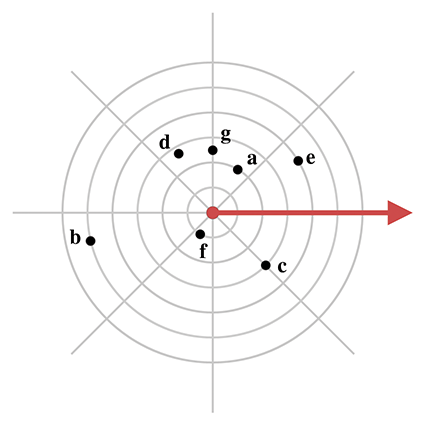
  1.  
    image

    1. (4,207o)(4,207o360o)(4,153o)(4,207^{o}) \equiv (4,207^{o} - 360^{o}) \equiv (4, - 153^{o})

    2. (5,720o)(5,0o)(5,180o)( - 5, - 720^{o}) \equiv ( - 5,0^{o}) \equiv (5,180^{o})

    3. (0,45,2o)(0,0o)(0,45{,}2^{o}) \equiv (0,0^{o})

    4. (12,6,11π/4rad)(12,6,11π/4rad2πrad)(12,6,3π/4rad)(12{,}6,11\pi/4\ {rad}) \equiv \left( 12{,}6,11\pi/4\ {rad} - 2\pi\ {rad} \right) \equiv (12{,}6,3\pi/4\ {rad})

    1. (1,45o)p(1cos45o,1sin45o)c(10,707,10,707)c=(0,707,0,707)c(1,45^{o})_{p} \equiv (1\cos{45^{o}},1\sin{45^{o}})_{c} \approx (1 \cdot 0{,}707,1 \cdot 0{,}707)_{c} = (0{,}707,0{,}707)_{c}

    2. (3,0o)p(3cos0o,3sin0o)c=(31,30)c=(3,0)c(3,0^{o})_{p} \equiv (3\cos{0^{o}},3\sin{0^{o}})_{c} = (3 \cdot 1,3 \cdot 0)_{c} = (3,0)_{c}

    3. (4,90o)p(4cos90o,4sin90o)c=(40,41)c=(0,4)c(4,90^{o})_{p} \equiv (4\cos{90^{o}},4\sin{90^{o}})_{c} = (4 \cdot 0,4 \cdot 1)_{c} = (0,4)_{c}

    4. (10,30o)p(10cos(30o),10sin(30o))c(100,866,10(0,500))c=(8,66,5,00)c(10, - 30^{o})_{p} \equiv \left( 10\cos( - 30^{o}),10\sin( - 30^{o}) \right)_{c} \approx (10 \cdot 0{,}866,10 \cdot ( - 0{,}500))_{c} = (8{,}66, - 5{,}00)_{c}

    5. (5,5,πrad)p(5,5cos(πrad),5,5sin(πrad))c=(5,5(1),5,5(0))c=(5,5,0)c(5{,}5,\pi\ {rad})_{p} \equiv (5{,}5\cos(\pi\ {rad}),5{,}5\sin(\pi\ {rad}))_{c} = (5{,}5 \cdot ({- 1}),5{,}5 \cdot (0))_{c} = ( - 5{,}5,0)_{c}

    1. (4,207o)p(4cos207o,4sin207o)c(4,891,4,454)c(3,56,1,82)c(4,207^{o})_{p} \equiv (4\cos{207^{o}},4\sin{207^{o}})_{c} \approx (4 \cdot - {,}891,4 \cdot - {,}454)_{c} \approx ( - 3{,}56, - 1{,}82)_{c}

    2. (5,720o)p(5cos(720o),5sin(720o))c=(51,50)c=(5,0)c( - 5, - 720^{o})_{p} \equiv ( - 5\cos( - 720^{o}), - 5\sin( - 720^{o}))_{c} = ( - 5 \cdot 1, - 5 \cdot 0)_{c} = ( - 5,0)_{c}

    3. (0,45,2o)p(0,0)c(0,45{,}2^{o})_{p} \equiv (0,0)_{c}. Aucun crédit ne sera accordé si vous avez réellement pris la peine de calculer le sinus et le cosinus de 45,2°.

    4. (12,6,11π/4rad)p(12,6cos(11π/4rad),12,6sin(11π/4rad))c(12,6,707,12,6707)c(8,91,8,91)c(12{,}6,11\pi/4\ {rad})_{p} \equiv (12{,}6\cos(11\pi/4\ {rad}),12{,}6\sin(11\pi/4\ {rad}))_{c} \approx (12{,}6 \cdot - {,}707,12{,}6 \cdot 707)_{c} \approx ( - 8{,}91,8{,}91)_{c}

    Remarquez que ce n’est réellement pas plus différent ni plus difficile de convertir des coordonnées polaires non canoniques en cartésiennes.

    1. (10,20)c(10,20)_{c} :

      r=102+202=100+400=50022,36θ=atan2(20,10)=arctan(20/10)63,43o(10,20)c(22,36,63,43o)p\begin{matrix} r & {= \sqrt{10^{2} + 20^{2}} = \sqrt{100 + 400} = \sqrt{500} \approx 22{,}36} \\ \theta & {= {atan2}(20,10) = \arctan(20/10) \approx 63{,}43^{o}} \\ {(10,20)_{c}} & {\cong (22{,}36,63{,}43^{o})_{p}} \\ \end{matrix}

    2. (12,5)c( - 12, - 5)_{c} :

      r=(12)2+(5)2=144+25=169=13θ=atan2(5,12)=arctan(5/12)180o22,62o180o157,38o(12,5)c(13,157,38o)p\begin{matrix} r & {= \sqrt{( - 12)^{2} + ( - 5)^{2}} = \sqrt{144 + 25} = \sqrt{169} = 13} \\ \theta & {= {atan2}( - 5, - 12) = \arctan(5/12) - 180^{o}} \\ & {\approx 22{,}62^{o} - 180^{o} \approx - 157{,}38^{o}} \\ {( - 12, - 5)_{c}} & {\cong (13, - 157{,}38^{o})_{p}} \\ \end{matrix}

    3. (0,4,5)c(0,4{,}5)_{c} :

      r=02+4,52=4,5θ=atan2(0,4,5)=90o(4,5,0)c(4,5,90o)p\begin{matrix} r & {= \sqrt{0^{2} + 4{,}5^{2}} = 4{,}5} \\ \theta & {= {atan2}(0,4{,}5) = 90^{o}} \\ {(4{,}5,0)_{c}} & {\equiv (4{,}5,90^{o})_{p}} \\ \end{matrix}

    4. (3,4)c( - 3,4)_{c} :

      r=(3)2+42=9+16=25=5θ=atan2(4,3)=arctan(4/3)+180o53,13o+180o126,87o(3,4)c(5,126,87o)p\begin{matrix} r & {= \sqrt{( - 3)^{2} + 4^{2}} = \sqrt{9 + 16} = \sqrt{25} = 5} \\ \theta & {= {atan2}(4, - 3) = \arctan(4/3) + 180^{o}} \\ & {\approx - 53{,}13^{o} + 180^{o} \approx 126{,}87^{o}} \\ {( - 3,4)_{c}} & {\equiv (5,126{,}87^{o})_{p}} \\ \end{matrix}

    5. (0,0)c(0,0)p(0,0)_{c} \equiv (0,0)_{p}

    6. (5280,0)c( - 5280,0)_{c}

      r=(5280)2+02=5280θ=atan2(0,5280)=180o(5280,0)c(5280,180o)p\begin{matrix} r & {= \sqrt{( - 5280)^{2} + 0^{2}} = 5280} \\ \theta & {= {atan2}(0, - 5280) = 180^{o}} \\ {( - 5280,0)_{c}} & {\equiv (5280,180^{o})_{p}} \\ \end{matrix}

    1. (a) x=rcos(θ)=4cos(120o)=4(1/2)=2x = r\cos(\theta) = 4\cos(120^{o}) = 4( - 1/2) = - 2
      y=rsin(θ)=4sin(120o)=4(3/2)=23y = r\sin(\theta) = 4\sin(120^{o}) = 4(\sqrt{3}/2) = 2\sqrt{3}
      donc (x,y,z)=(2,23,5)(x,y,z) = ( - 2,2\sqrt{3},5)

    2. (b) x=rcos(θ)=2cos(45o)=2(2/2)=2x = r\cos(\theta) = 2\cos(45^{o}) = 2(\sqrt{2}/2) = \sqrt{2}
      y=rsin(θ)=2sin(45o)=2(2/2)=2y = r\sin(\theta) = 2\sin(45^{o}) = 2(\sqrt{2}/2) = \sqrt{2}
      donc (x,y,z)=(2,2,1)(x,y,z) = (\sqrt{2},\sqrt{2}, - 1)

    3. (c) x=rcos(θ)=6cos(π/6)=6cos(π/6)=6(3/2)=33x = r\cos(\theta) = 6\cos( - \pi/6) = 6\cos(\pi/6) = 6(\sqrt{3}/2) = 3\sqrt{3}
      y=rsin(θ)=6sin(π/6)=6sin(π/6)=6(1/2)=3y = r\sin(\theta) = 6\sin( - \pi/6) = - 6\sin(\pi/6) = - 6( - 1/2) = - 3
      donc (x,y,z)=(33,3,3)(x,y,z) = (3\sqrt{3}, - 3, - 3)

    4. (d) x=rcos(θ)=3cos(3π)=3cos(π)=3(1)=3x = r\cos(\theta) = 3\cos(3\pi) = 3\cos(\pi) = 3( - 1) = - 3
      y=rsin(θ)=3sin(3π)=3sin(π)=3(0)=0y = r\sin(\theta) = 3\sin(3\pi) = 3\sin(\pi) = 3(0) = 0
      donc (x,y,z)=(3,0,1)(x,y,z) = ( - 3,0,1)

    1. (a) r=12+12=2r = \sqrt{1^{2} + 1^{2}} = \sqrt{2}
      θ=arctan(1/1)=45o\theta = \arctan(1/1) = 45^{o}
      donc (r,θ,z)=(2,45o,1)(r,\theta,z) = (\sqrt{2},45^{o},1)

    2. (b) r=02+(5)2=5r = \sqrt{0^{2} + ( - 5)^{2}} = 5
      θ=90o\theta = - 90^{o}, puisque x=0x = 0 et y<0y < 0
      donc (r,θ,z)=(5,90o,2)(r,\theta,z) = (5, - 90^{o},2)

    3. (c) r=(3)2+42=5r = \sqrt{( - 3)^{2} + 4^{2}} = 5
      θ=arctan(4/(3))=126,87o\theta = \arctan(4/( - 3)) = 126{,}87^{o}
      donc (r,θ,z)=(5,126,87o,7)(r,\theta,z) = (5,126{,}87^{o}, - 7)

    4. (d) r=02+02=0r = \sqrt{0^{2} + 0^{2}} = 0
      θ=0\theta = 0, puisque x=0x = 0 et y=0y = 0
      donc (r,θ,z)=(0,0,3)(r,\theta,z) = (0,0, - 3)

    1. (a) x=rsin(ϕ)cos(θ)=4sin(3π/4)cos(π/3)=4(2/2)(1/2)=2x = r\sin(\phi)\cos(\theta) = 4\sin(3\pi/4)\cos(\pi/3) = 4(\sqrt{2}/2)(1/2) = \sqrt{2}
      y=rsin(ϕ)sin(θ)=4sin(3π/4)sin(π/3)=4(2/2)(3/2)=6y = r\sin(\phi)\sin(\theta) = 4\sin(3\pi/4)\sin(\pi/3) = 4(\sqrt{2}/2)(\sqrt{3}/2) = \sqrt{6}
      z=rcos(ϕ)=4cos(3π/4)=4(2/2)=22z = r\cos(\phi) = 4\cos(3\pi/4) = 4( - \sqrt{2}/2) = - 2\sqrt{2}
      donc (x,y,z)=(2,6,22)(x,y,z) = (\sqrt{2},\sqrt{6}, - 2\sqrt{2})

    2. (b) x=rsin(ϕ)cos(θ)=5sin(π/3)cos(5π/6)=5(3/2)(3/2)=15/4x = r\sin(\phi)\cos(\theta) = 5\sin(\pi/3)\cos( - 5\pi/6) = 5(\sqrt{3}/2)( - \sqrt{3}/2) = - 15/4
      y=rsin(ϕ)sin(θ)=5sin(π/3)sin(5π/6)=5(3/2)(1/2)=53/4y = r\sin(\phi)\sin(\theta) = 5\sin(\pi/3)\sin( - 5\pi/6) = 5(\sqrt{3}/2)( - 1/2) = - 5\sqrt{3}/4
      z=rcos(ϕ)=5cos(π/3)=5(1/2)=5/2z = r\cos(\phi) = 5\cos(\pi/3) = 5(1/2) = 5/2
      donc (x,y,z)=(15/4,53/4,5/2)(x,y,z) = ( - 15/4, - 5\sqrt{3}/4,5/2)

    3. (c) x=rsin(ϕ)cos(θ)=2sin(π)cos(π/6)=2(0)(3/2)=0x = r\sin(\phi)\cos(\theta) = 2\sin(\pi)\cos( - \pi/6) = 2(0)(\sqrt{3}/2) = 0
      y=rsin(ϕ)sin(θ)=2sin(π)sin(π/6)=2(0)(1/2)=0y = r\sin(\phi)\sin(\theta) = 2\sin(\pi)\sin( - \pi/6) = 2(0)( - 1/2) = 0
      z=rcos(ϕ)=2cos(π)=2(1)=2z = r\cos(\phi) = 2\cos(\pi) = 2( - 1) = - 2
      donc (x,y,z)=(0,0,2)(x,y,z) = (0,0, - 2)

    4. (d) x=rsin(ϕ)cos(θ)=8sin(π/6)cos(9π/4)=8(1/2)(2/2)=22x = r\sin(\phi)\cos(\theta) = 8\sin(\pi/6)\cos(9\pi/4) = 8(1/2)(\sqrt{2}/2) = 2\sqrt{2}
      y=rsin(ϕ)sin(θ)=8sin(π/6)sin(9π/4)=8(1/2)(2/2)=22y = r\sin(\phi)\sin(\theta) = 8\sin(\pi/6)\sin(9\pi/4) = 8(1/2)(\sqrt{2}/2) = 2\sqrt{2}
      z=rcos(ϕ)=8cos(π/6)=8(3/2)=43z = r\cos(\phi) = 8\cos(\pi/6) = 8(\sqrt{3}/2) = 4\sqrt{3}
      donc (x,y,z)=(22,22,43)(x,y,z) = (2\sqrt{2},2\sqrt{2},4\sqrt{3})

    1. (a1) (4,π/3,3π/4)(4,4π/3,π/4)(4,2π/3,π/4)(4,\pi/3,3\pi/4)\Longrightarrow(4,4\pi/3,\pi/4)\Longrightarrow(4, - 2\pi/3,\pi/4)

    2. (a2) x=rcospsinh=4cos(π/4)sin(2π/3)=4(2/2)(3/2)=6x = r\cos p\sin h = 4\cos(\pi/4)\sin( - 2\pi/3) = 4(\sqrt{2}/2)( - \sqrt{3}/2) = - \sqrt{6}
      y=rsinp=4sin(π/4)=4(2/2)=22y = - r\sin p = - 4\sin(\pi/4) = - 4(\sqrt{2}/2) = - 2\sqrt{2}
      z=rcospcosh=4cos(π/4)cos(2π/3)=4(2/2)(1/2)=2z = r\cos p\cos h = 4\cos(\pi/4)\cos( - 2\pi/3) = 4(\sqrt{2}/2)( - 1/2) = - \sqrt{2}
      donc (x,y,z)=(6,22,2)(x,y,z) = ( - \sqrt{6}, - 2\sqrt{2}, - \sqrt{2})

    3. (b1) (5,5π/6,π/3)(5, - 5\pi/6,\pi/3) est déjà dans l’ensemble canonique.

    4. (b2) x=rcospsinh=5cos(π/3)sin(5π/6)=5(1/2)(1/2)=5/4x = r\cos p\sin h = 5\cos(\pi/3)\sin( - 5\pi/6) = 5(1/2)( - 1/2) = - 5/4
      y=rsinp=5sin(π/3)=5(3/2)=(53)/2y = - r\sin p = - 5\sin(\pi/3) = - 5(\sqrt{3}/2) = - (5\sqrt{3})/2
      z=rcospcosh=5cos(π/3)cos(5π/6)=5(1/2)(3/2)=(53)/4z = r\cos p\cos h = 5\cos(\pi/3)\cos( - 5\pi/6) = 5(1/2)( - \sqrt{3}/2) = - (5\sqrt{3})/4
      donc (x,y,z)=(5/4,(53)/2,(53)/4)(x,y,z) = ( - 5/4, - (5\sqrt{3})/2, - (5\sqrt{3})/4)

    5. (c1) (2,π/6,π)(2,5π/6,0)(2, - \pi/6,\pi)\Longrightarrow(2,5\pi/6,0)

    6. (c2) x=rcospsinh=2cos(0)sin(5π/6)=(2)(1)(1/2)=1x = r\cos p\sin h = 2\cos(0)\sin(5\pi/6) = (2)(1)(1/2) = 1
      y=rsinp=2sin(0)=(2)(0)=0y = - r\sin p = - 2\sin(0) = ( - 2)(0) = 0
      z=rcospcosh=2cos(0)cos(5π/6)=(2)(1)(3/2)=3z = r\cos p\cos h = 2\cos(0)\cos(5\pi/6) = (2)(1)( - \sqrt{3}/2) = - \sqrt{3}
      donc (x,y,z)=(1,0,3)(x,y,z) = (1,0, - \sqrt{3})

    7. (d1) (8,9π/4,π/6)(8,π/4,π/6)(8,9\pi/4,\pi/6)\Longrightarrow(8,\pi/4,\pi/6)

    8. (d2) x=rcospsinh=8cos(π/6)sin(π/4)=8(3/2)(2/2)=26x = r\cos p\sin h = 8\cos(\pi/6)\sin(\pi/4) = 8(\sqrt{3}/2)(\sqrt{2}/2) = 2\sqrt{6}
      y=rsinp=8sin(π/6)=8(1/2)=4y = - r\sin p = - 8\sin(\pi/6) = - 8(1/2) = - 4
      z=rcospcosh=8cos(π/6)cos(π/4)=8(3/2)(2/2)=26z = r\cos p\cos h = 8\cos(\pi/6)\cos(\pi/4) = 8(\sqrt{3}/2)(\sqrt{2}/2) = 2\sqrt{6}
      donc (x,y,z)=(26,4,26)(x,y,z) = (2\sqrt{6}, - 4,2\sqrt{6})

    1. (a) r=x2+y2+z2=(2)2+(23)2+(2)2=2+12+2=16=4r = \sqrt{x^{2} + y^{2} + z^{2}} = \sqrt{(\sqrt{2})^{2} + (2\sqrt{3})^{2} + ( - \sqrt{2})^{2}} = \sqrt{2 + 12 + 2} = \sqrt{16} = 4
      h=arctan(x/z)=arctan(2/2)=arctan(1)=135oh = \arctan(x/z) = \arctan( - \sqrt{2}/\sqrt{2}) = \arctan( - 1) = 135^{o}, étant donné l’emplacement de (x,z)(x,z)
      p=arcsin(y/r)=arcsin((23)/4)=arcsin(3/2)=60op = \arcsin( - y/r) = \arcsin( - (2\sqrt{3})/4) = \arcsin( - \sqrt{3}/2) = - 60^{o}
      donc (r,h,p)=(4,135o,60o)(r,h,p) = (4,135^{o}, - 60^{o})

    2. (b)
      r=x2+y2+z2=(23)2+62+(4)2=12+36+16=64=8r = \sqrt{x^{2} + y^{2} + z^{2}} = \sqrt{(2\sqrt{3})^{2} + 6^{2} + ( - 4)^{2}} = \sqrt{12 + 36 + 16} = \sqrt{64} = 8
      h=arctan(x/z)=arctan((23)/4)=arctan(3/2)=139,11oh = \arctan(x/z) = \arctan( - (2\sqrt{3})/4) = \arctan( - \sqrt{3}/2) = 139{,}11^{o}, étant donné l’emplacement de (x,z)(x,z)
      p=arcsin(y/r)=arcsin(6/8)=arcsin(3/4)=48,59op = \arcsin( - y/r) = \arcsin( - 6/8) = \arcsin( - 3/4) = - 48{,}59^{o}
      donc (r,h,p)=(8,139,11o,48,59o)(r,h,p) = (8,139{,}11^{o}, - 48{,}59^{o})

    3. (c)
      r=x2+y2+z2=(1)2+(1)2+(1)2=1+1+1=3r = \sqrt{x^{2} + y^{2} + z^{2}} = \sqrt{( - 1)^{2} + ( - 1)^{2} + ( - 1)^{2}} = \sqrt{1 + 1 + 1} = \sqrt{3}
      h=arctan(x/z)=arctan((1)/(1))=arctan(1)=135oh = \arctan(x/z) = \arctan(( - 1)/( - 1)) = \arctan(1) = - 135^{o}, étant donné l’emplacement de (x,z)(x,z)
      p=arcsin(y/r)=arcsin(1/3)=35,26op = \arcsin( - y/r) = \arcsin(1/\sqrt{3}) = 35{,}26^{o}
      donc (r,h,p)=(3,135o,35,26o)(r,h,p) = (\sqrt{3}, - 135^{o},35{,}26^{o})

    4. (d) r=x2+y2+z2=22+(23)2+42=4+12+16=32=42r = \sqrt{x^{2} + y^{2} + z^{2}} = \sqrt{2^{2} + ( - 2\sqrt{3})^{2} + 4^{2}} = \sqrt{4 + 12 + 16} = \sqrt{32} = 4\sqrt{2}
      h=arctan(x/z)=arctan(2/4)=arctan(1/2)=26,57oh = \arctan(x/z) = \arctan(2/4) = \arctan(1/2) = 26{,}57^{o}, étant donné l’emplacement de (x,z)(x,z)
      p=arcsin(y/r)=arcsin((23)/(42))=arcsin(3/(22))=37,76op = \arcsin( - y/r) = \arcsin((2\sqrt{3})/(4\sqrt{2})) = \arcsin(\sqrt{3}/(2\sqrt{2})) = 37{,}76^{o}
      donc (r,h,p)=(42,26,57o,37,76o)(r,h,p) = (4\sqrt{2},26{,}57^{o},37{,}76^{o})

    5. (e) r=x2+y2+z2=(3)2+(3)2+(22)2=3+3+8=14r = \sqrt{x^{2} + y^{2} + z^{2}} = \sqrt{( - \sqrt{3})^{2} + ( - \sqrt{3})^{2} + (2\sqrt{2})^{2}} = \sqrt{3 + 3 + 8} = \sqrt{14}
      h=arctan(x/z)=arctan(3/(22))=31,48oh = \arctan(x/z) = \arctan( - \sqrt{3}/(2\sqrt{2})) = - 31{,}48^{o}, étant donné l’emplacement de (x,z)(x,z)
      p=arcsin(y/r)=arcsin(3/14)=27,58op = \arcsin( - y/r) = \arcsin(\sqrt{3}/\sqrt{14}) = 27{,}58^{o}
      donc (r,h,p)=(14,31,48o,27,58o)(r,h,p) = (\sqrt{14}, - 31{,}48^{o},27{,}58^{o})

    6. (f) r=x2+y2+z2=32+42+122=9+16+144=13r = \sqrt{x^{2} + y^{2} + z^{2}} = \sqrt{3^{2} + 4^{2} + 12^{2}} = \sqrt{9 + 16 + 144} = 13
      h=arctan(x/z)=arctan(3/12)=arctan(1/4)=14,04oh = \arctan(x/z) = \arctan(3/12) = \arctan(1/4) = 14{,}04^{o}
      p=arcsin(y/r)=arcsin(4/13)=17,92op = \arcsin( - y/r) = \arcsin( - 4/13) = - 17{,}92^{o}
      donc (r,h,p)=(13,14,04o,17,92o)(r,h,p) = (13,14{,}04^{o}, - 17{,}92^{o})

    1. (a) Une sphère de rayon r0r_{0}.

    2. (b) Un plan vertical, obtenu en faisant pivoter le plan x=0x = 0 dans le sens horaire autour de l’axe yy d’un angle h0h_{0}.

    3. (c) Une « surface conique circulaire droite » (deux cônes circulaires verticaux se rejoignant pointe à pointe à l’origine). L’angle intérieur du cône est 2p02p_{0}.

  2. Elle était au pôle nord, donc l’ours était blanc.1

B.8Chapitre 8

  1. (a) 5     (b) 3     (c) 6     (d) 1     (e) 2     (f) 4

    1. (a) 3. Oui, ce sont des angles d’Euler canoniques.

    2. (b) 4. Oui, ce sont des angles d’Euler canoniques.

    3. (c) 5. Non, cette orientation est en blocage de cardan, et dans l’ensemble canonique, le roulis devrait être zéro.

    4. (d) 1. Oui, ce sont des angles d’Euler canoniques.

    5. (e) 2. Oui, ce sont des angles d’Euler canoniques.

    6. (f) 3. Non, l’angle de tangage est en dehors de la plage légale.

    7. (g) 5. Oui, ce sont des angles d’Euler canoniques.

    8. (h) 2. Non, l’angle de tangage est en dehors de la plage légale.

    9. (i) 6. Oui, ce sont des angles d’Euler canoniques.

    1. (a) [cos(30o/2)(1sin(30o/2)0sin(30o/2)0sin(30o/2))]=[0,966(,2590,0000,000)]\begin{bmatrix} {\cos(30^{o}/2)} \\ \begin{pmatrix} {1 \cdot \sin(30^{o}/2)} \\ {0 \cdot \sin(30^{o}/2)} \\ {0 \cdot \sin(30^{o}/2)} \\ \end{pmatrix} \\ \end{bmatrix} = \begin{bmatrix} 0{,}966 \\ \begin{pmatrix} {,}259 \\ 0{,}000 \\ 0{,}000 \\ \end{pmatrix} \\ \end{bmatrix}

    2. (b) Tous les quaternions de rotation ont une magnitude de 1 !

    1. (c) [0,966(,2590,0000,000)]\begin{bmatrix} 0{,}966 & \begin{pmatrix} {- {,}259} & 0{,}000 & 0{,}000 \\ \end{pmatrix} \\ \end{bmatrix}

    2. (d) Cela correspond à un tangage de +30°.

  2. (a) 2     (b) 5     (c) 1     (d) 3     (e) 2     (f) 1     (g) 4     (h) 6     (i) 3

  3. (a) 5     (b) 2     (c) 6     (d) 1     (e) 3     (f) 5     (g) 4     (h) 2     (i) 3     

  4. (w1+x1i+y1j+z1k)(w2+x2i+y2j+z2k)=w1w2+w1x2i+w1y2j+w1z2k+x1w2i+x1x2i2+x1y2ij+x1z2ik+y1w2j+y1x2ji+y1y2j2+y1z2jk+z1w2k+z1x2ki+z1y2kj+z1z2k2=w1w2+w1x2i+w1y2j+w1z2k+x1w2i+x1x2(1)+x1y2k+x1z2(j)+y1w2j+y1x2(k)+y1y2(1)+y1z2i+z1w2k+z1x2j+z1y2(i)+z1z2(1)=w1w2x1x2y1y2z1z2+(w1x2+x1w2+y1z2z1y2)i+(w1y2+y1w2+z1x2x1z2)j+(w1z2+z1w2+x1y2y1x2)k{(w_{1} + x_{1}i + y_{1}j + z_{1}k)(w_{2} + x_{2}i + y_{2}j + z_{2}k)} = w_{1}w_{2} + w_{1}x_{2}i + w_{1}y_{2}j + w_{1}z_{2}k + x_{1}w_{2}i + x_{1}x_{2}i^{2} + x_{1}y_{2}ij + x_{1}z_{2}ik + y_{1}w_{2}j + y_{1}x_{2}ji + y_{1}y_{2}j^{2} + y_{1}z_{2}jk + z_{1}w_{2}k + z_{1}x_{2}ki + z_{1}y_{2}kj + z_{1}z_{2}k^{2} = w_{1}w_{2} + w_{1}x_{2}i + w_{1}y_{2}j + w_{1}z_{2}k + x_{1}w_{2}i + x_{1}x_{2}( - 1) + x_{1}y_{2}k + x_{1}z_{2}( - j) + y_{1}w_{2}j + y_{1}x_{2}( - k) + y_{1}y_{2}( - 1) + y_{1}z_{2}i + z_{1}w_{2}k + z_{1}x_{2}j + z_{1}y_{2}( - i) + z_{1}z_{2}( - 1) = w_{1}w_{2} - x_{1}x_{2} - y_{1}y_{2} - z_{1}z_{2} + (w_{1}x_{2} + x_{1}w_{2} + y_{1}z_{2} - z_{1}y_{2})i + (w_{1}y_{2} + y_{1}w_{2} + z_{1}x_{2} - x_{1}z_{2})j + (w_{1}z_{2} + z_{1}w_{2} + x_{1}y_{2} - y_{1}x_{2})k

  5. D’abord, on extrait le demi-angle et l’axe de rotation :

    α=θ/2=arccosw=arccos0,96515,0o,𝐧̂=normalize([0,1490,1490,149])[0,5770,5770,577].\begin{matrix} \alpha & {= \theta/2 = \arccos w = \arccos 0{,}965 \approx 15{,}0^{o},} \\ \hat{\mathbf{n}} & {= {normalize}(\begin{bmatrix} 0{,}149 & {- 0{,}149} & 0{,}149 \\ \end{bmatrix}) \approx \begin{bmatrix} 0{,}577 & {- 0{,}577} & 0{,}577 \\ \end{bmatrix}.} \\ \end{matrix}

    Maintenant, on forme un nouveau quaternion en utilisant le nouveau demi-angle, α=2α30,0o\alpha^{\prime} = 2\alpha \approx 30{,}0^{o} :

    [cosα(nxsinαnysinαnzsinα)]=[0,867(0,5770,5000,5770,5000,5770,500)]=[0,867(0,2880,2880,288)].\begin{matrix} {\begin{bmatrix} {\cos\alpha^{\prime}} \\ \begin{pmatrix} {n_{x}\sin\alpha^{\prime}} \\ {n_{y}\sin\alpha^{\prime}} \\ {n_{z}\sin\alpha^{\prime}} \\ \end{pmatrix} \\ \end{bmatrix} = \begin{bmatrix} 0{,}867 \\ \begin{pmatrix} {0{,}577 \cdot 0{,}500} \\ {- 0{,}577 \cdot 0{,}500} \\ {0{,}577 \cdot 0{,}500} \\ \end{pmatrix} \\ \end{bmatrix} = \begin{bmatrix} 0{,}867 \\ \begin{pmatrix} 0{,}288 \\ {- 0{,}288} \\ 0{,}288 \\ \end{pmatrix} \\ \end{bmatrix}.} \\ \end{matrix}

    1. (a) 𝐚𝐛=[0,233(0,0600,2570,935)][0,752(0,2860,3740,459)]=(0,233)(0,752)+(0,060)(0,286)+(0,257)(0,374)+(0,935)(0,459)=0,683\mathbf{a} \cdot \mathbf{b} = \begin{bmatrix} 0{,}233 \\ \begin{pmatrix} 0{,}060 \\ {- 0{,}257} \\ {- 0{,}935} \\ \end{pmatrix} \\ \end{bmatrix} \cdot \begin{bmatrix} {- 0{,}752} \\ \begin{pmatrix} 0{,}286 \\ 0{,}374 \\ 0{,}459 \\ \end{pmatrix} \\ \end{bmatrix} = (0{,}233)( - 0{,}752) + (0{,}060)(0{,}286) + ( - 0{,}257)(0{,}374)\mspace{59mu} + ( - 0{,}935)(0{,}459) = - 0{,}683

    2. (b) 𝐚𝐛=[0,333(0,2530,0150,906)]\mathbf{a}\mathbf{b} = \begin{bmatrix} 0{,}333 \\ \begin{pmatrix} 0{,}253 \\ {- 0{,}015} \\ 0{,}906 \\ \end{pmatrix} \\ \end{bmatrix}

    3. (c) 𝐝=𝐛𝐚1=[0,752(0,2860,3740,459)][0,233(0,0600,2570,935)]*=[0,683(0,3430,4010,500)]\mathbf{d} = \mathbf{b}\mathbf{a}^{- 1} = \begin{bmatrix} {- 0{,}752} \\ \begin{pmatrix} 0{,}286 \\ 0{,}374 \\ 0{,}459 \\ \end{pmatrix} \\ \end{bmatrix}\begin{bmatrix} 0{,}233 \\ \begin{pmatrix} 0{,}060 \\ {- 0{,}257} \\ {- 0{,}935} \\ \end{pmatrix} \\ \end{bmatrix}^{\ast} = \begin{bmatrix} {- 0{,}683} \\ \begin{pmatrix} 0{,}343 \\ {- 0{,}401} \\ {- 0{,}500} \\ \end{pmatrix} \\ \end{bmatrix}

  6. 𝐪1𝐪2=[w1(x1y1z1)][w2(x2y2z2)]=[w1w2x1x2y1y2z1z2(w1x2+x1w2+y1z2z1y2w1y2+y1w2+z1x2x1z2w1z2+z1w2+x1y2y1x2)]=(w1w2x1x2y1y2z1z2)2+(w1x2+x1w2+y1z2z1y2)2+(w1y2+y1w2+z1x2x1z2)2+(w1z2+z1w2+x1y2y1x2)2{\parallel {\mathbf{q}_{1}\mathbf{q}_{2}} \parallel} = {\parallel {\begin{bmatrix} w_{1} & \begin{pmatrix} x_{1} & y_{1} & z_{1} \\ \end{pmatrix} \\ \end{bmatrix}\begin{bmatrix} w_{2} & \begin{pmatrix} x_{2} & y_{2} & z_{2} \\ \end{pmatrix} \\ \end{bmatrix}} \parallel}\mspace{37mu} = {\parallel \begin{bmatrix} {w_{1}w_{2} - x_{1}x_{2} - y_{1}y_{2} - z_{1}z_{2}} \\ \begin{pmatrix} {w_{1}x_{2} + x_{1}w_{2} + y_{1}z_{2} - z_{1}y_{2}} \\ {w_{1}y_{2} + y_{1}w_{2} + z_{1}x_{2} - x_{1}z_{2}} \\ {w_{1}z_{2} + z_{1}w_{2} + x_{1}y_{2} - y_{1}x_{2}} \\ \end{pmatrix} \\ \end{bmatrix} \parallel}\mspace{37mu} = \sqrt{\begin{array}{l} {(w_{1}w_{2} - x_{1}x_{2} - y_{1}y_{2} - z_{1}z_{2})^{2}} \\ {+ (w_{1}x_{2} + x_{1}w_{2} + y_{1}z_{2} - z_{1}y_{2})^{2}} \\ {+ (w_{1}y_{2} + y_{1}w_{2} + z_{1}x_{2} - x_{1}z_{2})^{2}} \\ {+ (w_{1}z_{2} + z_{1}w_{2} + x_{1}y_{2} - y_{1}x_{2})^{2}} \\ \end{array}}
    [12pt] Après avoir développé ces produits puis simplifié les termes (une étape que nous avons omise car elle est très fastidieuse), on factorise :

    𝐪1𝐪2=w12w22+x12x22+y12y22+z12z22+w12x22+x12w22+y12z22+z12y22+w12y22+y12w22+z12x22+x12z22+w12z22+z12w22+x12y22+y12x22=w12(w22+x22+y22+z22)+x12(w22+x22+y22+z22)+y12(w22+x22+y22+z22)+z12(w22+x22+y22+z22)=(w12+x12+y12+z12)(w22+x22+y22+z22)=𝐪12𝐪22=𝐪1𝐪2\begin{matrix} {\parallel {\mathbf{q}_{1}\mathbf{q}_{2}} \parallel} & {= \sqrt{\begin{matrix} {{w_{1}}^{2}{w_{2}}^{2} + {x_{1}}^{2}{x_{2}}^{2} + {y_{1}}^{2}{y_{2}}^{2} + {z_{1}}^{2}{z_{2}}^{2}} \\ {+ {w_{1}}^{2}{x_{2}}^{2} + {x_{1}}^{2}{w_{2}}^{2} + {y_{1}}^{2}{z_{2}}^{2} + {z_{1}}^{2}{y_{2}}^{2}} \\ {+ {w_{1}}^{2}{y_{2}}^{2} + {y_{1}}^{2}{w_{2}}^{2} + {z_{1}}^{2}{x_{2}}^{2} + {x_{1}}^{2}{z_{2}}^{2}} \\ {+ {w_{1}}^{2}{z_{2}}^{2} + {z_{1}}^{2}{w_{2}}^{2} + {x_{1}}^{2}{y_{2}}^{2} + {y_{1}}^{2}{x_{2}}^{2}} \\ \end{matrix}}} \\ & {= \sqrt{\begin{matrix} {{w_{1}}^{2}({w_{2}}^{2} + {x_{2}}^{2} + {y_{2}}^{2} + {z_{2}}^{2})} \\ {+ {x_{1}}^{2}({w_{2}}^{2} + {x_{2}}^{2} + {y_{2}}^{2} + {z_{2}}^{2})} \\ {+ {y_{1}}^{2}({w_{2}}^{2} + {x_{2}}^{2} + {y_{2}}^{2} + {z_{2}}^{2})} \\ {+ {z_{1}}^{2}({w_{2}}^{2} + {x_{2}}^{2} + {y_{2}}^{2} + {z_{2}}^{2})} \\ \end{matrix}}} \\ & {= \sqrt{({w_{1}}^{2} + {x_{1}}^{2} + {y_{1}}^{2} + {z_{1}}^{2})({w_{2}}^{2} + {x_{2}}^{2} + {y_{2}}^{2} + {z_{2}}^{2})}} \\ & {= \sqrt{{\parallel \mathbf{q}_{1} \parallel}^{2}{\parallel \mathbf{q}_{2} \parallel}^{2}}} \\ & {= {\parallel \mathbf{q}_{1} \parallel}{\parallel \mathbf{q}_{2} \parallel}} \\ \end{matrix}

B.9Chapitre 9

  1. D’abord, on convertit le rayon en forme implicite en utilisant l’Équation (9.5) :

    a=dy=5,b=dx=7,d=xorgdyyorgdx=553(7)=46.\begin{matrix} a & {= d_{y} = 5,} \\ b & {= - d_{x} = 7,} \\ d & {= x_{org}d_{y} - y_{org}d_{x} = 5 \cdot 5 - 3 \cdot ( - 7) = 46.} \\ \end{matrix}

    Ensuite, on convertit en forme pente-ordonnée selon l’Équation (9.6) :

    m=a/b=5/7,y0=d/b=46/7.\begin{matrix} m & {= - a/b = - 5/7,} \\ y_{0} & {= d/b = 46/7.} \\ \end{matrix}

    Donc l’équation de la droite est y=(5/7)x+46/7y = - (5/7)x + 46/7.

  2. 4x+7y=427y=4x+42y=(4/7)x+64x + 7y = 42\mspace{29mu} 7y = - 4x + 42\mspace{37mu} y = - (4/7)x + 6
    La pente est 4/7- 4/7 et l’ordonnée à l’origine est 6.

    1. (a) 𝐩min=(5,7,5)\mathbf{p}_{min} = ( - 5, - 7, - 5), 𝐩max=(7,11,8)\mathbf{p}_{max} = (7,11,8)

    2. (b) (xmin,ymin,zmin)=(5,7,5)(xmin,ymin,zmax)=(5,7,8)(xmin,ymax,zmin)=(5,11,5)(xmin,ymax,zmax)=(5,11,8)(xmax,ymin,zmin)=(7,7,5)(xmax,ymin,zmax)=(7,7,8)(xmax,ymax,zmin)=(7,11,5)(xmax,ymax,zmax)=(7,11,8)(x_{min},y_{min},z_{min}) = ( - 5, - 7, - 5)\mspace{29mu}(x_{min},y_{min},z_{max}) = ( - 5, - 7,8)(x_{min},y_{max},z_{min}) = ( - 5,11, - 5)\mspace{29mu}(x_{min},y_{max},z_{max}) = ( - 5,11,8)(x_{max},y_{min},z_{min}) = (7, - 7, - 5)\mspace{37mu}(x_{max},y_{min},z_{max}) = (7, - 7,8)(x_{max},y_{max},z_{min}) = (7,11, - 5)\mspace{37mu}(x_{max},y_{max},z_{max}) = (7,11,8)

    3. (c) 𝐜=(𝐩min+𝐩max)/2=(1,2,1,5)\mathbf{c} = (\mathbf{p}_{min} + \mathbf{p}_{max})/2 = (1,2,1{,}5)
      𝐬=(𝐩max𝐩min)=(12,18,13)\mathbf{s} = (\mathbf{p}_{max} - \mathbf{p}_{min}) = (12,18,13)

    4. (d) 𝐯1=(2,828,12,728,5,000)𝐯2=(0,707,3,5355,8,000)𝐯3=(4,243,0,000,1,000)𝐯4=(1,414,8,485,0,000)𝐯5=(2,121,6,364,4,000)\mathbf{v}_{1}^{\prime} = ( - 2{,}828,12{,}728, - 5{,}000)\mspace{29mu}\mathbf{v}_{2}^{\prime} = ( - 0{,}707,3{,}5355,8{,}000)\mathbf{v}_{3}^{\prime} = ( - 4{,}243,0{,}000,1{,}000)\mspace{44mu}\mathbf{v}_{4}^{\prime} = (1{,}414, - 8{,}485,0{,}000)\mathbf{v}_{5}^{\prime} = (2{,}121,6{,}364,4{,}000)

    5. (e) 𝐩min=(4,243,8,485,5)\mathbf{p}_{min} = ( - 4{,}243, - 8{,}485, - 5), 𝐩max=(2,121,12,728,8)\mathbf{p}_{max} = (2{,}121,12{,}728,8)

    6. (f) D’abord, on détermine quels produits calculer en utilisant la technique de la Figure 9.4 :

      xmin=m11xminxmax=m11xmax(m11>0)+m21ymax+m21ymin(m21<0)+0+0(m31=0)ymin=m12xminymax=m12xmax(m12>0)+m22ymin+m22ymax(m22>0)+0+0(m32=0)zmin=0zmax=0(m13=0)+0+0(m23=0)+zmin+zmax(m33=1)\begin{matrix} x_{min}^{\prime} & {= m_{11} \cdot x_{min}} & x_{max}^{\prime} & {= m_{11} \cdot x_{max}} & {(m_{11} > 0)} \\ & {\quad + m_{21} \cdot y_{max}} & & {\quad + m_{21} \cdot y_{min}} & {(m_{21} < 0)} \\ & {\quad + 0} & & {\quad + 0} & {(m_{31} = 0)} \\ y_{min}^{\prime} & {= m_{12} \cdot x_{min}} & y_{max}^{\prime} & {= m_{12} \cdot x_{max}} & {(m_{12} > 0)} \\ & {\quad + m_{22} \cdot y_{min}} & & {\quad + m_{22} \cdot y_{max}} & {(m_{22} > 0)} \\ & {\quad + 0} & & {\quad + 0} & {(m_{32} = 0)} \\ z_{min}^{\prime} & {= 0} & z_{max}^{\prime} & {= 0} & {(m_{13} = 0)} \\ & {\quad + 0} & & {\quad + 0} & {(m_{23} = 0)} \\ & {\quad + z_{min}} & & {\quad + z_{max}} & {(m_{33} = 1)} \\ \end{matrix}

      En sommant les produits appropriés, on obtient

      xmin=m11xmin+m21ymax+0=0,7075+(0,707)11+0=11,312,ymin=m12xmin+m22ymin+0=0,7075+0,7077+0=8,484,zmin=zmin=5,xmax=m11xmax+m21ymin+0=0,7077+(0,707)7+0=9,898,ymax=m12xmax+m22ymax+0=0,7077+0,70711+0=12,726,zmax=zmax=8.\begin{matrix} x_{min}^{\prime} & {= m_{11} \cdot x_{min} + m_{21} \cdot y_{max} + 0 = 0{,}707 \cdot - 5 + ( - 0{,}707) \cdot 11 + 0 = - 11{,}312,} \\ y_{min}^{\prime} & {= m_{12} \cdot x_{min} + m_{22} \cdot y_{min} + 0 = 0{,}707 \cdot - 5 + 0{,}707 \cdot - 7 + 0 = - 8{,}484,} \\ z_{min}^{\prime} & {= z_{min} = - 5,} \\ x_{max}^{\prime} & {= m_{11} \cdot x_{max} + m_{21} \cdot y_{min} + 0 = 0{,}707 \cdot 7 + ( - 0{,}707) \cdot - 7 + 0 = 9{,}898,} \\ y_{max}^{\prime} & {= m_{12} \cdot x_{max} + m_{22} \cdot y_{max} + 0 = 0{,}707 \cdot 7 + 0{,}707 \cdot 11 + 0 = 12{,}726,} \\ z_{max}^{\prime} & {= z_{max} = 8.} \\ \end{matrix}

      Remarquez comme cette boîte est beaucoup plus grande que celle des points transformés !

    1. (a) D’abord, trouvons la normale en utilisant l’Équation (9.12) :

      𝐞3=𝐩2𝐩1=[3117][6102]=[31119],𝐞1=𝐩3𝐩2=[980][3117]=[12917],𝐞3×𝐞1=[(11)(17)(19)(9)(19)(12)(3)(17)(3)(9)(11)(12)]=[1871712285127132]=[16279159].\begin{matrix} \mathbf{e}_{3} & {= \mathbf{p}_{2} - \mathbf{p}_{1} = \begin{bmatrix} 3 \\ {- 1} \\ 17 \\ \end{bmatrix} - \begin{bmatrix} 6 \\ 10 \\ {- 2} \\ \end{bmatrix} = \begin{bmatrix} {- 3} \\ {- 11} \\ 19 \\ \end{bmatrix},} \\ \mathbf{e}_{1} & {= \mathbf{p}_{3} - \mathbf{p}_{2} = \begin{bmatrix} {- 9} \\ 8 \\ 0 \\ \end{bmatrix} - \begin{bmatrix} 3 \\ {- 1} \\ 17 \\ \end{bmatrix} = \begin{bmatrix} {- 12} \\ 9 \\ {- 17} \\ \end{bmatrix},} \\ {\mathbf{e}_{3} \times \mathbf{e}_{1}} & {= \begin{bmatrix} {( - 11)( - 17) - (19)(9)} \\ {(19)( - 12) - ( - 3)( - 17)} \\ {( - 3)(9) - ( - 11)( - 12)} \\ \end{bmatrix} = \begin{bmatrix} {187 - 171} \\ {- 228 - 51} \\ {- 27 - 132} \\ \end{bmatrix} = \begin{bmatrix} 16 \\ {- 279} \\ {- 159} \\ \end{bmatrix}.} \\ \end{matrix}

      Normalisons-la :

      𝐞3×𝐞1=162+(279)2+(159)2=103378321,5,𝐧̂=𝐞3×𝐞1𝐞3×𝐞1[16279159]321,5[,04976,8677,4945].\begin{matrix} {\parallel {\mathbf{e}_{3} \times \mathbf{e}_{1}} \parallel} & {= \sqrt{16^{2} + ( - 279)^{2} + ( - 159)^{2}} = \sqrt{103378} \approx 321{,}5,} \\ \hat{\mathbf{n}} & {= \frac{\mathbf{e}_{3} \times \mathbf{e}_{1}}{\parallel {\mathbf{e}_{3} \times \mathbf{e}_{1}} \parallel} \approx \frac{\begin{bmatrix} 16 & {- 279} & {- 159} \\ \end{bmatrix}}{321{,}5}} \\ & {\approx \begin{bmatrix} {,}04976 & {- {,}8677} & {- {,}4945} \\ \end{bmatrix}.} \\ \end{matrix}

      Pour vérification, on confirme qu’on obtient le même résultat avec l’Équation (9.13) de la Section 9.5.3 :

      nx=(z1+z2)(y1y2)+(z2+z3)(y2y3)+(z3+z1)(y3y1)=((2)+17)(10(1))+(17+0)((1)8)+(0+(2))(810)=16,ny=(x1+x2)(z1z2)+(x2+x3)(z2z3)+(x3+x1)(z3z1)=(6+3)((2)17)+(3+(9))(170)+((9)+6)(0(2))=279,nz=(y1+y2)(x1x2)+(y2+y3)(x2x3)+(y3+y1)(x3x1)=(10+(1))(63)+((1)+8)(3(9))+(8+10)((9)6)=159,𝐧̂=[16279159]162+(279)2+1592[16279159]321,5[,04976,86770,4945].\begin{matrix} n_{x} & {= (z_{1} + z_{2})(y_{1} - y_{2}) + (z_{2} + z_{3})(y_{2} - y_{3}) + (z_{3} + z_{1})(y_{3} - y_{1})} \\ & {= (( - 2) + 17)(10 - ( - 1)) + (17 + 0)(( - 1) - 8) + (0 + ( - 2))(8 - 10)} \\ & {= 16,} \\ n_{y} & {= (x_{1} + x_{2})(z_{1} - z_{2}) + (x_{2} + x_{3})(z_{2} - z_{3}) + (x_{3} + x_{1})(z_{3} - z_{1})} \\ & {= (6 + 3)(( - 2) - 17) + (3 + ( - 9))(17 - 0) + (( - 9) + 6)(0 - ( - 2))} \\ & {= - 279,} \\ n_{z} & {= (y_{1} + y_{2})(x_{1} - x_{2}) + (y_{2} + y_{3})(x_{2} - x_{3}) + (y_{3} + y_{1})(x_{3} - x_{1})} \\ & {= (10 + ( - 1))(6 - 3) + (( - 1) + 8)(3 - ( - 9)) + (8 + 10)(( - 9) - 6)} \\ & {= - 159,} \\ \hat{\mathbf{n}} & {= \frac{\begin{bmatrix} 16 & {- 279} & 159 \\ \end{bmatrix}}{\sqrt{16^{2} + ( - 279)^{2} + 159^{2}}} \approx \frac{\begin{bmatrix} 16 & {- 279} & 159 \\ \end{bmatrix}}{321{,}5} \approx \begin{bmatrix} {,}04976 & {- {,}8677} & {- 0{,}4945} \\ \end{bmatrix}.} \\ \end{matrix}

      Maintenant qu’on a 𝐧̂\hat{\mathbf{n}}, on peut calculer dd. On utilisera arbitrairement 𝐩1\mathbf{p}_{1} :

      d=𝐧𝐩1[,04976,8677,4945][6102](,04976)(6)+(,8677)(10)+(,4945)(2)7,389.\begin{matrix} d & {= \mathbf{n} \cdot \mathbf{p}_{1} \approx \begin{bmatrix} {,}04976 & {- {,}8677} & {- {,}4945} \\ \end{bmatrix} \cdot \begin{bmatrix} 6 & 10 & {- 2} \\ \end{bmatrix}} \\ & {\approx ({,}04976)(6) + ( - {,}8677)(10) + ( - {,}4945)( - 2) \approx - 7{,}389.} \\ \end{matrix}

      L’équation du plan pour ce triangle est

      ,04976x,8677y,4945z=7,389.{,}04976x - {,}8677y - {,}4945z = - 7{,}389.

    2. (b) Pour répondre aux deux questions, on calcule la distance signée par l’Équation (9.14) de la Section 9.5.4 :

      a=𝐪𝐧̂d[345][,04976,8677,4945](7,389)(,04976)(3)+(,8677)(4)+(,4945)(5)+7,3891,595\begin{matrix} a & {= \mathbf{q} \cdot \hat{\mathbf{n}} - d} \\ & {\approx \begin{bmatrix} 3 & 4 & 5 \\ \end{bmatrix} \cdot \begin{bmatrix} {,}04976 & {- {,}8677} & {- {,}4945} \\ \end{bmatrix} - ( - 7{,}389)} \\ & {\approx ({,}04976)(3) + ( - {,}8677)(4) + ( - {,}4945)(5) + 7{,}389} \\ & {\approx 1{,}595} \\ \end{matrix}

      Comme cette valeur est positive, on conclut que le point est du côté avant du plan.

    3. (c) Résolvons d’abord ce problème en utilisant la méthode de projection 2D. L’axe dominant de la normale est yy, donc on supprimera les coordonnées yy des sommets et on projettera sur le plan xzxz. En appliquant la notation de la Figure 9.6 (mais avec des indices à base 1) :

      u1=z1z3u2=z2z3u3=pzz1u4=pzz3=20=170=17,11(2)=17,110=2=17=19,11=17,11v1=x1x3v2=x2x3v3=pxx1v4=pxx3=6(9)=3(9)=13,606=13,60(9)=15=12=7,60=22,60\begin{matrix} u_{1} & {= z_{1} - z_{3}} & u_{2} & {= z_{2} - z_{3}} & u_{3} & {= p_{z} - z_{1}} & u_{4} & {= p_{z} - z_{3}} \\ & {= - 2 - 0} & & {= 17 - 0} & & {= 17{,}11 - ( - 2)} & & {= 17{,}11 - 0} \\ & {= - 2} & & {= 17} & & {= 19{,}11} & & {= 17{,}11} \\ v_{1} & {= x_{1} - x_{3}} & v_{2} & {= x_{2} - x_{3}} & v_{3} & {= p_{x} - x_{1}} & v_{4} & {= p_{x} - x_{3}} \\ & {= 6 - ( - 9)} & & {= 3 - ( - 9)} & & {= 13{,}60 - 6} & & {= 13{,}60 - ( - 9)} \\ & {= 15} & & {= 12} & & {= 7{,}60} & & {= 22{,}60} \\ \end{matrix}

      denom=v1u2v2u1=(15)(17)(12)(2)=279(b1)(denom)=v4u2v2u4=(22,60)(17)(12)(17,11)=178,9b1=178,9/279=0,641(b2)(denom)=v1u3v3u1=(15)(19,11)(7,60)(2)=301,85b2=301,85/279=1,082b3=1b1b2=10,6411,082=0,723\begin{matrix} {denom} & {= v_{1}u_{2} - v_{2}u_{1}} & {= (15)(17) - (12)( - 2)} & {= 279} \\ {(b_{1})({denom})} & {= v_{4}u_{2} - v_{2}u_{4}} & {= (22{,}60)(17) - (12)(17{,}11)} & {= 178{,}9} \\ b_{1} & {= 178{,}9/279} & & {= 0{,}641} \\ {(b_{2})({denom})} & {= v_{1}u_{3} - v_{3}u_{1}} & {= (15)(19{,}11) - (7{,}60)( - 2)} & {= 301{,}85} \\ b_{2} & {= 301{,}85/279} & & {= 1{,}082} \\ b_{3} & {= 1 - b_{1} - b_{2}} & {= 1 - 0{,}641 - 1{,}082} & {= - 0{,}723} \\ \end{matrix}

    4. (d) 𝐜Grav=𝐯1+𝐯2+𝐯33=[6102]+[3117]+[980]3=[(6+39)(101+8)(2+17+0)]3=[01715]3=[017/35][05,665]\mathbf{c}_{Grav} = \frac{\mathbf{v}_{1} + \mathbf{v}_{2} + \mathbf{v}_{3}}{3} = \frac{\begin{bmatrix} 6 & 10 & {- 2} \\ \end{bmatrix} + \begin{bmatrix} 3 & {- 1} & 17 \\ \end{bmatrix} + \begin{bmatrix} {- 9} & 8 & 0 \\ \end{bmatrix}}{3}\mspace{29mu} = \frac{\begin{bmatrix} {(6 + 3 - 9)} & {(10 - 1 + 8)} & {( - 2 + 17 + 0)} \\ \end{bmatrix}}{3} = \frac{\begin{bmatrix} 0 & 17 & 15 \\ \end{bmatrix}}{3}\mspace{29mu} = \begin{bmatrix} 0 & {17/3} & 5 \\ \end{bmatrix} \approx \begin{bmatrix} 0 & 5{,}66 & 5 \\ \end{bmatrix}

    5. (e) D’abord, on calcule les longueurs des côtés.

      l1=[980][3117]=[12917]22,67l2=[6102][980]=[1522]15,26l3=[3117][6102]=[31119]22,16\begin{matrix} l_{1} & {= {\parallel {\begin{bmatrix} {- 9} & 8 & 0 \\ \end{bmatrix} - \begin{bmatrix} 3 & {- 1} & 17 \\ \end{bmatrix}} \parallel} = {\parallel \begin{bmatrix} {- 12} & 9 & {- 17} \\ \end{bmatrix} \parallel} \approx 22{,}67} \\ l_{2} & {= {\parallel {\begin{bmatrix} 6 & 10 & {- 2} \\ \end{bmatrix} - \begin{bmatrix} {- 9} & 8 & 0 \\ \end{bmatrix}} \parallel} = {\parallel \begin{bmatrix} 15 & 2 & {- 2} \\ \end{bmatrix} \parallel} \approx 15{,}26} \\ l_{3} & {= {\parallel {\begin{bmatrix} 3 & {- 1} & 17 \\ \end{bmatrix} - \begin{bmatrix} 6 & 10 & {- 2} \\ \end{bmatrix}} \parallel} = {\parallel \begin{bmatrix} {- 3} & {- 11} & 19 \\ \end{bmatrix} \parallel} \approx 22{,}16} \\ \end{matrix}

      𝐜In=l1𝐯1+l2𝐯2+l3𝐯3p=22,67[6102]+15,26[3117]+22,16[980]22,67+16,22+22,16=[136,02226,7045,34]+[45,7815,26259,42]+[199,44177,280]60,09=[17,64388,72214,08]60,09=[0,2946,473,56]\begin{matrix} \mathbf{c}_{In} & {= \frac{l_{1}\mathbf{v}_{1} + l_{2}\mathbf{v}_{2} + l_{3}\mathbf{v}_{3}}{p}} \\ & {= \frac{22{,}67\begin{bmatrix} 6 & 10 & {- 2} \\ \end{bmatrix} + 15{,}26\begin{bmatrix} 3 & {- 1} & 17 \\ \end{bmatrix} + 22{,}16\begin{bmatrix} {- 9} & 8 & 0 \\ \end{bmatrix}}{22{,}67 + 16{,}22 + 22{,}16}} \\ & {= \frac{\begin{bmatrix} 136{,}02 & 226{,}70 & {- 45{,}34} \\ \end{bmatrix} + \begin{bmatrix} 45{,}78 & {- 15{,}26} & 259{,}42 \\ \end{bmatrix} + \begin{bmatrix} {- 199{,}44} & 177{,}28 & 0 \\ \end{bmatrix}}{60{,}09}} \\ & {= \frac{\begin{bmatrix} {- 17{,}64} & 388{,}72 & 214{,}08 \\ \end{bmatrix}}{60{,}09} = \begin{bmatrix} {- 0{,}294} & 6{,}47 & 3{,}56 \\ \end{bmatrix}} \\ \end{matrix}

    6. (f) 𝐞1=[980][3117]=[12917]\mathbf{e}_{1} = \begin{bmatrix} {- 9} \\ 8 \\ 0 \\ \end{bmatrix} - \begin{bmatrix} 3 \\ {- 1} \\ 17 \\ \end{bmatrix} = \begin{bmatrix} {- 12} \\ 9 \\ {- 17} \\ \end{bmatrix}
       
      𝐞2=[6102][980]=[1522]\mathbf{e}_{2} = \begin{bmatrix} 6 \\ 10 \\ {- 2} \\ \end{bmatrix} - \begin{bmatrix} {- 9} \\ 8 \\ 0 \\ \end{bmatrix} = \begin{bmatrix} 15 \\ 2 \\ {- 2} \\ \end{bmatrix}
       
      𝐞3=[3117][6102]=[31119]\mathbf{e}_{3} = \begin{bmatrix} 3 \\ {- 1} \\ 17 \\ \end{bmatrix} - \begin{bmatrix} 6 \\ 10 \\ {- 2} \\ \end{bmatrix} = \begin{bmatrix} {- 3} \\ {- 11} \\ 19 \\ \end{bmatrix}
       
      d1=𝐞2𝐞3=[1522][31119]=((153)+(211)+(219))=105d_{1} = - \mathbf{e}_{2} \cdot \mathbf{e}_{3} = - \begin{bmatrix} 15 \\ 2 \\ {- 2} \\ \end{bmatrix} \cdot \begin{bmatrix} {- 3} \\ {- 11} \\ 19 \\ \end{bmatrix} = - ((15 \cdot - 3) + (2 \cdot - 11) + ( - 2 \cdot 19)) = 105
       
      d2=𝐞3𝐞1=[31119][12917]=((312)+(119)+(1917))=386d_{2} = - \mathbf{e}_{3} \cdot \mathbf{e}_{1} = - \begin{bmatrix} {- 3} \\ {- 11} \\ 19 \\ \end{bmatrix} \cdot \begin{bmatrix} {- 12} \\ 9 \\ {- 17} \\ \end{bmatrix} = - (( - 3 \cdot - 12) + ( - 11 \cdot 9) + (19 \cdot - 17)) = 386
       
      d3=𝐞1𝐞2=[12917][1522]=((1215)+(92)+(172))=128d_{3} = - \mathbf{e}_{1} \cdot \mathbf{e}_{2} = - \begin{bmatrix} {- 12} \\ 9 \\ {- 17} \\ \end{bmatrix} \cdot \begin{bmatrix} 15 \\ 2 \\ {- 2} \\ \end{bmatrix} = - (( - 12 \cdot 15) + (9 \cdot 2) + ( - 17 \cdot - 2)) = 128
       
      c1=d2d3=386128=49408c_{1} = d_{2}d_{3} = 386 \cdot 128 = 49408
       
      c2=d3d1=128105=13440c_{2} = d_{3}d_{1} = 128 \cdot 105 = 13440
       
      c3=d1d2=105386=40530c_{3} = d_{1}d_{2} = 105 \cdot 386 = 40530
       
      c=c1+c2+c3=49408+13440+40530=103378c = c_{1} + c_{2} + c_{3} = 49408 + 13440 + 40530 = 103378
       
      𝐜Circ=(c2+c3)𝐯1+(c3+c1)𝐯2+(c1+c2)𝐯32c=(13440+40530)[6102]+(40530+49408)[3117]+(49408+13440)[980]2(103378)\begin{matrix} \mathbf{c}_{Circ} & {= \frac{(c_{2} + c_{3})\mathbf{v}_{1} + (c_{3} + c_{1})\mathbf{v}_{2} + (c_{1} + c_{2})\mathbf{v}_{3}}{2c}} \\ & {= \frac{(13440 + 40530)\begin{bmatrix} 6 \\ 10 \\ {- 2} \\ \end{bmatrix} + (40530 + 49408)\begin{bmatrix} 3 \\ {- 1} \\ 17 \\ \end{bmatrix} + (49408 + 13440)\begin{bmatrix} {- 9} \\ 8 \\ 0 \\ \end{bmatrix}}{2(103378)}} \\ \end{matrix}

      =53970206756[6102]+89938206756[3117]+62848206756[980]=0,261[6102]+0,435[3117]+0,304[980]=[1,5662,6100,522]+[1,3050,4357,395]+[2,7362,4320]=[0,1354,6076,873]\begin{matrix} & {= \frac{53970}{206756}\begin{bmatrix} 6 \\ 10 \\ {- 2} \\ \end{bmatrix} + \frac{89938}{206756}\begin{bmatrix} 3 \\ {- 1} \\ 17 \\ \end{bmatrix} + \frac{62848}{206756}\begin{bmatrix} {- 9} \\ 8 \\ 0 \\ \end{bmatrix}} \\ & {= 0{,}261\begin{bmatrix} 6 \\ 10 \\ {- 2} \\ \end{bmatrix} + 0{,}435\begin{bmatrix} 3 \\ {- 1} \\ 17 \\ \end{bmatrix} + 0{,}304\begin{bmatrix} {- 9} \\ 8 \\ 0 \\ \end{bmatrix}} \\ & {= \begin{bmatrix} 1{,}566 \\ 2{,}610 \\ {- 0{,}522} \\ \end{bmatrix} + \begin{bmatrix} 1{,}305 \\ {- 0{,}435} \\ 7{,}395 \\ \end{bmatrix} + \begin{bmatrix} {- 2{,}736} \\ 2{,}432 \\ 0 \\ \end{bmatrix} = \begin{bmatrix} 0{,}135 \\ 4{,}607 \\ 6{,}873 \\ \end{bmatrix}} \\ \end{matrix}

  3. En utilisant l’Équation (9.13) :

    nx=(12,70+(9,22))(13,9012,77)+(9,22+12,67)(12,772,34)+(12,67+(7,09))(2,3410,64)+(7,09+18,68)(10,643,16)+(18,68+12,70)(3,1613,90)=256,73ny=(29,74+11,53)(12,70(9,22))+(11,53+9,16)(9,2212,67)+(9,16+14,62)(12,67(7,09))+(14,62+(3,31))(7,0918,68)+(3,31+(29,74))(18,6812,70)=871,27nz=(13,90+12,77)(29,7411,53)+(12,77+2,34)(11,539,16)+(2,34+10,64)(9,1614,62)+(10,64+3,16)(14,62(3,31))+(3,16+13,90)(3,31(29,74))=437,40\begin{matrix} {n_{x} =} & {(12{,}70 + ( - 9{,}22))(13{,}90 - 12{,}77) + ( - 9{,}22 + 12{,}67)(12{,}77 - 2{,}34)} \\ & {+ (12{,}67 + ( - 7{,}09))(2{,}34 - 10{,}64) + ( - 7{,}09 + 18{,}68)(10{,}64 - 3{,}16)} \\ & {+ (18{,}68 + 12{,}70)(3{,}16 - 13{,}90) = - 256{,}73} \\ {n_{y} =} & {( - 29{,}74 + 11{,}53)(12{,}70 - ( - 9{,}22)) + (11{,}53 + 9{,}16)( - 9{,}22 - 12{,}67)} \\ & {+ (9{,}16 + 14{,}62)(12{,}67 - ( - 7{,}09)) + (14{,}62 + ( - 3{,}31))( - 7{,}09 - 18{,}68)} \\ & {+ ( - 3{,}31 + ( - 29{,}74))(18{,}68 - 12{,}70) = - 871{,}27} \\ {n_{z} =} & {(13{,}90 + 12{,}77)( - 29{,}74 - 11{,}53) + (12{,}77 + 2{,}34)(11{,}53 - 9{,}16)} \\ & {+ (2{,}34 + 10{,}64)(9{,}16 - 14{,}62) + (10{,}64 + 3{,}16)(14{,}62 - ( - 3{,}31))} \\ & {+ (3{,}16 + 13{,}90)( - 3{,}31 - ( - 29{,}74)) = - 437{,}40} \\ \end{matrix}

    En normalisant ce résultat, on obtient

    𝐧̂=[0,255,0,864,0,434].\begin{matrix} \hat{\mathbf{n}} & {= \lbrack - 0{,}255, - 0{,}864, - 0{,}434\rbrack.} \\ \end{matrix}

    Maintenant la valeur dd du meilleur ajustement est calculée par

    d=𝐧̂(𝐩1+𝐩2+𝐩3+𝐩4+𝐩5)/5=[0,255,0,864,0,434][2,26,42,81,27,74]/5=9,92.\begin{matrix} d & {= \hat{\mathbf{n}} \cdot (\mathbf{p}_{1} + \mathbf{p}_{2} + \mathbf{p}_{3} + \mathbf{p}_{4} + \mathbf{p}_{5})/5} \\ & {= \lbrack - 0{,}255, - 0{,}864, - 0{,}434\rbrack \cdot \lbrack 2{,}26,42{,}81,27{,}74\rbrack/5 = - 9{,}92.} \\ \end{matrix}

  4. Le polygone à sept côtés est décomposé en éventail de cinq triangles. Une façon possible de découper le polygone en éventail, basée sur la stratégie simple donnée à la Section 9.7.3, est

    {𝐯1,𝐯2,𝐯3},{𝐯1,𝐯3,𝐯4},{𝐯1,𝐯4,𝐯5},{𝐯1,𝐯5,𝐯6},{𝐯1,𝐯6,𝐯7}.\{\mathbf{v}_{1},\mathbf{v}_{2},\mathbf{v}_{3}\},\{\mathbf{v}_{1},\mathbf{v}_{3},\mathbf{v}_{4}\},\{\mathbf{v}_{1},\mathbf{v}_{4},\mathbf{v}_{5}\},\{\mathbf{v}_{1},\mathbf{v}_{5},\mathbf{v}_{6}\},\{\mathbf{v}_{1},\mathbf{v}_{6},\mathbf{v}_{7}\}.

B.10Chapitre 10

  1. Il s’agit d’une application directe de l’Équation (10.2).

    1. (a) pixPhysxpixPhysy=devPhysxdevPhysydevResydevResx=43480640=1\frac{{pixPhys}_{x}}{{pixPhys}_{y}} = \frac{{devPhys}_{x}}{{devPhys}_{y}} \cdot \frac{{devRes}_{y}}{{devRes}_{x}} = \frac{4}{3} \cdot \frac{480}{640} = 1

    2. (b) pixPhysxpixPhysy=devPhysxdevPhysydevResydevResx=169480640=43(largeur supérieure à la hauteur)\frac{{pixPhys}_{x}}{{pixPhys}_{y}} = \frac{{devPhys}_{x}}{{devPhys}_{y}} \cdot \frac{{devRes}_{y}}{{devRes}_{x}} = \frac{16}{9} \cdot \frac{480}{640} = \frac{4}{3}\quad\text{(largeur\ supérieure\ à\ la\ hauteur)}

    1. (a) winPhysxwinPhysy=winResxwinResypixPhysxpixPhysy=3204801=23(largeur inférieure à la hauteur)\frac{{winPhys}_{x}}{{winPhys}_{y}} = \frac{{winRes}_{x}}{{winRes}_{y}} \cdot \frac{{pixPhys}_{x}}{{pixPhys}_{y}} = \frac{320}{480} \cdot 1 = \frac{2}{3}\quad\text{(largeur\ inférieure\ à\ la\ hauteur)}

    2. (b) En utilisant le membre gauche de l’Équation (10.3), on a

      zoomx=1tan(fovx/2)=1tan(60o/2)1,732.{zoom}_{x} = \frac{1}{\tan\left( {fov}_{x}/2 \right)} = \frac{1}{\tan\left( 60^{o}/2 \right)} \approx 1{,}732.

    3. (c) En utilisant l’Équation (10.4),

      zoomyzoomx=winPhysxwinPhysy,zoomy1,732=23,zoomy=1,155.\begin{matrix} \frac{{zoom}_{y}}{{zoom}_{x}} & {= \frac{{winPhys}_{x}}{{winPhys}_{y}},} \\ \frac{{zoom}_{y}}{1{,}732} & {= \frac{2}{3},} \\ {zoom}_{y} & {= 1{,}155.} \\ \end{matrix}

    4. (d) En utilisant le membre droit de l’Équation (10.3), on a

      fovy=2arctan(1/zoomy)=2arctan(1/1,155)=81,77o.\begin{matrix} {{fov}_{y} = 2\ \arctan\left( 1/{zoom}_{y} \right) = 2\ \arctan\left( 1/1{,}155 \right) = 81{,}77^{o}.} \\ \end{matrix}

    5. (e) La formule correcte est donnée par l’Équation (10.3.4).

      [zoomx0000zoomy0000f+nfn2nffn0010]=[1,73200001,1550000256,0+1,0256,01,02(1,0)(256,0)256,01,00010]=[1,73200001,15500001,007842,007840010]\begin{matrix} \begin{bmatrix} {zoom}_{x} & 0 & 0 & 0 \\ 0 & {zoom}_{y} & 0 & 0 \\ 0 & 0 & {- \frac{f + n}{f - n}} & \frac{- 2nf}{f - n} \\ 0 & 0 & {- 1} & 0 \\ \end{bmatrix} & {= \begin{bmatrix} 1{,}732 & 0 & 0 & 0 \\ 0 & 1{,}155 & 0 & 0 \\ 0 & 0 & {- \frac{256{,}0 + 1{,}0}{256{,}0 - 1{,}0}} & \frac{- 2(1{,}0)(256{,}0)}{256{,}0 - 1{,}0} \\ 0 & 0 & {- 1} & 0 \\ \end{bmatrix}} \\ & {= \begin{bmatrix} 1{,}732 & 0 & 0 & 0 \\ 0 & 1{,}155 & 0 & 0 \\ 0 & 0 & {- 1{,}00784} & {- 2{,}00784} \\ 0 & 0 & {- 1} & 0 \\ \end{bmatrix}} \\ \end{matrix}

    6. (f) Cette fois, on utilise l’Équation (10.7).

      [zoomx0000zoomy0000ffn100nffn0]=[1,73200001,15500002562561100(1)(256)25610]=[1,73200001,15500001,003921001,003920]\begin{matrix} \begin{bmatrix} {zoom}_{x} & 0 & 0 & 0 \\ 0 & {zoom}_{y} & 0 & 0 \\ 0 & 0 & \frac{f}{f - n} & 1 \\ 0 & 0 & \frac{- nf}{f - n} & 0 \\ \end{bmatrix} & {= \begin{bmatrix} 1{,}732 & 0 & 0 & 0 \\ 0 & 1{,}155 & 0 & 0 \\ 0 & 0 & \frac{256}{256 - 1} & 1 \\ 0 & 0 & \frac{- (1)(256)}{256 - 1} & 0 \\ \end{bmatrix} = \begin{bmatrix} 1{,}732 & 0 & 0 & 0 \\ 0 & 1{,}155 & 0 & 0 \\ 0 & 0 & 1{,}00392 & 1 \\ 0 & 0 & {- 1{,}00392} & 0 \\ \end{bmatrix}} \\ \end{matrix}

    1. (a) winPhysxwinPhysy=winResxwinResypixPhysxpixPhysy=32048043=89\frac{{winPhys}_{x}}{{winPhys}_{y}} = \frac{{winRes}_{x}}{{winRes}_{y}} \cdot \frac{{pixPhys}_{x}}{{pixPhys}_{y}} = \frac{320}{480} \cdot \frac{4}{3} = \frac{8}{9}

    2. (b) Même qu’avant, 1,732.

    3. (c) zoomyzoomx=winPhysxwinPhysyzoomy1,732=89,zoomy=1,540{\frac{{zoom}_{y}}{{zoom}_{x}} = \frac{{winPhys}_{x}}{{winPhys}_{y}}}\ \frac{{zoom}_{y}}{1{,}732} = \frac{8}{9},{zoom}_{y} = 1{,}540

    4. (d) fovy=2arctan(1/zoomy)=2arctan(1/1,540)=66,00o{fov}_{y} = 2\ \arctan\left( 1/{zoom}_{y} \right) = 2\ \arctan\left( 1/1{,}540 \right) = 66{,}00^{o}

  2. (a) 2     (b) 1     (c) 4     (d) 6     (e) 3     (f) 5

  3. (a) 7     (b) 3     (c) 1     (d) 10     (e) 4     (f) 2     (g) 9     (h) 6     (i) 8     (j) 5

  4. Ici on encode chaque composante en multipliant par 127, en ajoutant 128, puis en arrondissant à un entier. Si une réponse est décalée d’1 pixel, c’est probablement acceptable. (Il vaut mieux s’assurer que 1- 1 est encodé comme zéro.)

    (a) R=0, V=128, B=128 (b) R=162, V=60, B=230
    [4pt] (c) R=128, V=128, B=255 (d) R=128, V=237, B=193
  5. Normale espace Normale espace
    tangent Binormale modèle
    [4pt] (a) [0,000,1,000,0,000]\lbrack 0{,}000,1{,}000,0{,}000\rbrack [0,577,0,577,0,577]\lbrack 0{,}577, - 0{,}577,0{,}577\rbrack [0,577,0,577,0,577]\lbrack 0{,}577, - 0{,}577,0{,}577\rbrack
    [4pt] (b) [0,172,0,211,0,953]\lbrack - 0{,}172,0{,}211,0{,}953\rbrack [0,000,0,000,1,000]\lbrack 0{,}000,0{,}000,1{,}000\rbrack [0,172,0,953,0,211]\lbrack - 0{,}172,0{,}953,0{,}211\rbrack
    [4pt] (c) [0,000,0,703,0,703]\lbrack 0{,}000,0{,}703,0{,}703\rbrack [0,000,0,894,0,447]\lbrack 0{,}000,0{,}894,0{,}447\rbrack [0,703,0,628,0,314]\lbrack 0{,}703,0{,}628,0{,}314\rbrack
    [4pt] (d) [0,820,0,547,0,133]\lbrack 0{,}820, - 0{,}547,0{,}133\rbrack [0,064,0,786,0,615]\lbrack - 0{,}064, - 0{,}786, - 0{,}615\rbrack [0,864,0,386,0,307]\lbrack 0{,}864,0{,}386,0{,}307\rbrack

B.11Chapitre 11

  1. 1lbin21lbin2×4,448N1lb×(1in0,0254m)26,89×10³Nm21\,\frac{lb}{{in}^{2}} \approx 1\,\frac{lb}{{in}^{2}} \times \frac{4{,}448\ N}{1\ {lb}} \times \left( \frac{1\ {in}}{0{,}0254\ m} \right)^{2} \approx 6{,}89 \times 10^{3}\,\frac{N}{m^{2}}

  2.  
    image

    1. (a) x(1)x(0)10=101=1\frac{x(1) - x(0)}{1 - 0} = \frac{1 - 0}{1} = 1

    2. (b) x(2)x(1)21=011=1\frac{x(2) - x(1)}{2 - 1} = \frac{0 - 1}{1} = - 1

    3. (c) x(2)x(0)20=002=0\frac{x(2) - x(0)}{2 - 0} = \frac{0 - 0}{2} = 0

    4. (d) x(6,5)x(5,5)6,55,5=1(1)1=2\frac{x(6{,}5) - x(5{,}5)}{6{,}5 - 5{,}5} = \frac{1 - ( - 1)}{1} = 2

    5. (e) x(9)x(0)90=(2)09=29\frac{x(9) - x(0)}{9 - 0} = \frac{( - 2) - 0}{9} = - \frac{2}{9}

  3. v(t)={22t0<t<202<t<4πcos(πt)4<t<717<tv(t) = \left\{ \begin{matrix} {2 - 2t} & {0 < t < 2} \\ 0 & {2 < t < 4} \\ {\pi\cos(\pi t)} & {4 < t < 7} \\ {- 1} & {7 < t} \\ \end{matrix} \right.

    1. (a) v(0,1)=22(0,1)=1,8v(0{,}1) = 2 - 2(0{,}1) = 1{,}8

    2. (b) v(1,0)=22(1,0)=0,0v(1{,}0) = 2 - 2(1{,}0) = 0{,}0

    3. (c) v(1,9)=22(1,9)=1,8v(1{,}9) = 2 - 2(1{,}9) = - 1{,}8

    4. (d) v(4,1)=πcos(4,1π)=2,988v(4{,}1) = \pi\cos(4{,}1\pi) = 2{,}988

    5. (e) v(5)=πcos(5π)=πv(5) = \pi\cos(5\pi) = - \pi

    6. (f) v(6,5)=πcos(6,5π)=0v(6{,}5) = \pi\cos(6{,}5\pi) = 0

    7. (g) v(8)=1v(8) = - 1

    8. (h) v(9)=1v(9) = - 1

  4. a(t)={20<t<202<t<4π2sin(πt)4<t<707<ta(t) = \left\{ \begin{matrix} {- 2} & {0 < t < 2} \\ 0 & {2 < t < 4} \\ {- \pi^{2}\sin(\pi t)} & {4 < t < 7} \\ 0 & {7 < t} \\ \end{matrix} \right.

    1. (a) a(0,1)=2a(0{,}1) = - 2

    2. (b) a(1,0)=2a(1{,}0) = - 2

    3. (c) a(1,9)=2a(1{,}9) = - 2

    4. (d) a(4,1)=π2sin(4,1π)=3,050a(4{,}1) = - \pi^{2}\sin(4{,}1\pi) = - 3{,}050

    5. (e) a(5)=π2sin(5π)=0a(5) = - \pi^{2}\sin(5\pi) = 0

    6. (f) a(6,5)=πsin(6,5π)=9,870a(6{,}5) = - \pi\sin(6{,}5\pi) = - 9{,}870

    7. (g) a(8)=0a(8) = 0

    8. (h) a(9)=0a(9) = 0

  5. Un discriminant négatif indique que le sommet du mouvement (le déplacement maximal dans la direction de la vitesse initiale) n’est pas suffisamment grand pour atteindre le déplacement souhaité Δx\Delta x. Ainsi, il n’existe aucune valeur de tt pour laquelle le déplacement recherché sera atteint. Si le discriminant est nul, il existe exactement une solution à l’Équation (11.16), et le déplacement est égal au déplacement maximal au sommet.
    Notez que si l’accélération et le déplacement ont le même signe, alors le discriminant ne peut jamais être positif, et il y aura toujours deux solutions, sauf dans le cas trivial où toutes les valeurs sont nulles.

    1. (a) 𝐯0=150[cos40o,sin40o]ft/s[114,9,96,4]ft/s\mathbf{v}_{0} = 150\lbrack\cos 40^{o},\sin 40^{o}\rbrack\ {ft/s} \approx \lbrack 114{,}9,96{,}4\rbrack\ {ft/s}

    2. (b) t=(𝐯0)y/ay=(96,4ft/s)/(32,0ft/s2)=3,01st = - (\mathbf{v}_{0})_{y}/a_{y} = - (96{,}4\ {ft/s})/( - 32{,}0\ {ft}/s^{2}) = 3{,}01\ s

    3. (c) 𝐩(t)=[0ft10ft]+[114,9ft/s96,4ft/s]t+12[0ft/s232,0ft/s2]t2𝐩(3,01s)=[0ft10ft]+[114,9ft/s96,4ft/s](3,01s)+12[0ft/s232,0ft/s2](3,01s)2=[0ft10ft]+[345,8ft290,2ft]+[0ft145,0ft]=[345,8ft155,2ft]\mathbf{p}(t) = \begin{bmatrix} {0\ {ft}} \\ {10\ {ft}} \\ \end{bmatrix} + \begin{bmatrix} {114{,}9\ {ft/s}} \\ {96{,}4\ {ft/s}} \\ \end{bmatrix}t + \frac{1}{2}\begin{bmatrix} {0\ {ft}/s^{2}} \\ {- 32{,}0\ {ft}/s^{2}} \\ \end{bmatrix}t^{2}\mathbf{p}(3{,}01\ s) = \begin{bmatrix} {0\ {ft}} \\ {10\ {ft}} \\ \end{bmatrix} + \begin{bmatrix} {114{,}9\ {ft/s}} \\ {96{,}4\ {ft/s}} \\ \end{bmatrix}(3{,}01\ s) + \frac{1}{2}\begin{bmatrix} {0\ {ft}/s^{2}} \\ {- 32{,}0\ {ft}/s^{2}} \\ \end{bmatrix}(3{,}01\ s)^{2}\mspace{44mu} = \begin{bmatrix} {0\ {ft}} \\ {10\ {ft}} \\ \end{bmatrix} + \begin{bmatrix} {345{,}8\ {ft}} \\ {290{,}2\ {ft}} \\ \end{bmatrix} + \begin{bmatrix} {0\ {ft}} \\ {- 145{,}0\ {ft}} \\ \end{bmatrix} = \begin{bmatrix} {345{,}8\ {ft}} \\ {155{,}2\ {ft}} \\ \end{bmatrix}

    4. (d) C’est le double du temps pour atteindre le sommet, 2(3,01s)=6,02s2(3{,}01\ s) = 6{,}02\ s.

    5. (e) x(t)=(0ft)+(114,9ft/s)t+(1/2)(0ft/s2)t2x(6,02s)=(114,9ft/s)(6,02s)=691,7ftx(t) = (0\ {ft}) + (114{,}9\ {ft/s})t + (1/2)(0\ {ft}/s^{2})t^{2} x(6{,}02\ s) = (114{,}9\ {ft/s})(6{,}02\ s) = 691{,}7\ {ft}

  6. Δ𝐩=𝐯0t+(1/2)𝐚t2Δ𝐩𝐚=(𝐯0t+(1/2)𝐚t2)𝐚Δ𝐩𝐚=(𝐯0𝐚)t+(1/2)(𝐚𝐚)t20=(𝐚𝐚/2)t2+(𝐯0𝐚)tΔ𝐩𝐚t=(𝐯0𝐚)±(𝐯0𝐚)24(𝐚𝐚/2)(Δ𝐩𝐚)2(𝐚𝐚/2)t=(𝐯0𝐚)±(𝐯0𝐚)22(𝐚𝐚)(Δ𝐩𝐚)𝐚𝐚\Delta\mathbf{p} = \mathbf{v}_{0}t + (1/2)\mathbf{a}t^{2}\Delta\mathbf{p} \cdot \mathbf{a} = (\mathbf{v}_{0}t + (1/2)\mathbf{a}t^{2}) \cdot \mathbf{a}\Delta\mathbf{p} \cdot \mathbf{a} = (\mathbf{v}_{0} \cdot \mathbf{a})t + (1/2)(\mathbf{a} \cdot \mathbf{a})t^{2}\mspace{29mu} 0 = (\mathbf{a} \cdot \mathbf{a}/2)t^{2} + (\mathbf{v}_{0} \cdot \mathbf{a})t - \Delta\mathbf{p} \cdot \mathbf{a}\mspace{29mu} t = \frac{- (\mathbf{v}_{0} \cdot \mathbf{a}) \pm \sqrt{(\mathbf{v}_{0} \cdot \mathbf{a})^{2} - 4(\mathbf{a} \cdot \mathbf{a}/2)(\Delta\mathbf{p} \cdot \mathbf{a})}}{2(\mathbf{a} \cdot \mathbf{a}/2)}\mspace{29mu} t = \frac{- (\mathbf{v}_{0} \cdot \mathbf{a}) \pm \sqrt{(\mathbf{v}_{0} \cdot \mathbf{a})^{2} - 2(\mathbf{a} \cdot \mathbf{a})(\Delta\mathbf{p} \cdot \mathbf{a})}}{\mathbf{a} \cdot \mathbf{a}}

  7. En développant la série de Taylor pour eixe^{ix} :

    eix=1+ix+(ix)22!+(ix)33!+(ix)44!+(ix)55!+(ix)66!+(ix)77!+(ix)88!+\begin{matrix} e^{ix} & {= 1 + ix + \frac{(ix)^{2}}{2!} + \frac{(ix)^{3}}{3!} + \frac{(ix)^{4}}{4!} + \frac{(ix)^{5}}{5!} + \frac{(ix)^{6}}{6!} + \frac{(ix)^{7}}{7!} + \frac{(ix)^{8}}{8!} + \cdots} \\ \end{matrix}

    En substituant les puissances de ii (i2=1i^{2} = - 1, i3=ii^{3} = - i, i4=1i^{4} = 1, etc.) :

    eix=1+ixx22!ix33!+x44!+ix55!x66!ix77!+x88!+\begin{matrix} e^{ix} & {= 1 + ix - \frac{x^{2}}{2!} - \frac{ix^{3}}{3!} + \frac{x^{4}}{4!} + \frac{ix^{5}}{5!} - \frac{x^{6}}{6!} - \frac{ix^{7}}{7!} + \frac{x^{8}}{8!} + \cdots} \\ \end{matrix}

    On sépare maintenant les termes réels et imaginaires :

    eix=(1x22!+x44!x66!+x88!)+i(xx33!+x55!x77!+)\begin{matrix} e^{ix} & {= \left( 1 - \frac{x^{2}}{2!} + \frac{x^{4}}{4!} - \frac{x^{6}}{6!} + \frac{x^{8}}{8!} - \cdots \right) + i\left( x - \frac{x^{3}}{3!} + \frac{x^{5}}{5!} - \frac{x^{7}}{7!} + \cdots \right)} \\ \end{matrix}

    Les sommes peuvent être reconnues comme les développements en série de Taylor du cosinus et du sinus ; donc,

    eix=cosx+isinx.e^{ix} = \cos x + i\sin x.

    Cette équation est connue sous le nom de formule d’Euler. En substituant x=πx = \pi et en déplaçant tout au membre gauche, on obtient l’identité d’Euler, une belle équation qui relie cinq constantes mathématiques importantes :

    eiπ+1=0.e^{i\pi} + 1 = 0.

  8. Celle-ci a quelques astuces. D’abord, on doit calculer le rayon réel de l’orbite, en tenant compte du rayon moyen de la Terre de 6 371 km :

    r=6371km+340km=6711km.r = 6\,371\ {km} + 340\ {km} = 6\,711\ {km}.

    Maintenant, la longueur de l’orbite circulaire est simplement la circonférence d’un cercle de ce rayon, calculable par la géométrie élémentaire :

    C=2πr=2π(6711km)=4,217×104km.C = 2\pi r = 2\pi(6\,711\ {km}) = 4{,}217 \times 10^{4}\ {km}.

    Enfin, on divise cette distance par la vitesse moyenne pour obtenir la période orbitale :

    P=C/s=(4,217×104km)/(27740km/hr)=1,520hr=91,21min.P = C/s = (4{,}217 \times 10^{4}\ {km})/(27\,740\ {km/hr}) = 1{,}520\ {hr} = 91{,}21\ {min}.

    L’accélération centripète peut être calculée par l’Équation (11.29) :

    a=s2r=(27740kmhr×1hr3600s)26711km=(7,706kms)26711km=0,008849kms2=8,849ms2.a = \frac{s^{2}}{r} = \frac{\left( 27\,740\ \frac{km}{hr} \times \frac{1\ {hr}}{3\,600\ s} \right)^{2}}{6\,711\ {km}} = \frac{\left( 7{,}706\ \frac{km}{s} \right)^{2}}{6\,711\ {km}} = 0{,}008849\ \frac{km}{s^{2}} = 8{,}849\ \frac{m}{s^{2}}.

B.12Chapitre 12

  1. On doit tenir compte de toutes les forces agissant sur le ventilateur, l’air et le bateau. Quand le ventilateur tourne, il existe une force entre le ventilateur et l’air qui pousse l’air vers l’avant et le ventilateur vers l’arrière. Comme le ventilateur n’accélère pas vers l’arrière, on sait qu’il doit exister une force qui s’y oppose, et cette force provient de la friction exercée par le bateau. Mais cela signifie que le bateau reçoit une force vers l’arrière, et cette force vers l’arrière contrebalance toute force éventuellement reçue par le vent frappant la voile.

  2. D’abord, on identifie quatre corps : la fille, le garçon, la corde et la Terre. Ensuite, on identifie les forces de tension et de friction actives :

    Tg,rLa fille tire sur la cordeTr,gLa corde tire sur la filleFg,eLa fille pousse sur la TerreFe,gLa Terre pousse sur la filleTb,rLe garçon tire sur la cordeTr,bLa corde tire sur le garçonFb,eLe garçon pousse sur la TerreFe,bLa Terre pousse sur le garçon\begin{matrix} T_{g,r} & {\quad\text{La fille tire sur la corde}} & T_{r,g} & {\quad\text{La corde tire sur la fille}} \\ F_{g,e} & {\quad\text{La fille pousse sur la Terre}} & F_{e,g} & {\quad\text{La Terre pousse sur la fille}} \\ T_{b,r} & {\quad\text{Le garçon tire sur la corde}} & T_{r,b} & {\quad\text{La corde tire sur le garçon}} \\ F_{b,e} & {\quad\text{Le garçon pousse sur la Terre}} & F_{e,b} & {\quad\text{La Terre pousse sur le garçon}} \\ \end{matrix}

    Par la troisième loi de Newton, on suppose que chaque force à gauche est égale en magnitude mais opposée en direction à la force correspondante à droite. Ensuite, comme on suppose que l’élongation de la corde est négligeable, la tension à une extrémité doit être égale à la tension à l’autre extrémité, donc toutes les forces TT ont la même magnitude. Comme les enfants accélèrent tous les deux, il doit y avoir une force nette sur chacun d’eux causant leur déplacement. La Terre pousse la fille plus fort que la corde ne la tire, donc elle accélère vers l’arrière. Pour le garçon, c’est l’inverse, et les directions des forces lui font avancer vers l’avant. Donc la raison pour laquelle les enfants, en tant que système, accélèrent par rapport à la Terre est que la force de poussée de la fille est plus grande que celle du garçon, ce qui résulte en une force nette sur les enfants dans la direction de la fille.

  3. Faux. L’accélération due à la gravité est constante, mais la force due à la gravité augmente proportionnellement à la masse.

  4. Il s’agit d’une application directe de la loi de gravitation universelle de Newton avec la distance égale au rayon de la Terre plus l’altitude de l’orbite.

    d=6371km+340km=6711km.d = 6\,371\ {km} + 340\ {km} = 6\,711\ {km}.

    En insérant cette valeur et la masse de la Terre dans l’Équation (12.3), on a

    f=Gm1m2d2=(6,673×1011Nm2kg2)(5,98×1024kg)m2(6,711×106m)2=(8,86N)m2kg=(8,86ms2)m2\begin{matrix} f & {= G\frac{m_{1}m_{2}}{d^{2}} = \left( 6{,}673 \times 10^{- 11}\frac{N\ m^{2}}{{kg}^{2}} \right)\frac{(5{,}98 \times 10^{24}\ {kg})m_{2}}{(6{,}711 \times 10^{6}\ m)^{2}}} \\ & {= (8{,}86\ N)\frac{m_{2}}{kg} = \left( 8{,}86\ \frac{m}{s^{2}} \right)m_{2}} \\ \end{matrix}

    On observe quelques éléments concernant ce résultat. Premièrement, il n’est certainement pas nul ; en fait, il n’est inférieur d’environ que 10% à l’accélération due à la gravité à la surface de la Terre. Bien que le terme « apesanteur » soit souvent utilisé pour décrire l’environnement des objets en orbite dans l’espace, on voit que ce terme est quelque peu impropre, car la gravité est bien réelle, même à 340 km au-dessus de la surface de la Terre. En fait, c’est la gravité qui fournit l’accélération centripète nécessaire pour maintenir l’orbite.
    Deuxièmement, on compare ce résultat à ceux de l’Exercice 11.12, et on constate que les chiffres sont identiques. (Presque exactement les mêmes. La différence de 0,1% résulte de quelques légères simplifications du problème et d’arrondis.) Cette concordance nous amène à répondre à la deuxième partie du problème. L’apparente apesanteur existe parce que la station spatiale et tous les objets qu’elle contient sont en chute libre. L’apesanteur apparente se produit dans toute situation de chute libre, quelle que soit la force gravitationnelle et même si l’objet n’est pas en orbite (par exemple, dans un ascenseur en chute, un manège de parc d’attractions ou dans l’avion « vomit comet » de la NASA).
    La différence entre un ascenseur en chute et un objet en orbite autour de la Terre est que la chute libre dans la station spatiale se poursuit indéfiniment. La vitesse et l’altitude orbitales sont choisies de telle sorte que l’accélération due à la gravité soit exactement égale à l’accélération centripète, et contrairement à un ascenseur en chute, la station spatiale ne se rapproche jamais du sol. La station spatiale continue de « tomber au-delà de l’horizon » et n’atteint jamais le fond.

  5. À l’angle critique, la force de friction statique fsf_{s} équilibre exactement la composante latérale de la force gravitationnelle, gallelg_{a}llel. La friction maximale est égale à la magnitude nn de la force normale multipliée par le coefficient de friction statique μs\mu_{s}. La force normale est égale à gg_{\bot}, la composante de la gravité perpendiculaire à la surface, et d’après le Tableau 12.1, le coefficient de friction statique entre le béton et le bois est de 0,62. Ainsi, on a

    fs=gallel,(μsn)=gallel,(0,62g)=gallel.\begin{matrix} f_{s} & {= g_{a}llel,} \\ {(\mu_{s}n)} & {= g_{a}llel,} \\ {(0{,}62g_{\bot})} & {= g_{a}llel.} \\ \end{matrix}

    Les composantes normale et latérale de la gravité peuvent être exprimées en fonction de l’angle d’inclinaison θ\theta comme

    g=𝐠cosθ,gallel=𝐠sinθ,\begin{matrix} {g_{\bot} = {\parallel \mathbf{g} \parallel}\cos\theta,} \\ {g_{a}llel = {\parallel \mathbf{g} \parallel}\sin\theta,} \\ \end{matrix}

    𝐠\parallel \mathbf{g} \parallel est la magnitude totale de la force gravitationnelle sur le bloc. En insérant ces valeurs et en résolvant pour θ\theta, on a

    0,62g=gallel,0,62𝐠cosθ=𝐠sinθ,0,62=𝐠sinθ𝐠cosθ,0,62=sinθcosθ,0,62=tanθ,arctan0,62=θ,32oθ.32oθ.\begin{matrix} {0{,}62g_{\bot}} & {= g_{a}llel,} \\ {0{,}62{\parallel \mathbf{g} \parallel}\cos\theta} & {= {\parallel \mathbf{g} \parallel}\sin\theta,} \\ 0{,}62 & {= \frac{{\parallel \mathbf{g} \parallel}\sin\theta}{{\parallel \mathbf{g} \parallel}\cos\theta},} \\ 0{,}62 & {= \frac{\sin\theta}{\cos\theta},} \\ 0{,}62 & {= \tan\theta,} \\ {\arctan 0{,}62} & {= \theta,} \\ {32^{o}} & {\approx \theta.} \\ {32^{o}} & {\approx \theta.} \\ \end{matrix}

    Notez que ni le poids du bloc ni l’accélération due à la gravité n’étaient pertinents dans cette expérience. Ainsi, si vous réalisiez cette expérience sur la lune, vous obtiendriez le même angle critique.

    1. (a)La loi de Hooke nous dit f=kx0f = kx_{0} . La force dans ce cas est la gravité, qui est proportionnelle à la masse et donnée par f=mgf = mg . Ainsi, la relation est

      mg=kx0.\begin{matrix} {mg = kx_{0}.} \\ \end{matrix}

    2. (b)En substituant dans l’équation obtenue en (a), nous avons

      mg=kx0,(5,00kg)(9,8m/s2)=k(10,0cm),49N0,100m=k,4,9×102N/m=k.\begin{matrix} {mg} & {= kx_{0},} \\ {(5{,}00\ {kg})(9{,}8\ {m/s}^{2})} & {= k(10{,}0\ {cm}),} \\ \frac{49\ N}{0{,}100\ m} & {= k,} \\ {4{,}9 \times 10^{2}\ {N/m}} & {= k.} \\ \end{matrix}

    3. (c) mg=kx0m(9,8m/s2)=(4,9×102N/m)(17,0cm)m=(4,9×102N/m)(0,170m)9,8m/s2=8,5kg{mg = kx_{0}} m(9{,}8\ {m/s}^{2}) = (4{,}9 \times 10^{2}\ {N/m})(17{,}0\ {cm}) m = \frac{(4{,}9 \times 10^{2}\ {N/m})(0{,}170\ m)}{9{,}8\ {m/s}^{2}} = 8{,}5\ {kg}

    4. (d)En supposant que le ressort et l’environnement n’ont pas changé, on s’attendrait à ce qu’une masse de 1 kg provoque un allongement de 2 cm. Puisque la variation réelle de longueur était de 8 cm, il n’y a que deux explications.2 Soit la constante de raideur a été réduite, soit la force de pesanteur apparente a augmenté (ou les deux). Peut-être que le ressort était usé ? L’augmentation de la gravité pourrait être due à l’exécution de l’expérience sur une planète plus grande ou dans un référentiel non inertiel qui accélère vers le haut.

    1. (a) F=12πkm=12π1,00×10²(kgm/s2)/m5,00kg=20,0s22π=0,712HzF = \frac{1}{2\pi}\sqrt{\frac{k}{m}} = \frac{1}{2\pi}\sqrt{\frac{1{,}00 \times 10^{2}\ ({kg\ m/s}^{2})/m}{5{,}00\ {kg}}} = \frac{\sqrt{20{,}0\ s^{- 2}}}{2\pi} = 0{,}712\ {Hz}

    2. (b)L’amplitude est simplement le déplacement initial, 14,7 cm.

    3. (c)Nous savons que le mouvement de la masse doit être de la forme Acos(ωt+θ0)A\cos(\omega t + \theta_{0}) . Nous avons déjà déterminé l’amplitude A=14,7cmA = 14{,}7\ {cm} , et nous connaissons la fréquence angulaire ω=2πF=4,47Hz\omega = 2\pi F = 4{,}47\ {Hz} .
      Lorsque la masse passe par la position de repos, cos(ωt+θ0)=0\cos(\omega t + \theta_{0}) = 0 . Par conséquent, à cet instant, sin(ωt+θ0)=±1\sin(\omega t + \theta_{0}) = \pm 1 , et la vitesse est

      v(t)=Aωsin(ωt+θ0)=±(14,7cm)(4,47s1)=±65,7cm/s\begin{matrix} {v(t)} & {= - A\omega\sin(\omega t + \theta_{0})} \\ & {= \pm (14{,}7\ {cm})(4{,}47\ s^{- 1}) = \pm 65{,}7\ {cm/s}} \\ \end{matrix}

      Puisque la vitesse est toujours positive, nous pouvons éliminer le « ±\pm ».

  6. Comme il n’y a pas de forces extérieures, le centre de masse du système homme + wagon ne se déplace pas, et la quantité de mouvement totale de ce système doit rester nulle en permanence. Nous désignerons par vmv_{m} et vcv_{c} les vitesses de l’homme et du wagon, respectivement, par rapport à la Terre.

    1. (a)La vitesse relative de l’homme et du wagon est exprimée par

      vmvc=1,25m/s,vm=vc+1,25m/s,\begin{matrix} {v_{m} - v_{c}} & {= 1{,}25\ {m/s},} \\ v_{m} & {= v_{c} + 1{,}25\ {m/s},} \\ \end{matrix}

      et nous savons également que la quantité de mouvement combinée du système doit rester nulle,

      Pm+Pc=mmvm+mcvc=0.\begin{matrix} {P_{m} + P_{c} = m_{m}v_{m} + m_{c}v_{c} = 0.} \\ \end{matrix}

      En substituant la première équation dans la deuxième, nous obtenons

      (75,0kg)(vc+1,25m/s)+(1,00×103kg)vc=0,(75,0kg)vc+93,8kgm/s+(1,00×103kg)vc=0,(1,08×103kg)vc=93,8kgm/s,vc=0,0869m/s.\begin{matrix} {(75{,}0\ {kg})(v_{c} + 1{,}25\ {m/s}) + (1{,}00 \times 10^{3}\ {kg})v_{c}} & {= 0,} \\ {(75{,}0\ {kg})v_{c} + 93{,}8\ {kg\ m/s} + (1{,}00 \times 10^{3}\ {kg})v_{c}} & {= 0,} \\ {(1{,}08 \times 10^{3}\ {kg})v_{c}} & {= - 93{,}8\ {kg\ m/s},} \\ v_{c} & {= - 0{,}0869\ {m/s}.} \\ \end{matrix}

      Nous obtenons ainsi la vitesse inertielle de l’homme comme suit

      vm=vc+1,25m/s=0,0869m/s+1,25m/s=1,16m/s.\begin{matrix} v_{m} & {= v_{c} + 1{,}25\ {m/s} = - 0{,}0869\ {m/s} + 1{,}25\ {m/s} = 1{,}16\ {m/s}.} \\ \end{matrix}

    2. (b)Tout d’abord, nous calculons la durée du trajet en considérant le mouvement de l’homme dans le repère fixé au wagon, comme suit

      Δt=Δx/v=(20,0m)/(1,25m/s)=16,0s.\begin{matrix} {\Delta t = \Delta x/v = (20{,}0\ m)/(1{,}25\ {m/s}) = 16{,}0\ s.} \\ \end{matrix}

      Nous multiplions ensuite les vitesses du wagon et de l’homme par cette durée pour obtenir leurs déplacements.

      Δxm=vmΔt=(1,16m/s)(16,0s)=18,6mΔxc=vcΔt=(0,0869m/s)(16,0s)=1,39m\begin{matrix} {\Delta x_{m}} & {= v_{m}\Delta t = (1{,}16\ {m/s})(16{,}0\ s) = 18{,}6\ m} \\ {\Delta x_{c}} & {= v_{c}\Delta t = ( - 0{,}0869\ {m/s})(16{,}0\ s) = - 1{,}39\ m} \\ \end{matrix}

      Une approche alternative consiste à reconnaître que le centre de masse du système ne se déplace pas, puisqu’il n’y a pas de forces extérieures, et à traiter l’homme et le wagon comme des masses ponctuelles. Puisque l’homme a parcouru la longueur du wagon,

      Δxm=Δxc+20,0m.\begin{matrix} {\Delta x_{m} = \Delta x_{c} + 20{,}0\ m.} \\ \end{matrix}

      Le déplacement de l’homme doit être compensé par le déplacement du wagon, de sorte que le centre de gravité ne se déplace pas.

      Δxmmm+Δxcmc=0\begin{matrix} {\Delta x_{m}m_{m} + \Delta x_{c}m_{c} = 0} \\ \end{matrix}

      Une fois encore, le système d’équations est résolu en substituant la première équation dans la deuxième.

      (Δxc+20,0m)mm+Δxcmc=0(Δxc+20,0m)(75,0kg)+Δxc(1,00×10³kg)=0Δxc(75,0kg)+(1,50×10³kgm)+Δxc(1,00×10³kg)=0Δxc(1,08×10³kg)=1,50×10³kgmΔxc=1,39m\begin{matrix} {(\Delta x_{c} + 20{,}0\ m)m_{m} + \Delta x_{c}m_{c}} & {= 0} \\ {(\Delta x_{c} + 20{,}0\ m)(75{,}0\ {kg}) + \Delta x_{c}(1{,}00 \times 10^{3}\ {kg})} & {= 0} \\ {\Delta x_{c}(75{,}0\ {kg}) + (1{,}50 \times 10^{3}\ {kg\ m}) + \Delta x_{c}(1{,}00 \times 10^{3}\ {kg})} & {= 0} \\ {\Delta x_{c}(1{,}08 \times 10^{3}\ {kg})} & {= - 1{,}50 \times 10^{3}\ {kg\ m}} \\ {\Delta x_{c}} & {= - 1{,}39\ m} \\ \end{matrix}

    3. (c)La vitesse du wagon augmenterait également dans la même proportion que celle de l’homme. En tout temps, la quantité de mouvement totale et le déplacement total du centre de masse seraient nuls. La configuration finale du wagon et de l’homme serait la même qu’auparavant.

    4. (d)Ici, il suffit d’ajouter +5,00 m/s à nos résultats précédents.

      vc=0,0869m/s+5,00m/s=4,91m/svm=1,16m/s+5,00m/s=6,16m/s\begin{matrix} v_{c} & {= - 0{,}0869\ {m/s} + 5{,}00\ {m/s} = 4{,}91\ {m/s}} \\ v_{m} & {= 1{,}16\ {m/s} + 5{,}00\ {m/s} = 6{,}16\ {m/s}} \\ \end{matrix}

    5. (e) Δxm=vmΔt=(6,16m/s)(16,0s)=98,6mΔxc=vcΔt=(4,91m/s)(16,0s)=78,6m{\Delta x_{m} = v_{m}\Delta t = (6{,}16\ {m/s})(16{,}0\ s) = 98{,}6\ m}\Delta x_{c} = v_{c}\Delta t = (4{,}91\ {m/s})(16{,}0\ s) = 78{,}6\ m

  7. Tout d’abord, nous devons calculer la normale de contact 𝐧\mathbf{n} comme suit

    𝐧=[cos110osin110o][0,3420,940],\begin{matrix} {\mathbf{n} = \begin{bmatrix} {\cos - 110^{o}} \\ {\sin - 110^{o}} \\ \end{bmatrix} \approx \begin{bmatrix} {- 0{,}342} \\ {- 0{,}940} \\ \end{bmatrix},} \\ \end{matrix}

    et la vitesse relative 𝐯rel\mathbf{v}_{rel} comme suit

    𝐯rel=𝐯1𝐯2=(35km/hr)[10](65km/hr)[cos115osin115o][7,50558,890]km/hr.\begin{matrix} {\mathbf{v}_{rel} = \mathbf{v}_{1} - \mathbf{v}_{2} = (35\ {km/hr})\begin{bmatrix} {- 1} \\ 0 \\ \end{bmatrix} - (65\ {km/hr})\begin{bmatrix} {\cos 115^{o}} \\ {\sin 115^{o}} \\ \end{bmatrix} \approx \begin{bmatrix} {- 7{,}505} \\ {- 58{,}890} \\ \end{bmatrix}\ {km/hr}.} \\ \end{matrix}

    Nous substituons maintenant ces valeurs, ainsi que les masses et le coefficient de restitution, dans l’Équation (12.23), pour déterminer kk , l’intensité de l’impulsion de collision. (Notez que nous supposons également que 𝐧\mathbf{n} est un vecteur unitaire, donc 𝐧𝐧=1\mathbf{n} \cdot \mathbf{n} = 1 .)

    k=(e+1)𝐯rel𝐧(1/m1+1/m2)𝐧𝐧=(1+0,1)([7,50558,890]km/hr)[0,3420,940](1/1,500kg+1/2,500kg)=63,716km/hr0,00107kg1=59,533kgkm/hr\begin{matrix} k & {= \frac{(e + 1)\mathbf{v}_{rel} \cdot \mathbf{n}}{(1/m_{1} + 1/m_{2})\,\mathbf{n} \cdot \mathbf{n}} = \frac{(1 + 0{,}1)\left( \begin{bmatrix} {- 7{,}505} \\ {- 58{,}890} \\ \end{bmatrix}\ {km/hr} \right) \cdot \begin{bmatrix} {- 0{,}342} \\ {- 0{,}940} \\ \end{bmatrix}}{(1/1{,}500\ {kg} + 1/2{,}500\ {kg})}} \\ & {= \frac{63{,}716\ {km/hr}}{0{,}00107\ {kg}^{- 1}} = 59{,}533\ {kg}\ {km/hr}} \\ \end{matrix}

    L’impulsion vectorielle reçue par Kari (qui est m2m_{2} ) est

    k𝐧=(59,533kgkm/hr)[0,3420,940]=[20,36055,961]kgkm/hr.\begin{matrix} {k\mathbf{n} = (59{,}533\ {kg}\ {km/hr})\begin{bmatrix} {- 0{,}342} \\ {- 0{,}940} \\ \end{bmatrix} = \begin{bmatrix} {- 20{,}360} \\ {- 55{,}961} \\ \end{bmatrix}\ {kg}\ {km/hr}.} \\ \end{matrix}

    Enfin, en calculant les vitesses après l’impact, nous obtenons

    𝐯1=𝐏1m1=𝐏1k𝐧m1=([52,5000][20,36055,961])kgkm/hr1,500kg=[21,4337,31]km/hr𝐯2=𝐏2m2=𝐏2+k𝐧m2=([68,700147,000]+[20,36055,961])kgkm/hr2,500kg=[35,6236,42]km/hr\begin{matrix} \mathbf{v}_{1}^{\prime} & {= \frac{\mathbf{P}_{1}^{\prime}}{m_{1}} = \frac{\mathbf{P}_{1} - k\mathbf{n}}{m_{1}} = \frac{\left( \begin{bmatrix} {- 52{,}500} \\ 0 \\ \end{bmatrix} - \begin{bmatrix} {- 20{,}360} \\ {- 55{,}961} \\ \end{bmatrix} \right)\ {kg}\ {km/hr}}{1{,}500\ {kg}} = \begin{bmatrix} {- 21{,}43} \\ 37{,}31 \\ \end{bmatrix}\ {km/hr}} \\ \mathbf{v}_{2}^{\prime} & {= \frac{\mathbf{P}_{2}^{\prime}}{m_{2}} = \frac{\mathbf{P}_{2} + k\mathbf{n}}{m_{2}} = \frac{\left( \begin{bmatrix} {- 68{,}700} \\ {147{,}000} \\ \end{bmatrix} + \begin{bmatrix} {- 20{,}360} \\ {- 55{,}961} \\ \end{bmatrix} \right)\ {kg}\ {km/hr}}{2{,}500\ {kg}} = \begin{bmatrix} {- 35{,}62} \\ 36{,}42 \\ \end{bmatrix}\ {km/hr}} \\ \end{matrix}

  8. Parce que la force de gravité est toujours dirigée directement vers le bas, la courbure de la barre d’équilibre fait varier le bras de levier de chaque côté en fonction de l’angle du singe. Par exemple, si le singe commence à pencher vers la gauche, cela fait pivoter le poids à l’extrémité droite de la perche vers le haut. Dans cette situation, la force de gravité agit davantage perpendiculairement à la barre à droite (le bras de levier), et le couple est augmenté. En même temps, la masse à l’extrémité opposée pivote vers le bas, ce qui fait que la barre devient plus parallèle à la force de gravité, réduisant ainsi le couple. En d’autres termes, le couple restaurateur est toujours plus grand que le couple qui tendrait à le faire basculer, et lorsqu’il est debout, ils sont en équilibre.

  9. Le cylindre creux sera plus difficile à faire rouler, car son moment d’inertie sera plus grand. Imaginez que les cylindres soient faits d’une substance compressible. Maintenant imaginez prendre un élément de masse individuel au centre du cylindre solide et le pousser vers l’extérieur. À mesure que le rayon augmente, le moment d’inertie de cet élément augmente. C’est essentiellement la différence entre les deux cylindres : le cylindre creux possède un anneau extérieur plus dense, avec davantage de sa masse repoussée vers l’extérieur.

    1. (a)Nous déterminons d’abord la masse totale, qui est de 2200 kg. Puis nous calculons une moyenne pondérée des centres de masse selon l’Équation (12.22).

      𝐫c=1Minmi𝐫𝐢=12200(1000(0,100,225)+600(0,125,75)+400(0,100,120)+50(100,35,230)+50(100,35,230)+50(100,35,150)+50(100,35,150))=(0,101,105)\begin{matrix} \mathbf{r}_{c} & {= \frac{1}{M}\sum\limits_{i}^{n}m_{i}\mathbf{r}_{\mathbf{i}} = \frac{1}{2200}\begin{pmatrix} {1000 \cdot (0,100,225) + 600 \cdot (0,125,75)} \\ {\ + 400 \cdot (0,100, - 120) + 50 \cdot ( - 100,35,230)} \\ {\ + 50 \cdot (100,35,230) + 50 \cdot ( - 100,35, - 150)} \\ {\ + 50 \cdot (100,35, - 150)} \\ \end{pmatrix}} \\ & {= (0,101,105)} \\ \end{matrix}

    2. (b)Au moment de la rédaction de ce document, toutes les formules sont disponibles sur l’article Wikipédia Liste des tenseurs du moment d’inertie.
      Avant du corps :

      J=1000kg12[(0,80m)2+(1,50m)2000(2,00m)2+(1,50m)2000(2,00m)2+(0,80m)2]=[241000521000387](kgm2)\begin{matrix} J & {= \frac{1000\ {kg}}{12}\begin{bmatrix} {(0{,}80\ m)^{2} + (1{,}50\ m)^{2}} & 0 & 0 \\ 0 & {(2{,}00\ m)^{2} + (1{,}50\ m)^{2}} & 0 \\ 0 & 0 & {(2{,}00\ m)^{2} + (0{,}80\ m)^{2}} \\ \end{bmatrix}} \\ & {= \begin{bmatrix} 241 & 0 & 0 \\ 0 & 521 & 0 \\ 0 & 0 & 387 \\ \end{bmatrix}({kg}\ m^{2})} \\ \end{matrix}

      Milieu du corps :

      J=600kg12[(1,30m)2+(1,50m)2000(2,00m)2+(1,50m)2000(2,00m)2+(1,30m)2]=[197000313000285](kgm2)\begin{matrix} J & {= \frac{600\ {kg}}{12}\begin{bmatrix} {(1{,}30\ m)^{2} + (1{,}50\ m)^{2}} & 0 & 0 \\ 0 & {(2{,}00\ m)^{2} + (1{,}50\ m)^{2}} & 0 \\ 0 & 0 & {(2{,}00\ m)^{2} + (1{,}30\ m)^{2}} \\ \end{bmatrix}} \\ & {= \begin{bmatrix} 197 & 0 & 0 \\ 0 & 313 & 0 \\ 0 & 0 & 285 \\ \end{bmatrix}({kg}\ m^{2})} \\ \end{matrix}

      Arrière du corps :

      J=400kg12[(0,80m)2+(2,40m)2000(2,00m)2+(2,40m)2000(2,00m)2+(0,80m)2]=[213000325000155](kgm2)\begin{matrix} J & {= \frac{400\ {kg}}{12}\begin{bmatrix} {(0{,}80\ m)^{2} + (2{,}40\ m)^{2}} & 0 & 0 \\ 0 & {(2{,}00\ m)^{2} + (2{,}40\ m)^{2}} & 0 \\ 0 & 0 & {(2{,}00\ m)^{2} + (0{,}80\ m)^{2}} \\ \end{bmatrix}} \\ & {= \begin{bmatrix} 213 & 0 & 0 \\ 0 & 325 & 0 \\ 0 & 0 & 155 \\ \end{bmatrix}({kg}\ m^{2})} \\ \end{matrix}

      Chaque roue :

      J=(50kg)[12(0,35m)2000112(3(0,35m)2+(0,20m)2)000112(3(0,35m)2+(0,20m)2)]=[3,060001,700001,70](kgm2)\begin{matrix} J & {= (50\ {kg})\begin{bmatrix} {\frac{1}{2}(0{,}35\ m)^{2}} & 0 & 0 \\ 0 & {\frac{1}{12}(3(0{,}35\ m)^{2} + (0{,}20\ m)^{2})} & 0 \\ 0 & 0 & {\frac{1}{12}(3(0{,}35\ m)^{2} + (0{,}20\ m)^{2})} \\ \end{bmatrix}} \\ & {= \begin{bmatrix} 3{,}06 & 0 & 0 \\ 0 & 1{,}70 & 0 \\ 0 & 0 & 1{,}70 \\ \end{bmatrix}({kg}\ m^{2})} \\ \end{matrix}

    3. (c)Nous appliquons le théorème des axes parallèles (Équation (12.31)) à chaque partie. Nous devons d’abord calculer la position de chaque partie par rapport au centre de masse du camion, que nous notons 𝐫\mathbf{r}^{\prime} .
      Avant du corps :

      𝐫=(0,1,00,2,25)(0,1,01,1,05)=(0,0,01,1,20)J=[241000521000387]+1000[(0,01)2+1,2020(0,01)01,200(0,01)02+1,202(0,01)1,2001,20(0,01)1,2002+(0,01)2](kgm2)=[1680000196012,0012,0387](kgm2)\begin{matrix} \mathbf{r}^{\prime} & {= (0,1{,}00,2{,}25) - (0,1{,}01,1{,}05) = (0, - 0{,}01,1{,}20)} \\ J^{\prime} & {= \begin{bmatrix} 241 & 0 & 0 \\ 0 & 521 & 0 \\ 0 & 0 & 387 \\ \end{bmatrix} + 1000\begin{bmatrix} {( - 0{,}01)^{2} + 1{,}20^{2}} & {- 0 \cdot ( - 0{,}01)} & {- 0 \cdot 1{,}20} \\ {- 0 \cdot ( - 0{,}01)} & {0^{2} + 1{,}20^{2}} & {- ( - 0{,}01) \cdot 1{,}20} \\ {- 0 \cdot 1{,}20} & {- ( - 0{,}01) \cdot 1{,}20} & {0^{2} + ( - 0{,}01)^{2}} \\ \end{bmatrix}\ ({kg}\ m^{2})} \\ & {= \begin{bmatrix} 1680 & 0 & 0 \\ 0 & 1960 & 12{,}0 \\ 0 & 12{,}0 & 387 \\ \end{bmatrix}\ ({kg}\ m^{2})} \\ \end{matrix}

      Milieu du corps :

      𝐫=(0,125,75)(0,1,01,1,05)=(0,0,24,0,30)J=[197000313000285]+600[0,242+(0,30)200,240(0,30)00,2402+(0,30)20,24(0,30)0(0,30)0,24(0,30)02+0,242](kgm2)=[28600036743,2043,2320](102kgm2)\begin{matrix} \mathbf{r}^{\prime} & {= (0,125,75) - (0,1{,}01,1{,}05) = (0,0{,}24, - 0{,}30)} \\ J^{\prime} & {= \begin{bmatrix} 197 & 0 & 0 \\ 0 & 313 & 0 \\ 0 & 0 & 285 \\ \end{bmatrix} + 600\begin{bmatrix} {0{,}24^{2} + ( - 0{,}30)^{2}} & {- 0 \cdot 0{,}24} & {- 0 \cdot ( - 0{,}30)} \\ {- 0 \cdot 0{,}24} & {0^{2} + ( - 0{,}30)^{2}} & {- 0{,}24 \cdot ( - 0{,}30)} \\ {- 0 \cdot ( - 0{,}30)} & {- 0{,}24 \cdot ( - 0{,}30)} & {0^{2} + 0{,}24^{2}} \\ \end{bmatrix}\ ({kg}\ m^{2})} \\ & {= \begin{bmatrix} 286 & 0 & 0 \\ 0 & 367 & 43{,}2 \\ 0 & 43{,}2 & 320 \\ \end{bmatrix}\ (10^{2}\ {kg}\ m^{2})} \\ \end{matrix}

      Arrière du corps :

      𝐫=(0,1,00,1,20)(0,1,01,1,05)=(0,0,01,2,25)J=[213000325000155]+400[(0,01)2+(2,25)20(0,01)0(2,25)0(0,01)02+(2,25)2(0,01)(2,25)0(2,25)(0,01)(2,25)02+0,012](kgm2)=[22,400023,50,0900,091,55](102kgm2)\begin{matrix} \mathbf{r}^{\prime} & {= (0,1{,}00, - 1{,}20) - (0,1{,}01,1{,}05) = (0, - 0{,}01, - 2{,}25)} \\ J^{\prime} & {= \begin{bmatrix} 213 & 0 & 0 \\ 0 & 325 & 0 \\ 0 & 0 & 155 \\ \end{bmatrix} + 400\begin{bmatrix} {( - 0{,}01)^{2} + ( - 2{,}25)^{2}} & {- 0 \cdot ( - 0{,}01)} & {- 0 \cdot ( - 2{,}25)} \\ {- 0 \cdot ( - 0{,}01)} & {0^{2} + ( - 2{,}25)^{2}} & {- ( - 0{,}01) \cdot ( - 2{,}25)} \\ {- 0 \cdot ( - 2{,}25)} & {- ( - 0{,}01) \cdot ( - 2{,}25)} & {0^{2} + 0{,}01^{2}} \\ \end{bmatrix}\ ({kg}\ m^{2})} \\ & {= \begin{bmatrix} 22{,}4 & 0 & 0 \\ 0 & 23{,}5 & {- 0{,}09} \\ 0 & {- 0{,}09} & 1{,}55 \\ \end{bmatrix}\ (10^{2}\ {kg}\ m^{2})} \\ \end{matrix}

      Roue avant gauche :

      𝐫=(1,00,0,35,2,30)(0,1,01,1,05)=(1,00,0,66,1,25)J=[3,060001,700001,70](kgm2)+50[(0,66)2+1,252(1,00)(0,66)(1,00)1,25(1,00)(0,66)(1,00)2+1,252(0,66)1,25(1,00)1,25(0,66)1,25(1,00)2+(0,66)2](kgm2)=[10333,062,533,013041,362,541,373,5](kgm2)\begin{matrix} \mathbf{r}^{\prime} & {= ( - 1{,}00,0{,}35,2{,}30) - (0,1{,}01,1{,}05) = ( - 1{,}00, - 0{,}66,1{,}25)} \\ J^{\prime} & {= \begin{bmatrix} 3{,}06 & 0 & 0 \\ 0 & 1{,}70 & 0 \\ 0 & 0 & 1{,}70 \\ \end{bmatrix}({kg}\ m^{2})} \\ & {\quad + 50\begin{bmatrix} {( - 0{,}66)^{2} + 1{,}25^{2}} & {- ( - 1{,}00) \cdot ( - 0{,}66)} & {- ( - 1{,}00) \cdot 1{,}25} \\ {- ( - 1{,}00) \cdot ( - 0{,}66)} & {( - 1{,}00)^{2} + 1{,}25^{2}} & {- ( - 0{,}66) \cdot 1{,}25} \\ {- ( - 1{,}00) \cdot 1{,}25} & {- ( - 0{,}66) \cdot 1{,}25} & {( - 1{,}00)^{2} + ( - 0{,}66)^{2}} \\ \end{bmatrix}\ ({kg}\ m^{2})} \\ & {= \begin{bmatrix} 103 & {- 33{,}0} & 62{,}5 \\ {- 33{,}0} & 130 & 41{,}3 \\ 62{,}5 & 41{,}3 & 73{,}5 \\ \end{bmatrix}\ ({kg}\ m^{2})} \\ \end{matrix}

      Roue avant droite :

      𝐫=(1,00,0,35,2,30)(0,1,01,1,05)=(1,00,0,66,1,25)J=[3,060001,700001,70](kgm2)+50[(0,66)2+1,252(1,00)(0,66)(1,00)1,25(1,00)(0,66)(1,00)2+1,252(0,66)1,25(1,00)1,25(0,66)1,25(1,00)2+(0,66)2](kgm2)=[10333,062,533,013041,362,541,373,5](kgm2)\begin{matrix} \mathbf{r}^{\prime} & {= (1{,}00,0{,}35,2{,}30) - (0,1{,}01,1{,}05) = (1{,}00, - 0{,}66,1{,}25)} \\ J^{\prime} & {= \begin{bmatrix} 3{,}06 & 0 & 0 \\ 0 & 1{,}70 & 0 \\ 0 & 0 & 1{,}70 \\ \end{bmatrix}({kg}\ m^{2})} \\ & {\quad + 50\begin{bmatrix} {( - 0{,}66)^{2} + 1{,}25^{2}} & {- (1{,}00) \cdot ( - 0{,}66)} & {- (1{,}00) \cdot 1{,}25} \\ {- (1{,}00) \cdot ( - 0{,}66)} & {(1{,}00)^{2} + 1{,}25^{2}} & {- ( - 0{,}66) \cdot 1{,}25} \\ {- (1{,}00) \cdot 1{,}25} & {- ( - 0{,}66) \cdot 1{,}25} & {(1{,}00)^{2} + ( - 0{,}66)^{2}} \\ \end{bmatrix}\ ({kg}\ m^{2})} \\ & {= \begin{bmatrix} 103 & 33{,}0 & {- 62{,}5} \\ 33{,}0 & 130 & 41{,}3 \\ {- 62{,}5} & 41{,}3 & 73{,}5 \\ \end{bmatrix}\ ({kg}\ m^{2})} \\ \end{matrix}

      Roue arrière gauche :

      𝐫=(1,00,0,35,1,50)(0,1,01,1,05)=(1,00,0,66,2,55)J=[3,060001,700001,70](kgm2)+50[(0,66)2+(2,55)2(1,00)(0,66)(1,00)(2,55)(1,00)(0,66)(1,00)2+(2,55)2(0,66)(2,55)(1,00)(2,55)(0,66)(2,55)(1,00)2+(0,66)2](kgm2)=[35033,012833,037784,212884,273,5](kgm2)\begin{matrix} \mathbf{r}^{\prime} & {= ( - 1{,}00,0{,}35, - 1{,}50) - (0,1{,}01,1{,}05) = ( - 1{,}00, - 0{,}66, - 2{,}55)} \\ J^{\prime} & {= \begin{bmatrix} 3{,}06 & 0 & 0 \\ 0 & 1{,}70 & 0 \\ 0 & 0 & 1{,}70 \\ \end{bmatrix}({kg}\ m^{2})} \\ & {\quad + 50\begin{bmatrix} {( - 0{,}66)^{2} + ( - 2{,}55)^{2}} & {- ( - 1{,}00) \cdot ( - 0{,}66)} & {- ( - 1{,}00) \cdot ( - 2{,}55)} \\ {- ( - 1{,}00) \cdot ( - 0{,}66)} & {( - 1{,}00)^{2} + ( - 2{,}55)^{2}} & {- ( - 0{,}66) \cdot ( - 2{,}55)} \\ {- ( - 1{,}00) \cdot ( - 2{,}55)} & {- ( - 0{,}66) \cdot ( - 2{,}55)} & {( - 1{,}00)^{2} + ( - 0{,}66)^{2}} \\ \end{bmatrix}\ ({kg}\ m^{2})} \\ & {= \begin{bmatrix} 350 & {- 33{,}0} & {- 128} \\ {- 33{,}0} & 377 & {- 84{,}2} \\ {- 128} & {- 84{,}2} & 73{,}5 \\ \end{bmatrix}\ ({kg}\ m^{2})} \\ \end{matrix}

      Roue arrière droite :

      𝐫=(1,00,0,35,1,50)(0,1,01,1,05)=(1,00,0,66,2,55)J=[3,060001,700001,70](kgm2)+50[(0,66)2+(2,55)2(1,00)(0,66)(1,00)(2,55)(1,00)(0,66)(1,00)2+(2,55)2(0,66)(2,55)(1,00)(2,55)(0,66)(2,55)(1,00)2+(0,66)2](kgm2)=[35033,012833,037784,212884,273,5](kgm2)\begin{matrix} \mathbf{r}^{\prime} & {= (1{,}00,0{,}35, - 1{,}50) - (0,1{,}01,1{,}05) = (1{,}00, - 0{,}66, - 2{,}55)} \\ J^{\prime} & {= \begin{bmatrix} 3{,}06 & 0 & 0 \\ 0 & 1{,}70 & 0 \\ 0 & 0 & 1{,}70 \\ \end{bmatrix}({kg}\ m^{2})} \\ & {\quad + 50\begin{bmatrix} {( - 0{,}66)^{2} + ( - 2{,}55)^{2}} & {- (1{,}00) \cdot ( - 0{,}66)} & {- (1{,}00) \cdot ( - 2{,}55)} \\ {- (1{,}00) \cdot ( - 0{,}66)} & {(1{,}00)^{2} + ( - 2{,}55)^{2}} & {- ( - 0{,}66) \cdot ( - 2{,}55)} \\ {- (1{,}00) \cdot ( - 2{,}55)} & {- ( - 0{,}66) \cdot ( - 2{,}55)} & {(1{,}00)^{2} + ( - 0{,}66)^{2}} \\ \end{bmatrix}\ ({kg}\ m^{2})} \\ & {= \begin{bmatrix} 350 & 33{,}0 & 128 \\ 33{,}0 & 377 & {- 84{,}2} \\ 128 & {- 84{,}2} & 73{,}5 \\ \end{bmatrix}\ ({kg}\ m^{2})} \\ \end{matrix}

      Total :

      [51100005690400401150](kgm2)\begin{matrix} {\begin{bmatrix} 5110 & 0 & 0 \\ 0 & 5690 & {- 40} \\ 0 & {- 40} & 1150 \\ \end{bmatrix}\ ({kg}\ m^{2})} \\ \end{matrix}

B.13Chapitre 13

  1. 1(t)=(tt2t1t2)(tt3t1t3)=(t101)(t202)=(t1)(t2)/2=(t23t+2)/22(t)=(tt1t2t1)(tt3t2t3)=(t010)(t212)=t(t2)=t2+2t3(t)=(tt1t3t1)(tt2t3t2)=(t020)(t121)=t(t1)/2=(t2t)/2{\ell_{1}(t) = \left( \frac{t - t_{2}}{t_{1} - t_{2}} \right)\left( \frac{t - t_{3}}{t_{1} - t_{3}} \right) = \left( \frac{t - 1}{0 - 1} \right)\left( \frac{t - 2}{0 - 2} \right) = (t - 1)(t - 2)/2}\mspace{29mu} = (t^{2} - 3t + 2)/2\ell_{2}(t) = \left( \frac{t - t_{1}}{t_{2} - t_{1}} \right)\left( \frac{t - t_{3}}{t_{2} - t_{3}} \right) = \left( \frac{t - 0}{1 - 0} \right)\left( \frac{t - 2}{1 - 2} \right) = - t(t - 2)\mspace{29mu} = - t^{2} + 2t\ell_{3}(t) = \left( \frac{t - t_{1}}{t_{3} - t_{1}} \right)\left( \frac{t - t_{2}}{t_{3} - t_{2}} \right) = \left( \frac{t - 0}{2 - 0} \right)\left( \frac{t - 1}{2 - 1} \right) = t(t - 1)/2\mspace{29mu} = (t^{2} - t)/2
    image

  2. Nous pouvons résoudre cet exercice de plusieurs façons, mais comme il s’agit d’un chapitre sur les courbes, nous voulions que vous utilisiez les techniques d’interpolation polynomiale de la Section 13.2 pour ajuster une parabole aux « points de contrôle » donnés dans le problème. Ces points de contrôle partagent justement la suite des nœuds de l’exercice précédent, et nous espérions que vous en profiteriez. Le calcul commence par la multiplication de chaque polynôme de base de Lagrange par le point de contrôle correspondant.

    𝐩(t)=𝐩11(t)+𝐩22(t)+𝐩33(t)=[00](t23t+2)/2+[d/2h](t2+2t)+[d0](t2t)/2=[d/2h](t2+2t)+[d0](t2t)/2=[d/2h]t2+[d2h]t+[d/20]t2+[d/20]t=[0h]t2+[d/22h]t\begin{matrix} {\mathbf{p}(t)} & {= \mathbf{p}_{1}\ell_{1}(t) + \mathbf{p}_{2}\ell_{2}(t) + \mathbf{p}_{3}\ell_{3}(t)} \\ & {= \begin{bmatrix} 0 \\ 0 \\ \end{bmatrix}(t^{2} - 3t + 2)/2 + \begin{bmatrix} {d/2} \\ h \\ \end{bmatrix}( - t^{2} + 2t) + \begin{bmatrix} d \\ 0 \\ \end{bmatrix}(t^{2} - t)/2} \\ & {= \begin{bmatrix} {d/2} \\ h \\ \end{bmatrix}( - t^{2} + 2t) + \begin{bmatrix} d \\ 0 \\ \end{bmatrix}(t^{2} - t)/2} \\ & {= \begin{bmatrix} {- d/2} \\ {- h} \\ \end{bmatrix}t^{2} + \begin{bmatrix} d \\ {2h} \\ \end{bmatrix}t + \begin{bmatrix} {d/2} \\ 0 \\ \end{bmatrix}t^{2} + \begin{bmatrix} {- d/2} \\ 0 \\ \end{bmatrix}t} \\ & {= \begin{bmatrix} 0 \\ {- h} \\ \end{bmatrix}t^{2} + \begin{bmatrix} {d/2} \\ {2h} \\ \end{bmatrix}t} \\ \end{matrix}

    1. (a)En commençant avec t=0,4t = 0{,}4 . Le premier tour d’interpolation :

      𝐛01=0,60𝐛00+0,40𝐛10=0,60(3,5)+0,40(6,1)=(4,20,3,40)𝐛11=0,60𝐛10+0,40𝐛20=0,60(6,1)+0,40(0,3)=(3,60,1,80)𝐛21=0,60𝐛20+0,40𝐛30=0,60(0,3)+0,40(5,5)=(2,00,3,80)\begin{matrix} \mathbf{b}_{0}^{1} & {= 0{,}60\,\mathbf{b}_{0}^{0} + 0{,}40\,\mathbf{b}_{1}^{0} = 0{,}60 \cdot (3,5) + 0{,}40 \cdot (6,1) = (4{,}20,3{,}40)} \\ \mathbf{b}_{1}^{1} & {= 0{,}60\,\mathbf{b}_{1}^{0} + 0{,}40\,\mathbf{b}_{2}^{0} = 0{,}60 \cdot (6,1) + 0{,}40 \cdot (0,3) = (3{,}60,1{,}80)} \\ \mathbf{b}_{2}^{1} & {= 0{,}60\,\mathbf{b}_{2}^{0} + 0{,}40\,\mathbf{b}_{3}^{0} = 0{,}60 \cdot (0,3) + 0{,}40 \cdot (5,5) = (2{,}00,3{,}80)} \\ \end{matrix}

      Deuxième tour :

      𝐛02=0,60𝐛01+0,40𝐛11=0,60(4,20,3,40)+0,40(3,60,1,80)=(3,96,2,76)𝐛12=0,60𝐛11+0,40𝐛21=0,60(3,60,1,80)+0,40(2,00,3,80)=(2,96,2,60)\begin{matrix} \mathbf{b}_{0}^{2} & {= 0{,}60\,\mathbf{b}_{0}^{1} + 0{,}40\,\mathbf{b}_{1}^{1} = 0{,}60 \cdot (4{,}20,3{,}40) + 0{,}40 \cdot (3{,}60,1{,}80) = (3{,}96,2{,}76)} \\ \mathbf{b}_{1}^{2} & {= 0{,}60\,\mathbf{b}_{1}^{1} + 0{,}40\,\mathbf{b}_{2}^{1} = 0{,}60 \cdot (3{,}60,1{,}80) + 0{,}40 \cdot (2{,}00,3{,}80) = (2{,}96,2{,}60)} \\ \end{matrix}

      Et le tour final :

      𝐛03=0,60𝐛02+0,40𝐛12=0,60(3,96,2,76)+0,40(2,96,2,60)=(3,56,2,70)\begin{matrix} \mathbf{b}_{0}^{3} & {= 0{,}60\,\mathbf{b}_{0}^{2} + 0{,}40\,\mathbf{b}_{1}^{2} = 0{,}60 \cdot (3{,}96,2{,}76) + 0{,}40 \cdot (2{,}96,2{,}60) = (3{,}56,2{,}70)} \\ \end{matrix}

    2. (b)En appliquant les Équations (13.32)(13.35) :

      𝐩0=𝐛0=(3,5)𝐯0=3(𝐛1𝐛0)=3[(6,1)(3,5)]=[9,12]𝐯1=3(𝐛3𝐛2)=3[(5,5)(0,3)]=[15,6]𝐩1=𝐛3=(5,5)\begin{matrix} \mathbf{p}_{0} & {= \mathbf{b}_{0} = (3,5)} \\ \mathbf{v}_{0} & {= 3(\mathbf{b}_{1} - \mathbf{b}_{0}) = 3\lbrack(6,1) - (3,5)\rbrack = \lbrack 9, - 12\rbrack} \\ \mathbf{v}_{1} & {= 3(\mathbf{b}_{3} - \mathbf{b}_{2}) = 3\lbrack(5,5) - (0,3)\rbrack = \lbrack 15,6\rbrack} \\ \mathbf{p}_{1} & {= \mathbf{b}_{3} = (5,5)} \\ \end{matrix}

    3. (c)En utilisant l’Équation (13.19) :

      𝐩(t)=𝐛0+t(3𝐛13𝐛0)+t2(3𝐛06𝐛1+3𝐛2)+t3(𝐛0+3𝐛13𝐛2+𝐛3)=[35]+t(3[61]3[35])+t2(3[35]6[61]+3[03])+t3([35]+3[61]3[03]+[55])=[35]+t[912]+t2[2718]+t3[206]\begin{matrix} {\mathbf{p}(t)} & {= \mathbf{b}_{0} + t(3\mathbf{b}_{1} - 3\mathbf{b}_{0}) + t^{2}(3\mathbf{b}_{0} - 6\mathbf{b}_{1} + 3\mathbf{b}_{2}) + t^{3}( - \mathbf{b}_{0} + 3\mathbf{b}_{1} - 3\mathbf{b}_{2} + \mathbf{b}_{3})} \\ & {= \begin{bmatrix} 3 \\ 5 \\ \end{bmatrix} + t\left( 3\begin{bmatrix} 6 \\ 1 \\ \end{bmatrix} - 3\begin{bmatrix} 3 \\ 5 \\ \end{bmatrix} \right) + t^{2}\left( 3\begin{bmatrix} 3 \\ 5 \\ \end{bmatrix} - 6\begin{bmatrix} 6 \\ 1 \\ \end{bmatrix} + 3\begin{bmatrix} 0 \\ 3 \\ \end{bmatrix} \right)} \\ & {\quad\quad + t^{3}\left( - \begin{bmatrix} 3 \\ 5 \\ \end{bmatrix} + 3\begin{bmatrix} 6 \\ 1 \\ \end{bmatrix} - 3\begin{bmatrix} 0 \\ 3 \\ \end{bmatrix} + \begin{bmatrix} 5 \\ 5 \\ \end{bmatrix} \right)} \\ & {= \begin{bmatrix} 3 \\ 5 \\ \end{bmatrix} + t\begin{bmatrix} 9 \\ {- 12} \\ \end{bmatrix} + t^{2}\begin{bmatrix} {- 27} \\ 18 \\ \end{bmatrix} + t^{3}\begin{bmatrix} 20 \\ {- 6} \\ \end{bmatrix}} \\ \end{matrix}

    4. (d) 𝐩(t)=[35]+0,40[912]+0,402[2718]+0,403[206]=[3,005,00]+[3,604,80]+[4,322,88]+[1,280,38]=[3,562,70]{\mathbf{p}(t) = \begin{bmatrix} 3 \\ 5 \\ \end{bmatrix} + 0{,}40\begin{bmatrix} 9 \\ {- 12} \\ \end{bmatrix} + 0{,}40^{2}\begin{bmatrix} {- 27} \\ 18 \\ \end{bmatrix} + 0{,}40^{3}\begin{bmatrix} 20 \\ {- 6} \\ \end{bmatrix}}\mspace{14mu} = \begin{bmatrix} 3{,}00 \\ 5{,}00 \\ \end{bmatrix} + \begin{bmatrix} 3{,}60 \\ {- 4{,}80} \\ \end{bmatrix} + \begin{bmatrix} {- 4{,}32} \\ 2{,}88 \\ \end{bmatrix} + \begin{bmatrix} 1{,}28 \\ {- 0{,}38} \\ \end{bmatrix} = \begin{bmatrix} 3{,}56 \\ 2{,}70 \\ \end{bmatrix}

    5. (e)En utilisant l’Équation (13.5) :

      𝐯(t)=𝐜1+2𝐜2t+3𝐜3t2=[912]+2t[2718]+3t2[206]=[912]+t[5436]+t2[6018]\begin{matrix} {\mathbf{v}(t)} & {= \mathbf{c}_{1} + 2\mathbf{c}_{2}t + 3\mathbf{c}_{3}t^{2} = \begin{bmatrix} 9 \\ {- 12} \\ \end{bmatrix} + 2t\begin{bmatrix} {- 27} \\ 18 \\ \end{bmatrix} + 3t^{2}\begin{bmatrix} 20 \\ {- 6} \\ \end{bmatrix}} \\ & {= \begin{bmatrix} 9 \\ {- 12} \\ \end{bmatrix} + t\begin{bmatrix} {- 54} \\ 36 \\ \end{bmatrix} + t^{2}\begin{bmatrix} 60 \\ {- 18} \\ \end{bmatrix}} \\ \end{matrix}

    6. (f) 𝐯(0,40)=[912]+0,40[5436]+0,402[6018]=[912]+[21,614,4]+[9,602,88]=[3,000,48]𝐯(0,00)=[912]+0,00[5436]+0,002[6018]=[9,0012,00]𝐯(1,00)=[912]+1,00[5436]+1,002[6018]=[15,006,00]\mathbf{v}(0{,}40) = \begin{bmatrix} 9 \\ {- 12} \\ \end{bmatrix} + 0{,}40\begin{bmatrix} {- 54} \\ 36 \\ \end{bmatrix} + 0{,}40^{2}\begin{bmatrix} 60 \\ {- 18} \\ \end{bmatrix} = \begin{bmatrix} 9 \\ {- 12} \\ \end{bmatrix} + \begin{bmatrix} {- 21{,}6} \\ 14{,}4 \\ \end{bmatrix} + \begin{bmatrix} 9{,}60 \\ {- 2{,}88} \\ \end{bmatrix} = \begin{bmatrix} {- 3{,}00} \\ {- 0{,}48} \\ \end{bmatrix}\mathbf{v}(0{,}00) = \begin{bmatrix} 9 \\ {- 12} \\ \end{bmatrix} + 0{,}00\begin{bmatrix} {- 54} \\ 36 \\ \end{bmatrix} + 0{,}00^{2}\begin{bmatrix} 60 \\ {- 18} \\ \end{bmatrix} = \begin{bmatrix} 9{,}00 \\ {- 12{,}00} \\ \end{bmatrix}\mathbf{v}(1{,}00) = \begin{bmatrix} 9 \\ {- 12} \\ \end{bmatrix} + 1{,}00\begin{bmatrix} {- 54} \\ 36 \\ \end{bmatrix} + 1{,}00^{2}\begin{bmatrix} 60 \\ {- 18} \\ \end{bmatrix} = \begin{bmatrix} 15{,}00 \\ 6{,}00 \\ \end{bmatrix}

  3. 1=B02(t)+B12(t)+B22(t)=(1t)2+2(1t)t+t2=(12t+t2)+(2t2t2)+t2=11 = B_{0}^{2}(t) + B_{1}^{2}(t) + B_{2}^{2}(t) = (1 - t)^{2} + 2(1 - t)t + t^{2} = (1 - 2t + t^{2}) + (2t - 2t^{2}) + t^{2} = 1

  4. Les quatre points de contrôle doivent tous être au même endroit.

  5. Il est évident que 𝐛0\mathbf{b}_{0} est le point de départ de la droite, et 𝐛3\mathbf{b}_{3} est le point d’arrivée, mais ce qu’il faut faire avec les points intérieurs 𝐛1\mathbf{b}_{1} et 𝐛2\mathbf{b}_{2} n’est pas aussi immédiat. Une façon de résoudre ce problème est d’écrire l’équation de la droite sous forme monomiale.

    𝐩(t)=𝐩0+(𝐩1𝐩0)t\mathbf{p}(t) = \mathbf{p}_{0} + (\mathbf{p}_{1} - \mathbf{p}_{0})t

    Maintenant, si nous extrayons les coefficients monomiaux

    𝐜0=𝐩0,𝐜1=𝐩1𝐩0,𝐜2=0,𝐜3=0,\begin{matrix} \mathbf{c}_{0} & {= \mathbf{p}_{0},} \\ \mathbf{c}_{1} & {= \mathbf{p}_{1} - \mathbf{p}_{0},} \\ \mathbf{c}_{2} & {= 0,} \\ \mathbf{c}_{3} & {= 0,} \\ \end{matrix}

    nous pouvons utiliser les Équations (13.20)(13.23) pour convertir en forme de Bézier :

    𝐛0𝐜0𝐩0𝐛1𝐜0+(1/3)𝐜1𝐩0+(1/3)(𝐩1𝐩0)𝐛2𝐜0+(2/3)𝐜1+(1/3)𝐜2𝐩0+(2/3)(𝐩1𝐩0)𝐛3𝐜0+𝐜1+𝐜2+𝐜3=𝐩0+(𝐩1𝐩0)𝐩1\begin{matrix} \mathbf{b}_{0} & \mathbf{c}_{0} & \mathbf{p}_{0} \\ \mathbf{b}_{1} & {\mathbf{c}_{0} + (1/3)\mathbf{c}_{1}} & {\mathbf{p}_{0} + (1/3)(\mathbf{p}_{1} - \mathbf{p}_{0})} \\ \mathbf{b}_{2} & {\mathbf{c}_{0} + (2/3)\mathbf{c}_{1} + (1/3)\mathbf{c}_{2}} & {\mathbf{p}_{0} + (2/3)(\mathbf{p}_{1} - \mathbf{p}_{0})} \\ \mathbf{b}_{3} & {\mathbf{c}_{0} + \mathbf{c}_{1} + \mathbf{c}_{2} + \mathbf{c}_{3} = \mathbf{p}_{0} + (\mathbf{p}_{1} - \mathbf{p}_{0})} & \mathbf{p}_{1} \\ \end{matrix}

    Notez que 𝐛0\mathbf{b}_{0} et 𝐛3\mathbf{b}_{3} sont mappés aux extrémités, comme prévu. Pour obtenir une vitesse constante, nous divisons la droite en tiers et plaçons les deux points intermédiaires à la jonction entre ces tiers.
    Cela est logique quand on réfléchit à l’aspect d’une courbe à vitesse constante sous forme d’Hermite. Le vecteur différence 𝐩1𝐩0\mathbf{p}_{1} - \mathbf{p}_{0} doit être parcouru sur l’intervalle de temps unitaire, donc les vecteurs de vitesse désirés 𝐯0\mathbf{v}_{0} et 𝐯1\mathbf{v}_{1} sont tous deux égaux à ce vecteur différence. En rappelant la relation entre les points de contrôle de Bézier et les vecteurs d’Hermite (Équations (13.32)(13.35)) on parvient à la même conclusion que ci-dessus.
    Cela est également logique quand on pense à la base de Bernstein. Rappelons que chaque fonction de base Bin(t)B_{i}^{n}\!(t) a un maximum local en t=i/nt = i/n où le point de contrôle correspondant 𝐛i\mathbf{b}_{i} exerce le plus d’influence sur la courbe.

  6. Nous espérons que vous avez réussi à résoudre celui-ci uniquement en y réfléchissant. Nous savons que les vitesses initiale et finale de la courbe sont nulles, et donc sous forme d’Hermite les vecteurs 𝐯0\mathbf{v}_{0} et 𝐯1\mathbf{v}_{1} sont nuls. Puisque les points de contrôle intérieurs de Bézier sont décalés des extrémités d’un tiers de la vitesse, cela signifie que le deuxième point de contrôle doit être le même que le premier, et le troisième point de contrôle doit être le même que le dernier :

    𝐛1=𝐛0+(1/3)𝐯0=𝐛0+(1/3)0=𝐛0,𝐛2=𝐛3(1/3)𝐯1=𝐛3(1/3)0=𝐛3.\begin{matrix} \mathbf{b}_{1} & {= \mathbf{b}_{0} + (1/3)\mathbf{v}_{0} = \mathbf{b}_{0} + (1/3)0 = \mathbf{b}_{0},} \\ \mathbf{b}_{2} & {= \mathbf{b}_{3} - (1/3)\mathbf{v}_{1} = \mathbf{b}_{3} - (1/3)0 = \mathbf{b}_{3}.} \\ \end{matrix}

  7. Pour résoudre celui-ci, convertissons en forme d’Hermite et examinons les vitesses initiale et finale :

    𝐯0=3(𝐛1𝐛0)=3(𝐛3𝐛0),𝐯1=3(𝐛3𝐛2)=3(𝐛3𝐛0).\begin{matrix} \mathbf{v}_{0} & {= 3(\mathbf{b}_{1} - \mathbf{b}_{0}) = 3(\mathbf{b}_{3} - \mathbf{b}_{0}),} \\ \mathbf{v}_{1} & {= 3(\mathbf{b}_{3} - \mathbf{b}_{2}) = 3(\mathbf{b}_{3} - \mathbf{b}_{0}).} \\ \end{matrix}

    Nous savons d’après l’Exercice 6 que si les points intérieurs sont distribués de manière égale, en divisant l’intervalle en tiers, alors la courbe résultante a une vitesse constante. Mais maintenant, les points de contrôle intérieurs sont plus éloignés de leur extrémité voisine qu’un tiers de l’intervalle total ; la distance est égale à la longueur totale de l’intervalle. Ainsi les vitesses initiale et finale sont trois fois plus rapides. Cela signifie que nous partons « trop vite » et devons ralentir quelque part au milieu, puis accélérer de nouveau jusqu’à la grande vitesse finale. Jusqu’où doit-on ralentir ? Traçons la courbe pour voir.
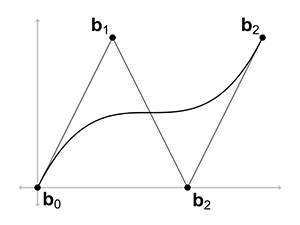
    image
    Ici les points de contrôle sont régulièrement espacés sur l’axe des xx , donc la courbe se déplace à vitesse horizontale constante. Les coordonnées yy sont distribuées selon la description de cet exercice, et comme vous pouvez le voir, la vitesse verticale initiale est grande, elle ralentit jusqu’à un minimum en t=1/2t = 1/2 , puis accélère jusqu’à une vitesse finale élevée. À en juger par le diagramme, la pente est horizontale au point milieu t=1/2t = 1/2 , ce qui signifie que la vitesse verticale est nulle.

  8. Nous pouvons résoudre ceci algébriquement. Tout d’abord, nous devons convertir notre réponse de l’Exercice 2 en une courbe sous forme monomiale avec un paramètre normalisé. Rappelons que la courbe est tracée lorsque tt varie de 0 à 2, mais toutes nos courbes ont utilisé un argument variant de 0 à 1. Nous poserons donc s=t/2s = t/2 et établirons une nouvelle courbe en termes de ss :

    𝐩(t)=[0h]t2+[d/22h]t,𝐩(s)=[0h](2s)2+[d/22h](2s),=[04h]s2+[d4h]s.\begin{matrix} {\mathbf{p}(t)} & {= \begin{bmatrix} 0 \\ {- h} \\ \end{bmatrix}t^{2} + \begin{bmatrix} {d/2} \\ {2h} \\ \end{bmatrix}t,} \\ {\mathbf{p}(s)} & {= \begin{bmatrix} 0 \\ {- h} \\ \end{bmatrix}(2s)^{2} + \begin{bmatrix} {d/2} \\ {2h} \\ \end{bmatrix}(2s),} \\ & {= \begin{bmatrix} 0 \\ {- 4h} \\ \end{bmatrix}s^{2} + \begin{bmatrix} d \\ {4h} \\ \end{bmatrix}s.} \\ \end{matrix}

    En écrivant les coefficients monomiaux, nous obtenons

    𝐜0=0,𝐜1=[d4h],𝐜2=[04h],𝐜3=0.\begin{matrix} \mathbf{c}_{0} & {= 0,} & \mathbf{c}_{1} & {= \begin{bmatrix} d \\ {4h} \\ \end{bmatrix},} & \mathbf{c}_{2} & {= \begin{bmatrix} 0 \\ {- 4h} \\ \end{bmatrix},} & \mathbf{c}_{3} & {= 0.} \\ \end{matrix}

    Nous pouvons maintenant convertir en forme de Bézier en utilisant les Équations (13.20)(13.23) :

    𝐛0=𝐜0=0,𝐛1=𝐜0+(1/3)𝐜1=(1/3)[d4h]=[d/34h/3],𝐛2=𝐜0+(2/3)𝐜1+(1/3)𝐜2=(2/3)[d4h]+(1/3)[04h]=[2d/38h/3]+[04h/3]=[2d/34h/3],𝐛3=𝐜0+𝐜1+𝐜2+𝐜3=[d4h]+[04h]=[d0].\begin{matrix} \mathbf{b}_{0} & {= \mathbf{c}_{0}} & & {= 0,} \\ \mathbf{b}_{1} & {= \mathbf{c}_{0} + (1/3)\mathbf{c}_{1} = (1/3)\begin{bmatrix} d \\ {4h} \\ \end{bmatrix}} & & {= \begin{bmatrix} {d/3} \\ {4h/3} \\ \end{bmatrix},} \\ \mathbf{b}_{2} & {= \mathbf{c}_{0} + (2/3)\mathbf{c}_{1} + (1/3)\mathbf{c}_{2}} & & \\ & {= (2/3)\begin{bmatrix} d \\ {4h} \\ \end{bmatrix} + (1/3)\begin{bmatrix} 0 \\ {- 4h} \\ \end{bmatrix} = \begin{bmatrix} {2d/3} \\ {8h/3} \\ \end{bmatrix} + \begin{bmatrix} 0 \\ {- 4h/3} \\ \end{bmatrix}} & & {= \begin{bmatrix} {2d/3} \\ {4h/3} \\ \end{bmatrix},} \\ \mathbf{b}_{3} & {= \mathbf{c}_{0} + \mathbf{c}_{1} + \mathbf{c}_{2} + \mathbf{c}_{3} = \begin{bmatrix} d \\ {4h} \\ \end{bmatrix} + \begin{bmatrix} 0 \\ {- 4h} \\ \end{bmatrix}} & & {= \begin{bmatrix} d \\ 0 \\ \end{bmatrix}.} \\ \end{matrix}

  9. Notre première tâche consiste à convertir la courbe de la forme fonctionnelle y=f(x)y = f(x) en forme paramétrique (x(t),y(t))(x(t),y(t)) . Nous supposerons que xx est une fonction linéaire de tt , donc nous résolvons x(t)=mt+bx(t) = mt + b avec x(0)=0,9683x(0) = - 0{,}9683 et x(1)=4,2253x(1) = 4{,}2253 . Cela nous donne x(t)=5,1936t0,9683x(t) = 5{,}1936t - 0{,}9683 . Les coordonnées xx des points de contrôle de Bézier sont facilement déterminées en utilisant les résultats de l’Exercice 6. Nous avons choisi xx comme fonction linéaire de tt car nous supposons qu’il a une vitesse horizontale constante, donc les coordonnées xx des points de contrôle sont régulièrement espacées en t=1/3t = 1/3 et t=2/3t = 2/3 . En récapitulant les quatre points de contrôle, nous avons

    x0=x(0)=0,968,x1=x(1/3)=5,1936(1/3)0,9683=0,763,x2=x(2/3)=5,1936(2/3)0,9683=2,494,x3=x(1)=4,225.\begin{matrix} x_{0} & {= x(0) = - 0{,}968,} \\ x_{1} & {= x(1/3) = 5{,}1936(1/3) - 0{,}9683 = 0{,}763,} \\ x_{2} & {= x(2/3) = 5{,}1936(2/3) - 0{,}9683 = 2{,}494,} \\ x_{3} & {= x(1) = 4{,}225.} \\ \end{matrix}

    Les coordonnées xx étaient triviales dans ce problème ; tout le vrai travail se trouvait dans les coordonnées yy . En substituant x(t)x(t) dans notre forme fonctionnelle, nous obtenons

    y=0,364x2+1,145x+2,110=0,364(5,1936t0,9683)2+1,145(5,1936t0,9683)+2,110=9,818t2+9,608t+0,660,\begin{matrix} y & {= - 0{,}364x^{2} + 1{,}145x + 2{,}110} \\ & {= - 0{,}364(5{,}1936t - 0{,}9683)^{2} + 1{,}145(5{,}1936t - 0{,}9683) + 2{,}110} \\ & {= - 9{,}818t^{2} + 9{,}608t + 0{,}660,} \\ \end{matrix}

    ce qui est une courbe cubique 1D parfaitement valide sous forme monomiale. Nous la convertissons en forme de Bézier en utilisant les Équations (13.20)(13.23) :

    y0=c0=0,660,y1=c0+(1/3)c1=0,660+(1/3)(9,608)=3,863,y2=c0+(2/3)c1+(1/3)c2=0,660+(2/3)(9,608)+(1/3)(9,818)=3,793,y3=c0+c1+c2+c3=0,660+9,608+(9,818)+0=0,450.\begin{matrix} y_{0} & {= c_{0} = 0{,}660,} \\ y_{1} & {= c_{0} + (1/3)c_{1} = 0{,}660 + (1/3)(9{,}608) = 3{,}863,} \\ y_{2} & {= c_{0} + (2/3)c_{1} + (1/3)c_{2} = 0{,}660 + (2/3)(9{,}608) + (1/3)( - 9{,}818) = 3{,}793,} \\ y_{3} & {= c_{0} + c_{1} + c_{2} + c_{3} = 0{,}660 + 9{,}608 + ( - 9{,}818) + 0 = 0{,}450.} \\ \end{matrix}

    Remarquez que les deux coordonnées yy médianes sont presque égales, car les points de départ et d’arrivée que nous avons choisis rendent notre parabole légèrement asymétrique.
    En rassemblant tout cela, nos quatre points de contrôle de Bézier sont

    𝐛0=(0,968,0,660),𝐛1=(0,763,3,863),𝐛2=(2,494,3,793),𝐛3=(4,225,0,450).\begin{matrix} \mathbf{b}_{0} & {= ( - 0{,}968,0{,}660),} & \mathbf{b}_{1} & {= (0{,}763,3{,}863),} & \mathbf{b}_{2} & {= (2{,}494,3{,}793),} & \mathbf{b}_{3} & {= (4{,}225,0{,}450).} \\ \end{matrix}

    1. (a)Pour le premier point de contrôle, nous effectuons l’algorithme de de Casteljau ordinaire en utilisant 0,2 à chaque tour.

      𝐛01=0,80𝐛00+0,20𝐛10=0,80(3,5)+0,20(6,1)=(3,60,4,20)𝐛11=0,80𝐛10+0,20𝐛20=0,80(6,1)+0,20(0,3)=(4,80,1,40)𝐛21=0,80𝐛20+0,20𝐛30=0,80(0,3)+0,20(5,5)=(1,00,3,40)𝐛02=0,80𝐛01+0,20𝐛11=0,80(3,60,4,20)+0,20(4,80,1,40)=(3,84,3,64)𝐛12=0,80𝐛11+0,20𝐛21=0,80(4,80,1,40)+0,20(1,00,3,40)=(4,04,1,80)𝐛0=0,80𝐛02+0,20𝐛12=0,80(3,84,3,64)+0,20(4,04,1,80)=(3,88,3,27)\begin{matrix} \mathbf{b}_{0}^{1} & {= 0{,}80\,\mathbf{b}_{0}^{0} + 0{,}20\,\mathbf{b}_{1}^{0} = 0{,}80 \cdot (3,5) + 0{,}20 \cdot (6,1) = (3{,}60,4{,}20)} \\ \mathbf{b}_{1}^{1} & {= 0{,}80\,\mathbf{b}_{1}^{0} + 0{,}20\,\mathbf{b}_{2}^{0} = 0{,}80 \cdot (6,1) + 0{,}20 \cdot (0,3) = (4{,}80,1{,}40)} \\ \mathbf{b}_{2}^{1} & {= 0{,}80\,\mathbf{b}_{2}^{0} + 0{,}20\,\mathbf{b}_{3}^{0} = 0{,}80 \cdot (0,3) + 0{,}20 \cdot (5,5) = (1{,}00,3{,}40)} \\ \mathbf{b}_{0}^{2} & {= 0{,}80\,\mathbf{b}_{0}^{1} + 0{,}20\,\mathbf{b}_{1}^{1} = 0{,}80 \cdot (3{,}60,4{,}20) + 0{,}20 \cdot (4{,}80,1{,}40) = (3{,}84,3{,}64)} \\ \mathbf{b}_{1}^{2} & {= 0{,}80\,\mathbf{b}_{1}^{1} + 0{,}20\,\mathbf{b}_{2}^{1} = 0{,}80 \cdot (4{,}80,1{,}40) + 0{,}20 \cdot (1{,}00,3{,}40) = (4{,}04,1{,}80)} \\ \mathbf{b}_{0}^{\prime} & {= 0{,}80\,\mathbf{b}_{0}^{2} + 0{,}20\,\mathbf{b}_{1}^{2} = 0{,}80 \cdot (3{,}84,3{,}64) + 0{,}20 \cdot (4{,}04,1{,}80) = (3{,}88,3{,}27)} \\ \end{matrix}

      Pour le deuxième point de contrôle, nous effectuons le dernier tour avec la fraction 0,5.

      𝐛02=(3,84,3,64)𝐛12=(4,04,1,80)𝐛1=0,50𝐛02+0,50𝐛12=0,50(3,84,3,64)+0,50(4,04,1,80)=(3,94,2,72)\begin{matrix} \mathbf{b}_{0}^{2} & {= (3{,}84,3{,}64)} \\ \mathbf{b}_{1}^{2} & {= (4{,}04,1{,}80)} \\ \mathbf{b}_{1}^{\prime} & {= 0{,}50\,\mathbf{b}_{0}^{2} + 0{,}50\,\mathbf{b}_{1}^{2} = 0{,}50 \cdot (3{,}84,3{,}64) + 0{,}50 \cdot (4{,}04,1{,}80) = (3{,}94,2{,}72)} \\ \end{matrix}

      Pour le troisième point de contrôle, nous effectuons les deux derniers tours avec la fraction 0,5.

      𝐛01=(3,60,4,20)𝐛11=(4,80,1,40)𝐛21=(1,00,3,40)𝐛02=0,50𝐛01+0,50𝐛11=0,50(3,60,4,20)+0,50(4,80,1,40)=(4,20,2,80)𝐛12=0,50𝐛11+0,50𝐛21=0,50(4,80,1,40)+0,50(1,00,3,40)=(2,90,2,40)𝐛2=0,50𝐛02+0,50𝐛12=0,50(4,20,2,80)+0,50(2,90,2,40)=(3,55,2,60)\begin{matrix} \mathbf{b}_{0}^{1} & {= (3{,}60,4{,}20)} \\ \mathbf{b}_{1}^{1} & {= (4{,}80,1{,}40)} \\ \mathbf{b}_{2}^{1} & {= (1{,}00,3{,}40)} \\ \mathbf{b}_{0}^{2} & {= 0{,}50\,\mathbf{b}_{0}^{1} + 0{,}50\,\mathbf{b}_{1}^{1} = 0{,}50 \cdot (3{,}60,4{,}20) + 0{,}50 \cdot (4{,}80,1{,}40) = (4{,}20,2{,}80)} \\ \mathbf{b}_{1}^{2} & {= 0{,}50\,\mathbf{b}_{1}^{1} + 0{,}50\,\mathbf{b}_{2}^{1} = 0{,}50 \cdot (4{,}80,1{,}40) + 0{,}50 \cdot (1{,}00,3{,}40) = (2{,}90,2{,}40)} \\ \mathbf{b}_{2}^{\prime} & {= 0{,}50\,\mathbf{b}_{0}^{2} + 0{,}50\,\mathbf{b}_{1}^{2} = 0{,}50 \cdot (4{,}20,2{,}80) + 0{,}50 \cdot (2{,}90,2{,}40) = (3{,}55,2{,}60)} \\ \end{matrix}

      Pour le dernier point de contrôle, nous effectuons tous les tours avec 0,5 comme fraction.

      𝐛01=0,50𝐛00+0,50𝐛10=0,50(3,5)+0,50(6,1)=(4,50,3,00)𝐛11=0,50𝐛10+0,50𝐛20=0,50(6,1)+0,50(0,3)=(3,00,2,00)𝐛21=0,50𝐛20+0,50𝐛30=0,50(0,3)+0,50(5,5)=(2,50,4,00)𝐛02=0,50𝐛01+0,50𝐛11=0,50(4,50,3,00)+0,50(3,00,2,00)=(3,75,2,50)𝐛12=0,50𝐛11+0,50𝐛21=0,50(3,00,2,00)+0,50(2,50,4,00)=(2,75,3,00)𝐛3=0,50𝐛02+0,50𝐛12=0,50(3,75,2,50)+0,50(2,75,3,00)=(3,25,2,75)\begin{matrix} \mathbf{b}_{0}^{1} & {= 0{,}50\,\mathbf{b}_{0}^{0} + 0{,}50\,\mathbf{b}_{1}^{0} = 0{,}50 \cdot (3,5) + 0{,}50 \cdot (6,1) = (4{,}50,3{,}00)} \\ \mathbf{b}_{1}^{1} & {= 0{,}50\,\mathbf{b}_{1}^{0} + 0{,}50\,\mathbf{b}_{2}^{0} = 0{,}50 \cdot (6,1) + 0{,}50 \cdot (0,3) = (3{,}00,2{,}00)} \\ \mathbf{b}_{2}^{1} & {= 0{,}50\,\mathbf{b}_{2}^{0} + 0{,}50\,\mathbf{b}_{3}^{0} = 0{,}50 \cdot (0,3) + 0{,}50 \cdot (5,5) = (2{,}50,4{,}00)} \\ \mathbf{b}_{0}^{2} & {= 0{,}50\,\mathbf{b}_{0}^{1} + 0{,}50\,\mathbf{b}_{1}^{1} = 0{,}50 \cdot (4{,}50,3{,}00) + 0{,}50 \cdot (3{,}00,2{,}00) = (3{,}75,2{,}50)} \\ \mathbf{b}_{1}^{2} & {= 0{,}50\,\mathbf{b}_{1}^{1} + 0{,}50\,\mathbf{b}_{2}^{1} = 0{,}50 \cdot (3{,}00,2{,}00) + 0{,}50 \cdot (2{,}50,4{,}00) = (2{,}75,3{,}00)} \\ \mathbf{b}_{3}^{\prime} & {= 0{,}50\,\mathbf{b}_{0}^{2} + 0{,}50\,\mathbf{b}_{1}^{2} = 0{,}50 \cdot (3{,}75,2{,}50) + 0{,}50 \cdot (2{,}75,3{,}00) = (3{,}25,2{,}75)} \\ \end{matrix}

    2. (b) 𝐪0=𝐛0=(3,0,5,0)𝐪1=𝐛0/2+𝐛1/2=(3,5)/2+(6,1)/2=(4,5,3,0)𝐪2=𝐛0/4+𝐛1/2+𝐛2/4=(3,5)/4+(6,1)/2+(0,3)/4=(3,75,2,5)𝐪3=𝐫0=𝐛0/8+3𝐛1/8+3𝐛2/8+𝐛3/8=(3,5)/8+3(6,1)/8+3(0,3)/8+(5,5)/8=(3,25,2,75)𝐫1=𝐛1/4+𝐛2/2+𝐛3/4=(6,1)/4+(0,3)/2+(5,5)/4=(2,75,3,0)𝐫2=𝐛2/2+𝐛3/2=(0,3)/2+(5,5)/2=(2,5,4,0)𝐫3=𝐛3=(5,0,5,0){\mathbf{q}_{0} = \mathbf{b}_{0} = (3{,}0,5{,}0)}\mathbf{q}_{1} = \mathbf{b}_{0}/2 + \mathbf{b}_{1}/2 = (3,5)/2 + (6,1)/2 = (4{,}5,3{,}0)\mathbf{q}_{2} = \mathbf{b}_{0}/4 + \mathbf{b}_{1}/2 + \mathbf{b}_{2}/4 = (3,5)/4 + (6,1)/2 + (0,3)/4 = (3{,}75,2{,}5)\mathbf{q}_{3} = \mathbf{r}_{0} = \mathbf{b}_{0}/8 + 3\mathbf{b}_{1}/8 + 3\mathbf{b}_{2}/8 + \mathbf{b}_{3}/8 = (3,5)/8 + 3 \cdot (6,1)/8 + 3 \cdot (0,3)/8 + (5,5)/8 = (3{,}25,2{,}75)\mathbf{r}_{1} = \mathbf{b}_{1}/4 + \mathbf{b}_{2}/2 + \mathbf{b}_{3}/4 = (6,1)/4 + (0,3)/2 + (5,5)/4 = (2{,}75,3{,}0)\mathbf{r}_{2} = \mathbf{b}_{2}/2 + \mathbf{b}_{3}/2 = (0,3)/2 + (5,5)/2 = (2{,}5,4{,}0)\mathbf{r}_{3} = \mathbf{b}_{3} = (5{,}0,5{,}0)

    3. (c)En utilisant l’Équation (13.38) avec n=3n = 3 :

      𝐛0=04𝐛1+(104)𝐛0=0[??]+1[35]=[3,005,00]𝐛1=14𝐛0+(114)𝐛1=14[35]+34[61]=[5,252,00]\begin{matrix} \mathbf{b}_{0}^{\prime} & {= \frac{0}{4}\,\mathbf{b}_{- 1} + \left( 1 - \frac{0}{4} \right)\mathbf{b}_{0} = 0\begin{bmatrix} ? \\ ? \\ \end{bmatrix} + 1\begin{bmatrix} 3 \\ 5 \\ \end{bmatrix} = \begin{bmatrix} 3{,}00 \\ 5{,}00 \\ \end{bmatrix}} \\ \mathbf{b}_{1}^{\prime} & {= \frac{1}{4}\,\mathbf{b}_{0} + \left( 1 - \frac{1}{4} \right)\mathbf{b}_{1} = \frac{1}{4}\begin{bmatrix} 3 \\ 5 \\ \end{bmatrix} + \frac{3}{4}\begin{bmatrix} 6 \\ 1 \\ \end{bmatrix} = \begin{bmatrix} 5{,}25 \\ 2{,}00 \\ \end{bmatrix}} \\ \end{matrix}

      𝐛2=24𝐛1+(124)𝐛2=12[61]+12[03]=[3,002,00]𝐛3=34𝐛2+(134)𝐛3=34[03]+14[55]=[1,253,50]𝐛4=44𝐛3+(144)𝐛4=1[55]+0[??]=[5,005,00]\begin{matrix} \mathbf{b}_{2}^{\prime} & {= \frac{2}{4}\,\mathbf{b}_{1} + \left( 1 - \frac{2}{4} \right)\mathbf{b}_{2} = \frac{1}{2}\begin{bmatrix} 6 \\ 1 \\ \end{bmatrix} + \frac{1}{2}\begin{bmatrix} 0 \\ 3 \\ \end{bmatrix} = \begin{bmatrix} 3{,}00 \\ 2{,}00 \\ \end{bmatrix}} \\ \mathbf{b}_{3}^{\prime} & {= \frac{3}{4}\,\mathbf{b}_{2} + \left( 1 - \frac{3}{4} \right)\mathbf{b}_{3} = \frac{3}{4}\begin{bmatrix} 0 \\ 3 \\ \end{bmatrix} + \frac{1}{4}\begin{bmatrix} 5 \\ 5 \\ \end{bmatrix} = \begin{bmatrix} 1{,}25 \\ 3{,}50 \\ \end{bmatrix}} \\ \mathbf{b}_{4}^{\prime} & {= \frac{4}{4}\,\mathbf{b}_{3} + \left( 1 - \frac{4}{4} \right)\mathbf{b}_{4} = 1\begin{bmatrix} 5 \\ 5 \\ \end{bmatrix} + 0\begin{bmatrix} ? \\ ? \\ \end{bmatrix} = \begin{bmatrix} 5{,}00 \\ 5{,}00 \\ \end{bmatrix}} \\ \end{matrix}

B.14Chapitre 14

Quarante-deux.

Pour tout problème complexe
il existe une réponse claire, simple, et
fausse.

— H. L. Mencken

  1. C’était un ours polaire. Vous saisissez ? Polaire !

  2. Aucun crédit n’est accordé pour avoir suggéré que « la physique a cessé de fonctionner ». En revanche, si vous avez répondu « nous sommes à l’intérieur d’un jeu vidéo », accordez-vous 20 points de crédit supplémentaires.

<< Tests Géométriques

Haut de page